

If you’re in a prime money market fund and you don’t know what happened today, you need to read up.
On Friday, new rules went into effect that will require prime funds to report a floating net asset value and would, in some cases, allow funds to gate investors.
For anyone who may be unaware, the difference between prime funds and government funds is that prime funds invest in CDs and commercial paper (short-term corporate debt), while government funds invest in, well, government securities.
Needless to say, investors can squeeze a bit more yield out of prime funds than government funds, but as we saw during the crisis, these funds have the potential to “break the buck,” so to speak. In other words, $1 isn’t worth $1.
As the rule change drew near, there was a veritable exodus from prime funds...
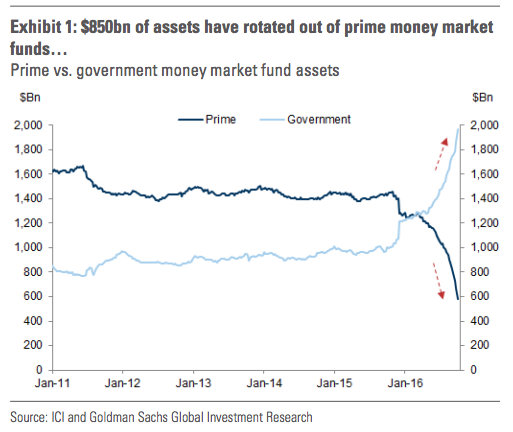
(Chart: Goldman)
… and a concurrent spike in LIBOR and CP rates…
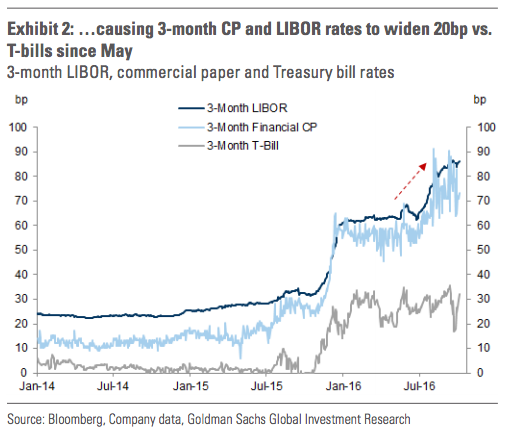
(Chart: Goldman)
Think, for a second, about what this means.
First of all, that’s nearly $1 trillion in unsecured funding that’s no longer available to purchase commercial paper. That’s a big deal. Here’s how we put it elsewhere over the summer:
“Money market reform sounds like the most painfully boring topic in all of finance, but as I've explained previously (see here for instance), it's extremely important. Prime money market funds invest in commercial paper. Commercial paper is a critical source of funding for corporate America. Bear in mind that $800 billion doesn't just move around with no consequences.”
“Remember, this is the market that panicked Treasury officials in Lehman's wake.”
If you’ve read “Too Big To Fail” (or seen the HBO adaptation), you’ll recall a moment when then-Treasury Secretary Hank Paulson gets a call from GE CEO Jeff Immelt who tells Paulson that GE is having trouble placing its commercial paper. That may well have been the moment when the severity of the situation truly became apparent to the government. This was General Electric saying it was having trouble obtaining short-term, unsecured funds or, more simply, it wouldn’t be long before companies the size of GE would be forced to shut the doors.
Now clearly that’s not what’s going on here BUT, you do need to understand the significance of what is truly a tectonic shift. Seekers of unsecured, short-term funding will need to develop other sources and there’s some argument to be made that the rise in LIBOR we’ve seen and may continue to see is tantamount to a rate hike, which complicates the Fed’s calculus even further.
At the very least, you should have a look at your money market funds to determine if they are prime or government. If they are prime, you need to decide for yourself whether the few extra basis points of yield you pick up over government funds adequately compensates you for the risk of a floating NAV or worse, redemption gates.
For institutional clients, here’s where Goldman sees opportunity:
“...in most economic scenarios, AAA bonds will receive 100% principal returned regardless of the amount of excess spread available to absorb losses. As a result, increases in short-term LIBOR should flow through one-for-one to the senior AAA CLO tranches. In the current low yield environment, and given our expectation for rising rates, we take a relatively constructive view on senior CLO floating rate assets.”
Take that for what it’s worth and have a good weekend.