


When is a chart pattern NOT a chart pattern?
When it hasn’t been CONFIRMED!
Far too many of us jump the gun, letting FOMO drive our decisions.
The scary part is you probably do this without realizing it.
That’s what I am to correct today.
I want you to trade signals, not possibilities.
During today’s 10% Club session, this principle played out across the euro, gold, and the S&P 500.
Every trade that worked followed the same rule.
The pattern had to break before the trade was live.
What Does "Confirmed" Actually Mean?
You see a channel forming…or a head and shoulders…or a wedge tightening up.
Your brain says, "I know what's coming next."
Except you don't. Not yet.
A pattern is NOT confirmed until price closes beyond its boundary.
A channel needs a breakout above or below its trendline.
A head and shoulders needs a close below the neckline.
Until that close happens, the formation is just a shape on your screen. It could resolve in ANY direction.
Martin Pring and John Murphy, two of the most respected names in technical analysis, are crystal clear on this. A developing pattern is not a tradable pattern.
It's a sketch. Not a signal.
Here's Where It Gets Expensive
Price patterns are like Schrodinger's cat. They’re both true UNTIL you know.
Let me give you an example.
You spot a formation that looks like a head and shoulders. Price makes the left shoulder. Then the head. Then what looks like the right shoulder.
You start shorting.
However, that same price action could also be a channel. Or a consolidation range. Or a dozen other formations that resolve completely differently.
I see this constantly. Someone spots a bearish channel and assumes bearish continuation.
That assumption is dead wrong.
Pring and Murphy both identify downward-sloping channels as BULLISH price patterns. The breakout to the upside statistically produces stronger moves than an upward-sloping channel.
Read that again if you need to.
Every early entry is a bet on a pattern that does not yet exist. You are trading what you THINK the chart will do rather than what it HAS done.
That gap between "think" and "has" is where money disappears.
How This Played Out on the Euro Today
The euro opened inside a downward-sloping channel on the five-minute chart. A textbook setup for what I just described.
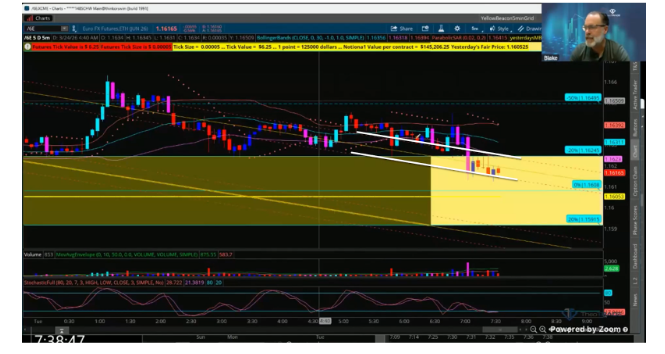
I had a buy stop limit waiting above the channel boundary. The order sat there for 20 minutes doing absolutely nothing while the channel made lower lows.
I didn't flinch.
I adjusted the entry down three times, tracking the descending channel. The order would NOT fill unless price broke through the upper boundary.
When price finally broke through and the order filled at 1.6235, the pattern was confirmed. NOW we had a trade.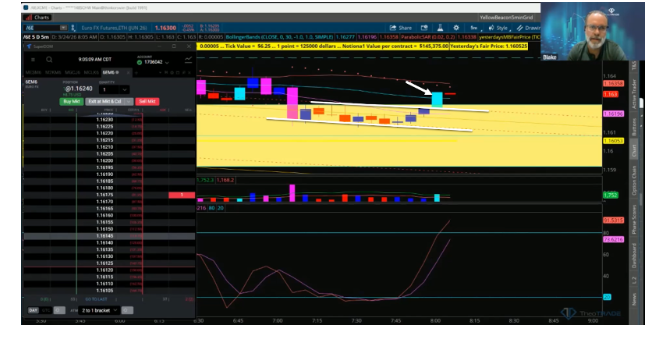
From there, stop management was purely mechanical:
- After the first one-candle reversal with higher highs and higher lows, the stop moved to 1.6175
- When price traded through half the channel height above the breakout, the stop moved to 1.6210
- Three consecutive candles of higher highs and higher lows pushed the stop to 1.6240, then 1.6250
- By mid-session, the stop sat at 1.6310, locking in $87.50 of profit with a target of 1.6500 for a potential $325 gain
Every stop followed the same rule. The low of the confirming candle minus one pip became the new stop.
No interpretation. No gut feelings. Just price.
The Same Rule Kept Us Out of Bad Trades
Confirmation doesn't just tell you when to get IN. It tells you when to stay OUT.
Gold fired a beacon buy signal near $4,359. One candle moved 18 points, worth $185 on a single micro.
Sounds great, right?
The problem was the stop. There was no structural justification for a tight stop at that level. The risk was too wide for our account parameters.
I told the room to let it reset. We needed a confirmed structure for stop placement before the trade made sense.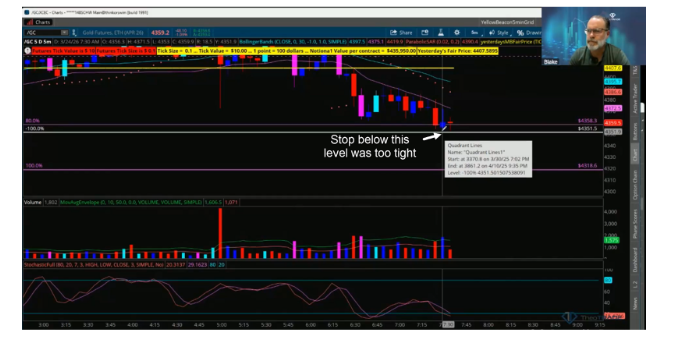
The S&P 500 told a similar story. A potential beacon short near 5,695 needed price to close below 5,695.25 on the five-minute chart.
That close never came.
No confirmation meant no trade. Period.
What You Can Do Right Now
Write this where you can see it during your next session: a pattern is not a pattern until it breaks.
When you see a formation developing, define the breakout level. Place a conditional order at that level. Do NOT enter before it triggers.
If you are watching a bearish channel, remember that the breakout to the upside carries higher probability. Wait for the break, then trade the confirmed direction.
Today's euro trade sat as a pending order for 20 minutes before it triggered. That patience turned a possibility into a $325 opportunity with locked-in profit along the way.
The next time you feel the urge to jump in early, ask yourself one question.
Has the pattern actually confirmed?
If the answer is no, your only job is to wait.
Every entry, every stop adjustment, and every target is called in real time.
Plus, you get tomorrow’s major market trading levels TODAY.
Sounds crazy?
Click Here to learn more about Dark Wires and my proprietary methodology.
Blake Young
Senior Market Strategist, TheoTRADE