

We weren’t going to write about oil again today but while perusing analyst commentary it occurred to us once again that no one has any clue whatsoever where prices are going. It’s turned into something akin to astrology at this point and it kind of goes back to something else Bloomberg’s Richard Breslow said today: “They aren’t really equipped to predict international events in a fully globalized world.”
Now by “they,” he meant the Fed, but the same thing goes for anyone trying to predict where oil is headed. There are just too many variables, many of which have far more to do with politics (Iran, Saudi Arabia, Russia) and terror-related outages (the PKK on the Ceyhan pipeline, the Niger Delta Avengers, etc.) than they do with anything else, which makes forecasting a job for political scientists, not analysts. Here’s an updated outage tracker from Goldman:
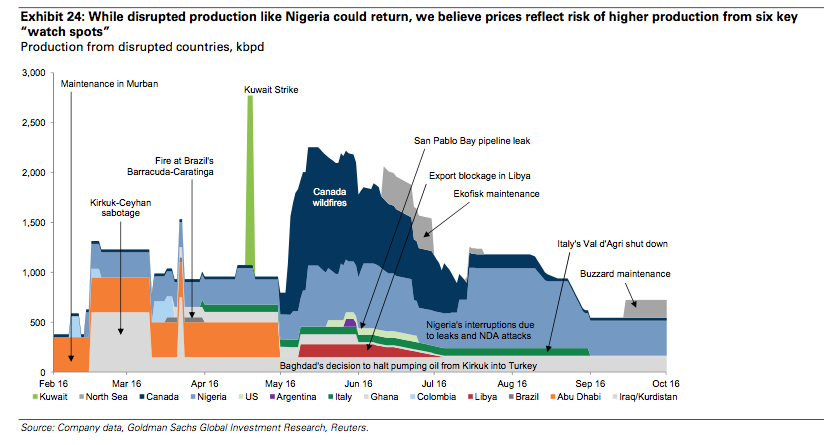
(Chart: Goldman)
However you want to slice it, crude has had a great run this month:
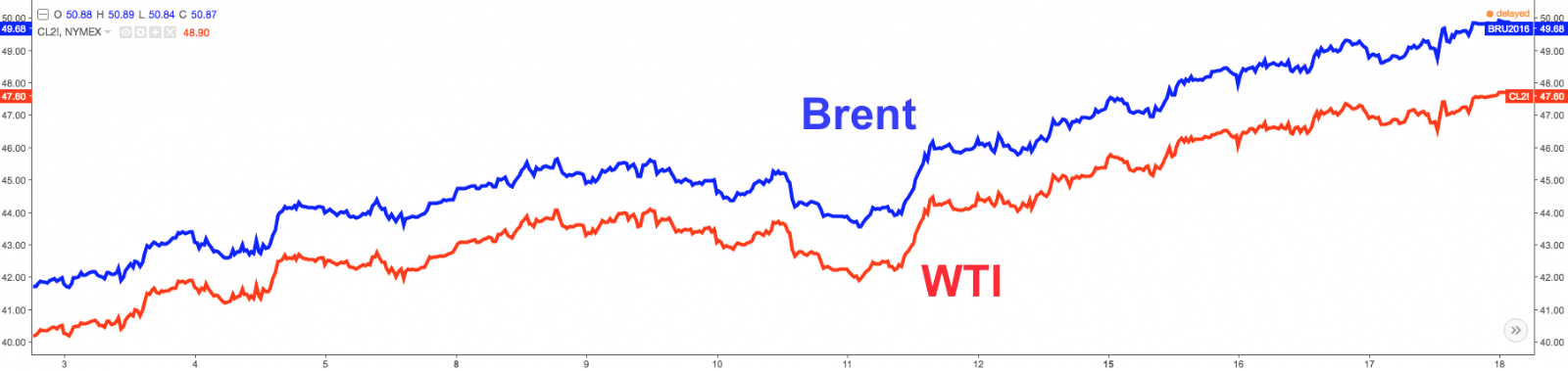
But it’s all predicated on this idea of an OPEC supply freeze which first of all isn’t likely and even if it were, it wouldn’t matter because everyone’s already producing close to capacity. Here’s how we put it on Monday:
“So even if producers were to agree, they’re not really actively ‘freezing’ production. Production is freezing itself because no one can physically pump any more than they’re already pumping.”
As SocGen’s Michael Wittner put it earlier this week, “similar to April, a freeze would only be a boost to market sentiment. Russia, Iraq, and Iran are maxed out or close to it, and Saudi output will go down anyway after the summer peak. So a freeze would not have any impact on actual crude supply.”
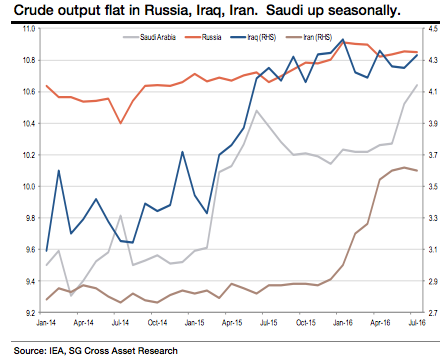
(Chart: SocGen)
Here’s some good commentary out of Citi that underscores the above:
“For now, Citi believes that talks of an accord are hyperbolic, especially with most of the Kingdom’s ministers outside of Riyadh during the holiday season. The Saudis are fully committed to implementing their Vision 2030 and National Transformation Program 2020 plans, both of which point to the need to maximize sales and to boost the notion that Saudi Aramco is an independent oil company operating free of foreign policy restrictions. That would make it very odd to succumb to the old geopolitics now, when markets are firming by the Saudi’s own statements.”
“The recurring theme of OPEC supply disruptions returned last week - Force majeure was declared on Nigeria’s 200-k b/d Bonny Light crude stream; Northern Iraqi crude exports are dropping in August following attacks on the 80-k b/d Bai Hassan pumping plant and tracked Venezuelan crude exports in August are showing a sharp drop-off month to date. Supply disruptions are unpredictable, and shouldn’t be a sole reason for being optimistic crude prices, but in a balanced oil market with the current level of geopolitical risk, Citi believes that the risk remains skewed to the upside in terms of disrupted oil supplies, which totaled ~3.2-m b/d in July.”
See? Frankly this is just a crapshoot. At a certain point the number of variables involved increases to a point where “analysis” is no longer possible. It’s the same reason why economists and weathermen are wrong more than they’re right. “The best one can expect from Russia, Saudi Arabia, Iran, Iraq is possibly agree not to have market-share war,” Credit Suisse’s Jan Stuart said today.
Ummm, Jan? We’re not sure if you’ve noticed or not, but that ship sailed a long, long time ago. The horse has left the barn. [Fill in any other applicable metaphor].
As for US E&Ps, it’s like watching someone on life support and just wondering when it’s time to pull the plug. Here’s Goldman:
“We hear significant commentary from E&P management teams about cost reduction efforts and how certain portfolios are now economic in a $50 oil environment. While this may be true in certain cases, on average HY E&Ps still need much higher oil prices to replace reserves at breakeven return levels. In this report, we look at cost structures for 8 HY E&Ps in our coverage representing about 7% of US oil production (596k b/d) and conclude that the HY rated segment industry still needs about $63/bbl to both replace reserves and breakeven from a cash perspective vs. about $73/bbl in 2014.”
It’s hopeless. The market can’t sustain a price above $63/bbl given the supply glut. That’s absurd on its face. We can debate whether or not this API report or that DOE report is incrementally bullish, but at the end of the day, the big picture for the US is this:
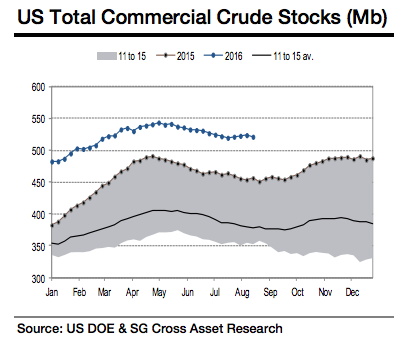
(Chart: SocGen)
In the end, you’re probably better off just asking a fortune teller in Manhattan after a night of drinking to tell you where crude is headed. Or, alternatively, pin a chart on the wall, find a Chimpanzee, and give it some darts. Just make sure to maintain a safe distance.