Investors Love High Unemployment
When the economy is doing well and the unemployment rate is high, it’s bad for stock returns. It is like an hour glass that’s running out of sand. You can debate whether that analogy holds true for this cycle because low unemployment didn’t create inflation and cause the Fed to hike rates excessively. The economy was about to avoid a recession as the slowdown was ending. Unfortunately, COVID-19 caused a recession which proved the rule that investing when the unemployment rate is low isn’t a great idea.
Generally, there aren’t recessions after the unemployment rate spikes as that’s when the Fed eases monetary policy. Since stocks do well in expansions and poorly in recessions because of the increase in uncertainty, even if there was a double dip recession, stocks would have less room to fall.
Conversely, when the unemployment rate is high, it’s a great time to own stocks. While it’s not always clear when expansions will end, recessions have a more clearly defined path. This current recession likely will be shorter than usual. Investing during recessions is all about defining the catalyst of the uncertainty and figuring out how the situation will be resolved. Once it became clear that the economic shutdowns were working to slow the growth of COVID-19, stocks began to rise.
Personally, I don’t see a new high until the economy is reopened, but definitely wouldn’t wait until the economic data starts to get better to buy stocks. You’re supposed to buy stocks when the data looks the worst and there is no light at the end of the tunnel. Recessions always end in a timely manner. A depression is unlikely forthcoming because that involves elongated weakness. Once the shutdowns end this spring/summer, the economy will begin to recover. Fiscal and monetary lifelines will also prevent a depression.
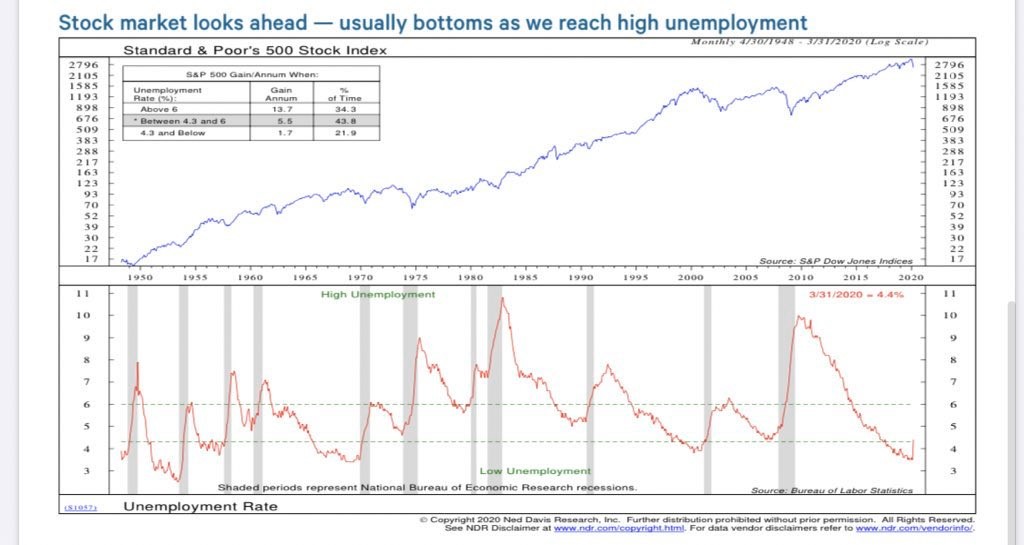
You can see in the chart above that stocks love high unemployment. This time, the market didn’t even wait until the unemployment rate officially was dreadful to buy stocks. We all know the unemployment rate will be in double digits in the April report. Investors front rate the great returns. When the unemployment rate is above 6%, gains per year are 13.7%.Skeptics say this time is different. If you believe this is a depression, you should be bearish. However, this time we have boosted unemployment insurance and loans to small businesses to prevent disaster.
When To Buy
Usually, stocks do well when the unemployment rate is high, but this time stocks front ran the report, so we need something more updated. That’s why we have jobless claims. They have been terrible for 3 weeks. There have already been more jobless claims in the past few weeks than all the job losses in the last recession. When they are high, stocks do well.
And when claims are above 415,000, the stock market rises 15.4% per year. When they are high and falling, stocks rise 17.6% per year. That’s what we are about to see, since initial claims have likely peaked.
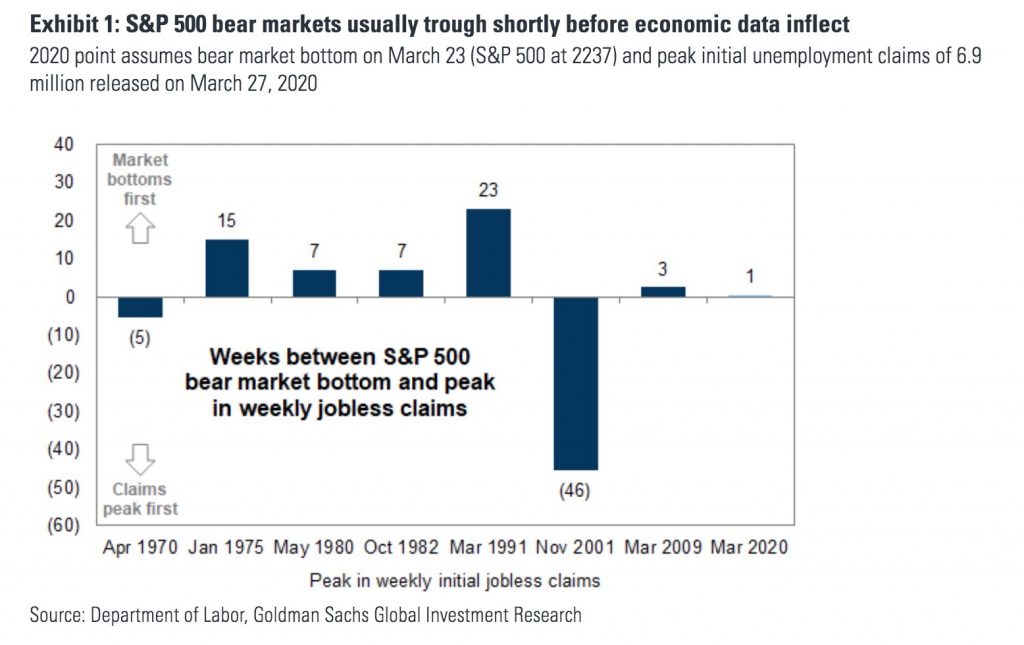
The chart below shows since 1970, the market has bottomed before claims have topped in 5 out of the past 7 recessions. The 2001 recession is unique because that decline was more caused by valuations than the weak economy. It was one of the worst bear markets in history, yet one of the mildest recessions. If March 23rd is the bottom and the recent claims report of 6.9 million in the week of March 27th was the top, the market was ahead of claims by just 1 week.
It makes sense the market wasn’t that far ahead of claims in this cycle because the spike only started in March. In the beginning of March, we didn’t know how bad COVID-19 would get; it was impossible for stocks to rally then. Now everything is under control and there are even talks of a vaccine being released this year.
Claims Have Peaked
After the latest jobless claims report was below the one in late March, we immediately thought claims peaked. That’s because it would only take 23.6 weeks for the entire labor market to be on unemployment insurance at the recent rate. The spike in claims was like a dam breaking.
After the initial break, there isn’t enough new water to keep up the pressure. There isn’t a new catalyst to keep claims that high. High school educated low payed workers lost their jobs, while college graduates didn’t. We’d need to see non-traditional people (college educated) lose their jobs en masse for claims to stay that high.
We now have facts to back up my assertion that claims have already peaked. As you can see from the chart below, the popularity of Google searches for the term “file for unemployment” has been falling in the past few days. This chart looks a lot like the one that showed hoarding at grocery stores. There was a rush of people looking up how to file for claims and buying groceries. That rush has slowed.
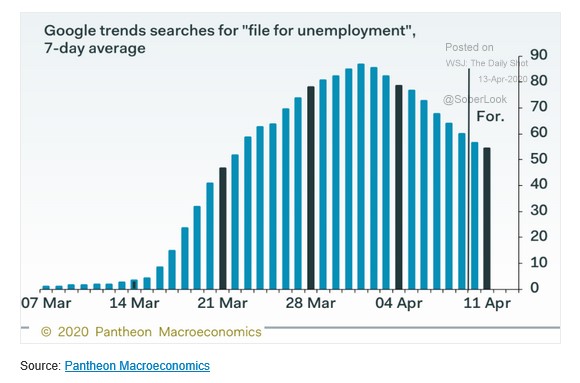
Don’t get me wrong, claims are still high. In this Thursday’s report, they will be higher than in any week other than the reports in this recession. However, the main point is they are falling. Declines from highs are very bullish. In support of this thesis, in Texas there were 313,832 claims filed in the week of April 4th. In the week of April 11th, there were 196,300 claims.
Remember, Texas was one of the later states to shut down its economy. Obviously, the collapse of the energy market plays a role for Texas. That started much earlier in the year. Energy doesn’t employ that many people, but it’s a bigger part of the Texas economy than it is of the national economy.
It's important to keep following continuing claims to see how long the people who lost their jobs because of this recession keep getting unemployment insurance.
2 Comments
Greg
April 14, 2020How come your report is so ROSY?
I thought this was The Dark Report?
Let me put some light out, with a question.
How long will the STOCK market recovery last when the ECONOMIC recovery fails to materialize...as reflected in CONTINUED jobless claims? I'm not asking about claims
for the next two weeks, but for claims (yes, declining) staying excessively HIGH for
the next 3 to 5 months.
This rosy picture of past stock market bottoms and weeks to recovery is not applicable.
If half of the current and soon-to-be unemployed are still not back to work after 23.5 weeks....what then? Think past the unemployment insurance deadline...the insurance ends.
Then what? Will Mr. Market still be rejoicing then?
Greg.
Kevin Morgan
April 15, 2020I believe a more careful look at your data indicates that the market likes the period following the PEAK in unemployment. That's the start of the bull periods on your chart. Has unemployment PEAKED in this recession? I doubt it. The unemployment offices are so overloaded we don't even know what the actual is, and then there the problem that for a major slice of the "new economy", the "gig workers", it's extremely hard to even get an unemployment claim accepted! Lastly, we come to the question of "what happens when the US gov't begins the process of allowing people back to work"? Is that an "instant on"? I don't think so. That's going to be a looooong, slow process, with a lot of risk of "resets". So I'm a bit dubious of the "this recession will be very short" and "economic #'s will bounce back quickly" view. I can quote you from February saying "the coronavirus threat is behind us" or something to that effect. No it wasn't, and doubtful this recession/depression (what's the definition of depression? Last I heard it was massive unemployment) is soon to be behind us either. Another item you might want to assess: is there a MASSIVE consolidation of US business "upward" that is and will go on here? That is, the small businesses are getting destroyed, and when that business activity comes back...won't it all go the surviving mega-corporations? Seems like we might be seeing the start of the biggest consolidation upward of business activity in US history. Something you might try to take a look at.