Bond Unusual Option Activity Report
Last week I posted on the burgeoning sell-off in U.S. Treasury bonds as option activity picked up in TBT. The selling in the Treasury bond market materialized today as 10-year yields approach 1.3%. That’s the highest year since just before the “Corona Crash” and may soon put pressure on equities and the Federal Reserve. Looking at the option activity today on iShares 20 Plus Year Treasury Bond ETF (NASDAQ: TLT) and iShares High Yield Corporate Bond ETF l(NYSEARCA: HYG) looks like the bearish pressure to continue.
Treasury Bonds and Stocks
You may be asking yourself, “what’s the big deal,” and say, “aren’t they just buying equities.” In a normal reflationary cycle, Treasury bond yields do rise along with equities. However, the potential growth in the economy and the risk on earnings with a rise in borrowing costs are considerable. This is because companies are sitting on an unprecedented amount of debt and a rise in the risk-free rate can change that picture quickly.
While debt is a concern, there is also another issue in terms of the multiple that companies can trade at. As the weighted average cost of capital (WACC) increases relative to the growth rate in cash flow, the present value of the asset diminishes. That means that it makes it harder for companies to maintain historically high valuations.
Bond Yields and the Federal Reserve
As deficit spending is exploding for the foreseeable future, a rise in the Federal government’s borrowing costs could be harrowing on our solvency. The Fed has engaged in unprecedented coordination with the Federal government and they will likely be placed in a position to take action if yield were to rise quickly. The potential for triggering yield curve control (YCC) policies may come to the fore. YCC is when the Fed buys an unlimited number of Treasuries in order to maintain a cap on bond yields.
Bond Technicals
Despite today’s sell-off in Treasury bonds, risk spreads didn’t really widen at all. The risk spread is the difference in yield between the risk-free rate, represented by U.S. Treasuries, and the yield on a similar maturity bond from another entity like corporate bonds.
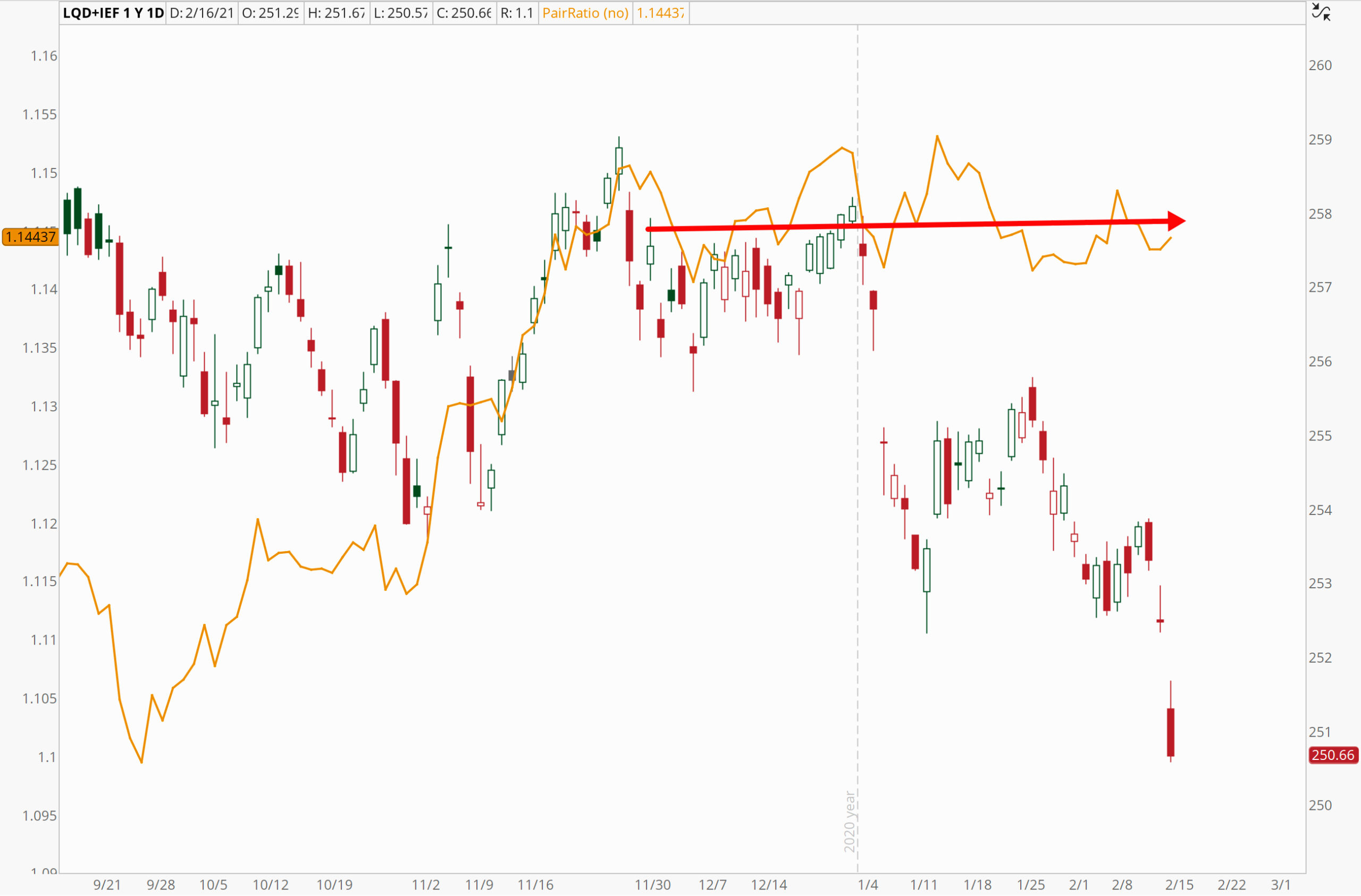
One way to reflect the risk spread is to plat the ratio of a corporate bond ETF and a Treasury ETF. For example, take the ratio of iShares Inv Grade Corporate Bond ETF (NYSEARCA: LQD) and the iShares 7-10 Year Treasury Bond ETF (NASDAQ: IEF) and it will give you an indication of the direction of the risk spread. LQD has a duration of 9.43 years and IEF has a duration of 7.78 years. The similarity in duration means that they will move similarly with a change in interest rates. As you can see, the ratio (yellow line) has changed little in recent months and actually rose today.
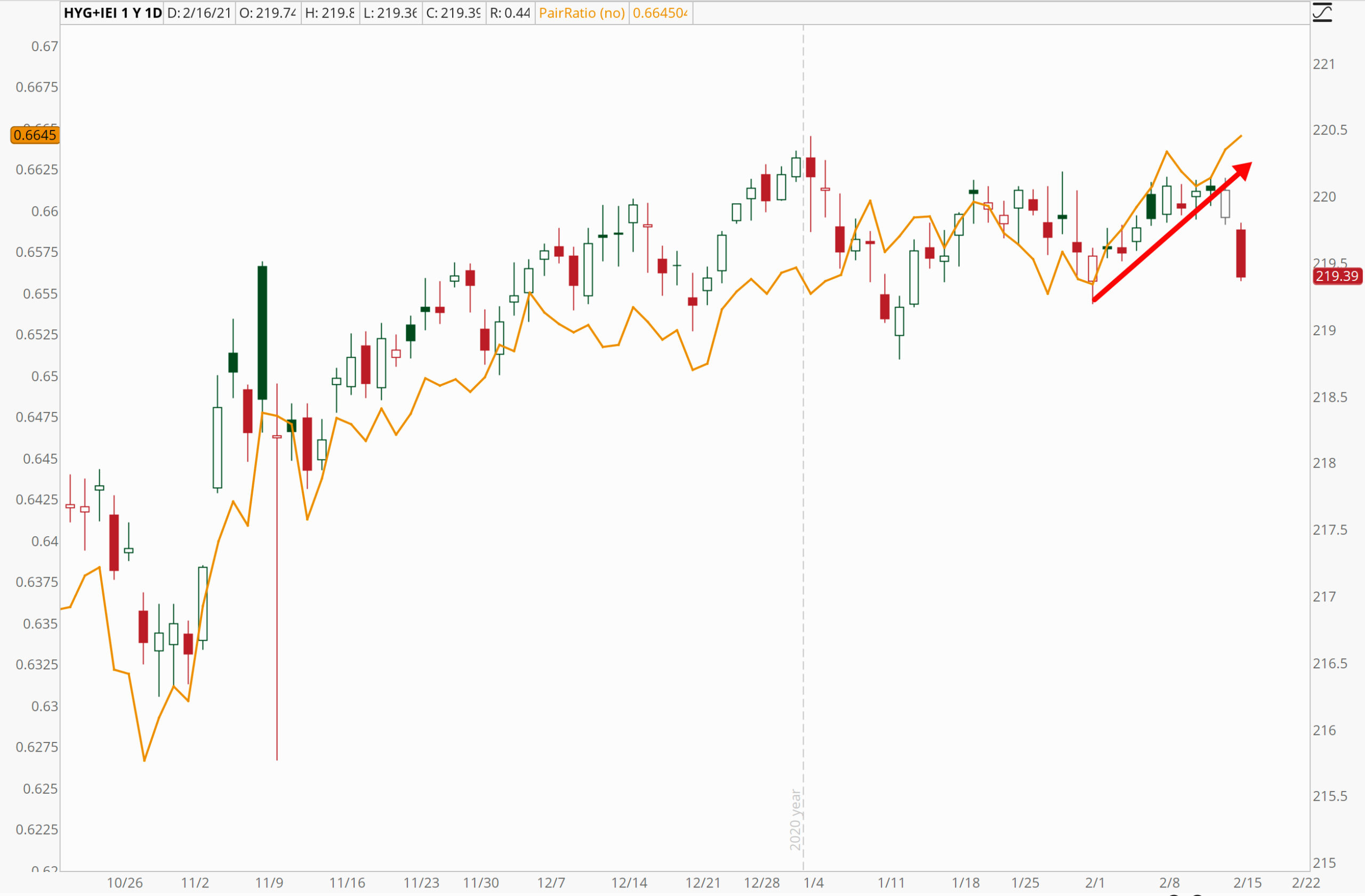
Another indicator to look at is taking a ratio of HYG to iShares 3-7 Year Treasury Bond ETF (NASDAQ: IEI). HYG has a duration of 3.25 years and IEI has a duration of 4.59 years. In this chart, the ratio (yellow line) is rising as the sell-off in Treasuries has not increased the risk spread of high yield credit.
Bond ETF Option Activity
While corporate bond ETFs have failed to price in the potential risks of rising Treasury yields, it appears option traders are beginning to do so. The put option volume was 1.43 times the average with over 270,000 contracts and a put-to-call ratio of 5.571. Nearly 30% of the volume filled at the ask and 54% between the market. That activity was skewed slightly more bearish but digging a little deeper the bearishness come out a little more. Here’s the details of the unusual bearish trading activity.
- 51,500 16 APR 21 $86 puts BOT in two prints of $0.67 to $0.73 against open interest of 31,670
- 51,500 16 APR 21 $83 puts sold in two prints of $0.28 to $0.37 against open interest of 13,789
This trade is a long put vertical that is looking for downside in HYG to its lows near that level in the fall. With a net debit of around $0.36, it gives significant potential upside for little risk.
Conclusion
The market finds itself in an interesting position near all-time highs and 10-year Treasury bond yields rising. The large amount of debt and the quickness with which yields are rising could create pressure on the equity markets and corporate bond markets. The unusual option trade on HYG certainly helps build that case.
Learn how to deal with uncertain markets by learning about the Vomma Zone. Not a subscriber? Become a TheoTrade member.