Do Economic Indicators Work?
Game theorists believe the moment an economic indicator becomes an indicator, it ceases to be valuable because it can be manipulated for profit or influence. It’s cynical to believe every single indicator is manipulated, but some manipulation occurs and only looking at the same stats everyone else looks at isn’t going to give you an edge. As I’ve discussed a few times, the percentage of firms beating their estimates has increased because management teams are trying to game the system by under promising and over delivering. This process may have worked in the past, but with most companies doing it, the jig is up. It’s best to look at future estimates because they reflect analysts’ sentiment before the firms under promise their results.
I don’t believe in conspiracies which explain why stats are wrong, but clearly there is political pressure for some stats like GDP and the unemployment rate to be altered to fit an agenda. It’s also clear that the Fed wants inflation to be calculated as low as possible since it looks at core PCE instead of core CPI. If it looked at core CPI, rates would be much higher. These hikes would have already inverted the yield curve. Finally, sometimes sentiment surveys lose relevance. For example, the ISM manufacturing report hasn’t been correlated with factory orders growth in the past few quarters.
Follow The Unfollowed Indicators
Mainstream indicators can be valuable and many times it’s correct to go along with the crowd. Just because everyone follows the monthly labor report doesn’t mean it doesn’t give investors important information on the economy. If the economy is falling into a recession, it doesn’t make sense to buy stocks just to be a contrarian. Being a contrarian is all about picking your spots. It only makes sense to disagree with the crowd when you have a great thesis. The point I am making in this section is if you only follow mainstream indicators, you won’t be able to have a contrarian opinion which can help you be wildly profitable. If you follow everything the crowd looks at and then go against the crowd, you will lose your money because your argument will have no merit.
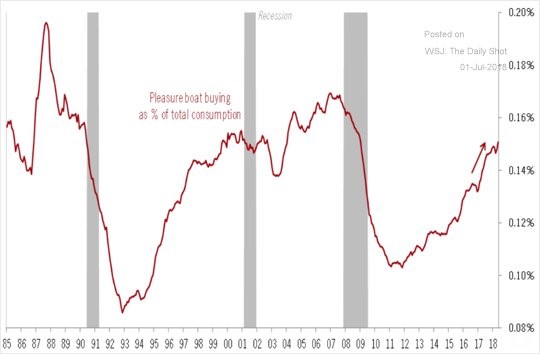
The chart below is one indicator which isn’t followed by the mainstream. I’m not saying it alone can make you money, but it is an example of an indicator which can help you understand where the economy is in the cycle. As you can see, the percentage of people buying a boat is cyclical. At the end of the cycle when there is full employment, people fell great about their wealth and take out an unnecessary expense. I have nothing against boats. The point here is when people feel comfortable to buy a boat, they feel great about their financial status.
It makes sense that the boat buying didn’t collapse in the early 2000s because home prices were rising and the recession in 2001 was weak. The current rising stock market and low unemployment rate is perfect for boat buying. It’s like the prime age labor force participation rate in that it has increased since the bottom, but probably has 1-2 more years of increases left before the cycle ends. Another similar stat is the quit rate because both have to do with confidence in the labor market.
May Construction Report
Monday and Tuesday had a slew of great economic reports. The only slightly weak one was the May construction spending report which showed monthly spending was up 0.4% instead of 0.6%. The year over year spending was up 4.5% which was a deceleration from last month’s year over year growth which was 5%. April had a sharp negative revision as it was down from 1.8% month over month growth to 0.9% growth. Residential spending was up 0.8%. Spending on new multi-family housing units was up 1.6% which is hugely important because there is an affordable housing shortage in many cities. Spending on home improvements was up 0.9% and spending on new single family homes was up 0.8%.
The weakest part of the report was non-housing private residential construction spending as it was down 0.3%. Manufacturing spending was down 2.4% month over month and 11% year over year. Office spending was up 1.4% month over month and 9.7% year over year.
Strong Factory Orders & ISM Manufacturing Report
The manufacturing spending was great in May. To be clear, the prior report I discussed was on construction and this one is on new factory orders. Orders were up 0.4% month over month which beat the expectation for no change. The prior report was revised up from -0.8% to -0.4%. Durable goods orders were down 0.4% because of weakness in aircraft orders and autos orders. Autos were weak because of the fire at the auto supplier warehouse. Non-durable orders were up 1.1% as they were boosted by petroleum and coal. Non-defense capital goods orders were up 0.3% after they were up 2% last month. Primary metals orders were up 0.5% with steal slipping and aluminum extending a 3 month run of growth.
The ISM PMI was fantastic as it came in at 60.2 which was 0.2 better than the highest estimate on Wall Street. The table below shows the change in the components. As you can see, PMI was up 1.5 points, new orders were down 0.2, production was up 0.8, and imports were up 4.9 points. Prices were down 2.7 points, but they are still running very hot. It makes sense that prices fell because the backlog index fell 3.4 points and the supplier deliveries index rose 6.2 points. The stress on the supply chain was partially alleviated.
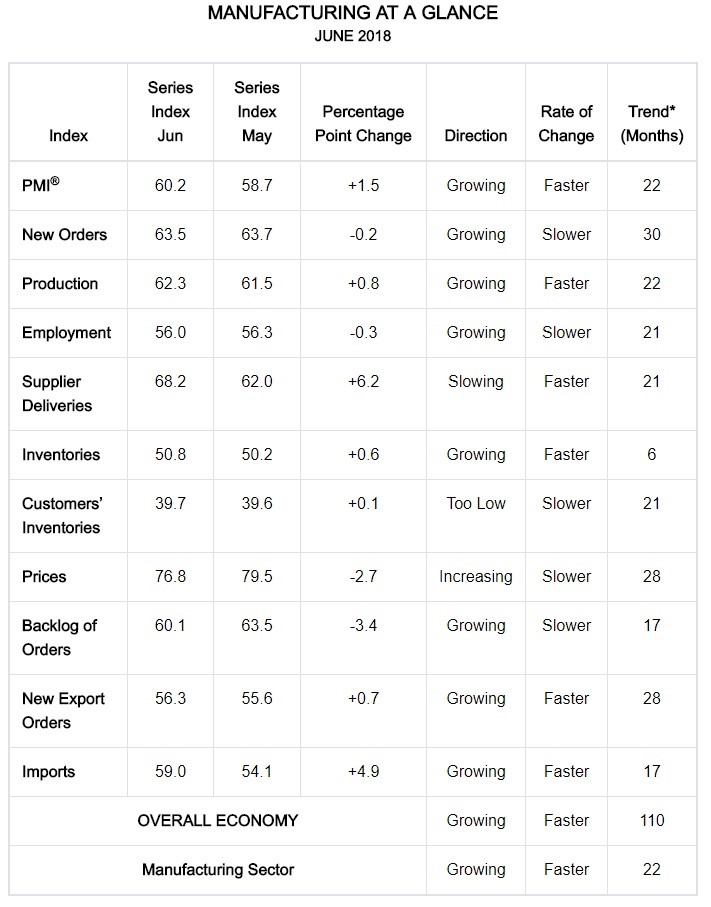
This report is consistent with 5.4% GDP growth, which is almost impossible even though this has been a strong quarter. As expected, the quotes taken from this report were very optimistic. A machinery company’s management said “The economy and product demand still continue to be strong. Having trouble finding people to fill blue collar positions. Lead times for parts and materials are moving out, and we are seeing commodity cost pressures increases with the threat of tariffs. Additionally, suppliers are asking for more price increases.” The economy is running out of workers in some industries such as manufacturing. This could boost nominal and real wage growth.