


Hey trader,
Bitcoin just broke a five-month losing streak while nobody was watching.
And it could just be the best trade opportunity no one knows about.
Traders are so locked into the equity selloff that they missed Bitcoin rallying 8% in March, outperforming every major index.
That kind of divergence does not stay hidden for long. It shows up first in the options flow of the names most levered to the move.
MARA Holdings saw 6,000 contracts land in a single block trade today.
Someone sold the $7 puts and bought the $13 calls for April 10. One print. One direction.
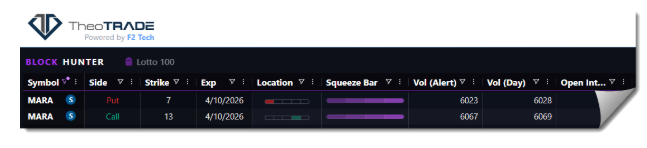
The Block Hunter Console flagged the trade immediately. The squeeze bar indicator lit up four bars on a stock carrying 24% short interest.
So how do we turn this information into an actionable trade?
Why Bitcoin Miners Are the Leverage Play
MARA is a Bitcoin mining company. It buys semiconductors, builds mining rigs, and converts electricity into Bitcoin.
When Bitcoin's price rises, MARA's revenue per coin increases while costs stay relatively fixed. That operating leverage gives miners a higher beta to Bitcoin than holding the coin itself.
Bitcoin sat near $68,770 at the start of March. It pushed through $73,000 last week. Today, it is trading near $73,880.
That rally happened while the S&P 500 was selling off on Iran headlines and elevated oil prices.
Perpetual futures funding rates have been negative for 14 consecutive days. That is the longest stretch since December 2022, which marked the bottom of the last major bear market.
Negative funding means short sellers are paying longs to hold their positions. When that dynamic persists for this long, the crowd is leaning bearish at precisely the wrong time.
What the Risk Reversal Tells You
The institution sold the $7 puts and bought the $13 calls in a single 6,000-contract block for April 10 expiration.
Selling puts generates premium that helps fund the call purchase. The combined trade creates bullish exposure in both directions.
Below $7, the institution is obligated to buy shares. Above $13, it profits from the calls.
The fill location matters. Calls bought at the ask confirm the institution was initiating a new position.
The $13 call carried a seven delta at the time of the trade. The market priced it as a low-probability event. The institution disagrees.
Four data points from a single print. The symbol is MARA, the direction is bullish, the target is $13, and the timeframe is April 10.
How the Squeeze Bar Quantifies the Risk
MARA carries 24% short interest on a 371-million-share float. The Block Hunter Console's squeeze bar registered four bars.
The squeeze bar does not predict that a squeeze will happen. It quantifies the potential magnitude if one does.
At 24% short interest, roughly 89 million shares are sold short.
If MARA starts moving toward $13, two forces compound simultaneously.
The first is gamma from the call contracts. As the stock approaches the $13 strike, market makers who sold those calls buy shares to hedge their growing delta exposure.
That buying pressure accelerates as the stock gets closer to the strike.
The second is short covering. Shorts who entered near $8 or $9 face growing losses if MARA pushes toward $11 or $12. Their buy-to-cover orders add fuel to the same move gamma is already driving.
The squeeze bar tells you the potential is there. The block trade tells you someone with deep pockets is positioned for it.
How to Structure the Trade
The call vertical offers the cleanest risk profile in the current environment. MARA's implied volatility skew favors buying lower strikes and selling higher strikes.
- Buy the April $10 call (approximately 90 implied volatility)
- Sell the April $12 call (approximately 91 implied volatility)
- Cost: Approximately $0.45
- Exit target: $0.77 (a 70% return on the spread)
- Max risk: $0.45 (the cost of the spread)
- Catalyst: Continued Bitcoin strength and short squeeze potential
The skew works in your favor. The call being sold carries slightly higher implied volatility than the call being bought, reducing the net cost.
MARA does not need to reach $13 for the spread to hit its target. A move to $11 puts the spread deep enough in the money to exit at the profit target.
The average true range on MARA is 87 cents. A two-ATR move from the current price reaches the upper end of the spread without requiring anything extraordinary.
What the Console Is Tracking Now
The Block Hunter Console flagged the 6,000-contract block and confirmed directional bias through the fill location at the ask.
Bitcoin is diverging from the equity market. That divergence is showing up in options flow before it shows up in stock prices.
The institutional inventory at $13 is built. The gamma from those contracts creates mechanical buying pressure as MARA approaches the strike.
The 24% short interest amplifies the move if it gets going.
One print gave you the symbol, the direction, the target, and the timeframe. The spread gives you the structure to act on it with 45 cents of risk.
See exactly how Block Hunter catches institutional positioning before the crowd catches on.
Brandon Chapman, CMT
Creator of Ghost Prints