Strong Jobless Claims
Prediction for a strong labor market in August looks good as the jobless claims report from the week of August 8th showed a lot of improvement. BLS report’s survey week is next week’s jobless claims report. As long as it shows more improvement, we could end up with better job creation in August than July which will really knock down the unemployment rate.
General trend is towards less improvement each month because there is less room to get better. This might be a rare case where job creation accelerates. Then, we can expect slower job creation where the labor market takes a few quarters to get back to normal which is below 5% unemployment.
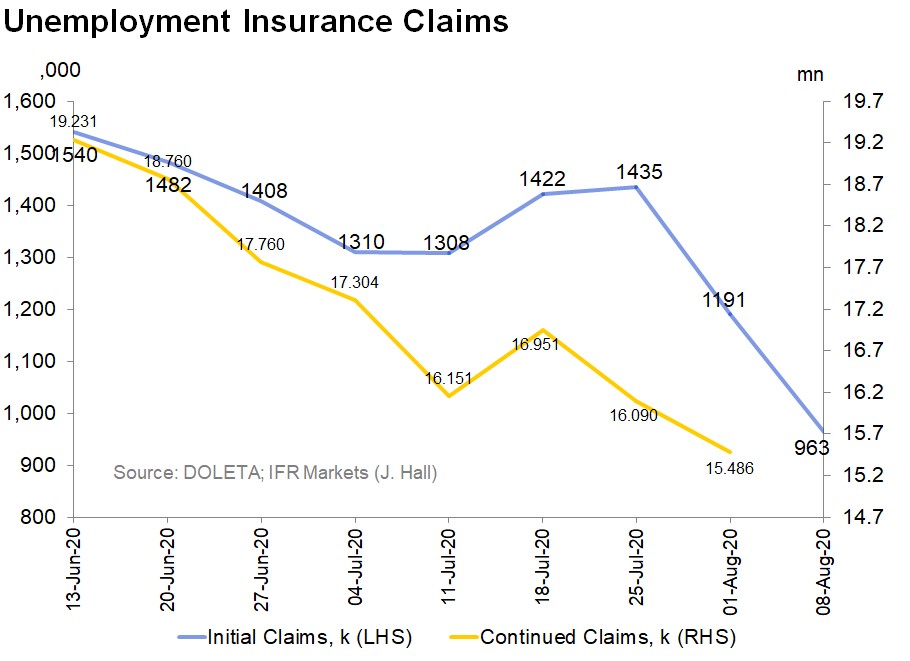
Last week unadjusted claims fell below 1 million. This week adjusted claims joined the party. Adjusted claims fell from 1.191 million to 963,000 which was below the consensus of 1.15 million and the lowest estimate which was 1.05 million.
You can see in the chart above the few weeks in July which bucked the trend of improvement. In the past 2 weeks, we had a 244,000 decline and a 228,000 decline. These are huge numbers. Claims only need to fall 3 more weeks at that rate to get back to normal.
Frankly, most would be happy if claims fell at a rate of 100,000 per week for the next few weeks. Unemployment rate might fall quicker than people expect. Economists live for a moment where the economy is in disarray. Their jobs were boring for most of the past few years. They are painting a worse picture than exists similar to how a weatherman proclaims a terrible storm is coming.
To be clear, we are of course sympathetic to anyone who lost their job. However, on a rate of change basis, the labor market is improving rapidly. Many unemployed people will get their jobs back. Permanent unemployment actually fell in the July report even though the economy dealt with a 2nd wave of new COVID-19 cases.
Details On The Great Report
Non-seasonally adjusted claims fell from 988,000 to 832,000 as it is now below the previous recessionary high. In the past 4 weeks, unadjusted claims have fallen over 100,000. Average decline is about 170,000 per week. At that rate, unadjusted claims would be back to normal in about 4 weeks.
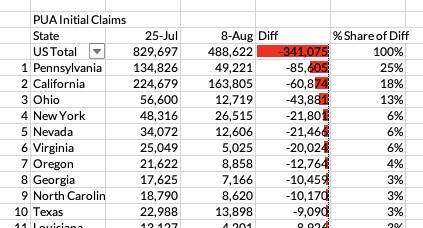
Furthermore, there was a big decline in PUA initial claims. PUAs fell from 656,000 to 489,000. There are still 10.7 million PUA continued claims, so we aren’t out of the woods yet. Declines in the past 2 weeks from 830,000 aren’t as glamorous as they seem. The table below shows the crackdown on fraud. As you can see, the decline related to fraud in Pennsylvania actually represents most of the decline in the past 2 weeks.
Adjusted continued claims also fell as they went from 16.1 million to 15.5 million in the week of August 1st. Keep in mind, at the peak of the last recession, there were 6.6 million continued claims. We are well over double that level with only a slightly larger population and labor force. We still have at least a couple months until we get to the peak of the last recession. This decline of 604,000 was slightly less than the decline of 861,000, but it was a step in the right direction.
With the large decline in initial claims in this report, we can expect next week’s continued claims report to show a bigger decline. Continued claims should be enough to scare lawmakers into action, but they haven’t budged. There will be no stimulus bill in August. At least President Trump’s measure will help people get $300 per week.
Positive Rate Falls, But Deaths Rise
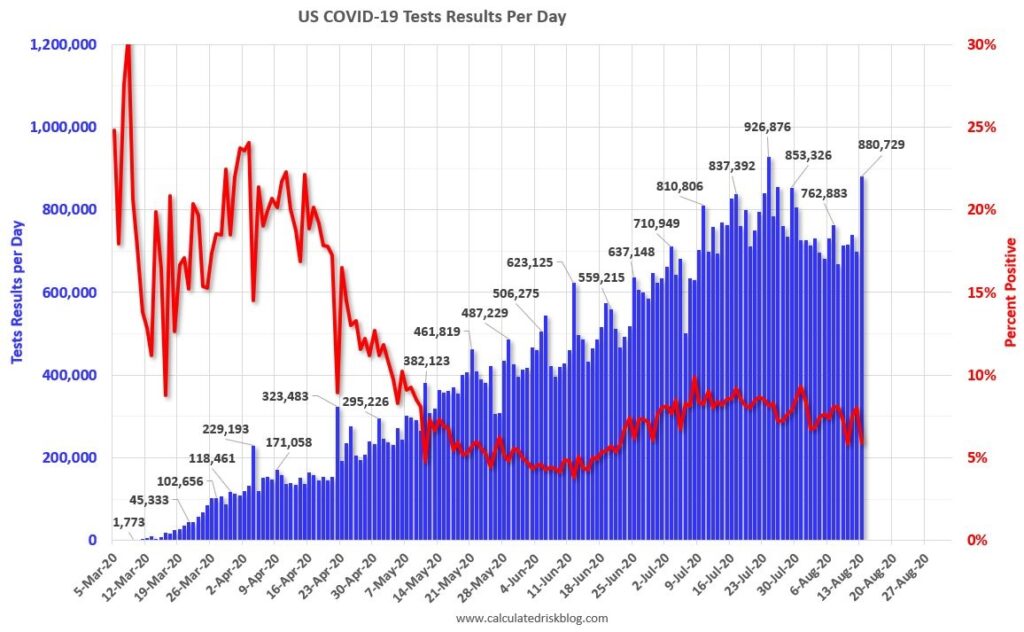
Even though new cases on Thursday didn’t fall that much, the positive rate fell significantly because there was a huge spike in new tests. Investors should not be too worried about the decline in cases being partially due to the decline in testing. Perhaps people aren’t feeling symptoms, so they aren’t getting tested.
Whenever the number of new tests increases, the positive rate falls. If everyone in America was tested, there would be an increase in positive cases, but the rate would plummet.
As you can see from the chart below, there were 881,000 tests on Thursday. They had been hovering around 700,000 prior to that. It’s a great sign that even with the spike in testing, daily new cases fell from 58,884 new cases last Thursday to 55,364 this Thursday. Current 7 day average is 54,503. If we see slightly lower new tests per day over the next week, we could get that 7 day average below 50,000.
Turns out, the 7 day average actually increased slightly. This was a very bad week for deaths as there were 1,284 new deaths on Thursday which was above 1,206 last Thursday. At least they have fallen in the past 2 days. Bulk of the decline in new cases per day was in the first week of August. If you push that forward 3 weeks, there should be a sharp decline in deaths per day next week in which case the 7 day average should fall below 1,000.
Conclusion
Jobless claims were strong again this week. That’s back to back weeks of great data after a rough July. Let’s see if these good numbers turn up in the August labor report. If there are more jobs created than last month, the unemployment rate could be in the 8s.
Some have been calling for the rate to fall below 8% by the end of the year. That reading would be even better than that estimate. New COVID-19 cases continued to fall on Thursday even with the spike in tests. However, deaths were stubbornly high this week. Surely, they will decline next week.