


Hello TheoTrader,
Last week quietly confirmed what a lot of traders have been afraid to admit…
Bulls are losing control of this market. Not in a dramatic, headline-grabbing way. In the slow, grinding way that catches people off guard.
The problem is that most traders won't notice until it's too late.
Defensive sectors are taking over. Bond yields are dropping.
The rotation is subtle, but it's building momentum fast.
This week's Tale of the Tape breaks down exactly what's shifting, why it matters, and what to watch so you're not the last one to react.
Growth Hanging on By a String as Defensives Surge
| Performance
Leader |
1-week | 30-day | YTD (It’s a New Year) |
1-year |
| Sector | Utilities (XLU) | Energy (XLE) | Energy (XLE) | Industrials (XLI) |
The top-performing sector last week was utilities. After spending a few months in the doldrums, the sector has come roaring back to life.
This is a classical defensive signal from the stock market, and it's being compounded by the fact that interest rates have dropped too.
When capital rotates into utilities, it tells you something important -- institutions are repositioning for uncertainty. They're not chasing growth. They're seeking shelter.
Utilities tend to be top performers when rates are coming down. The main reason is the sector's tendency to pay higher dividends compared to others.
When rates drop, that higher income becomes extra appealing. That's especially true in a risk-off environment like the one we're in now.
But here's the big catch from last week.
Energy's time on the leaderboard looks limited. With rates dropping, the signal from bond markets is clear -- inflationary pressures are weakening.
I'll always trust bond markets over energy markets. Bonds don't lie, and right now they're telling us that the inflation trade is losing steam.
Energy had a solid run, but the macro backdrop is shifting underneath it. If bonds continue to rally and yields keep falling, energy's recent run loses its fundamental support.
Here's another dynamic to consider -- tech loves lower interest rates. Lower yields reduce the discount rate on future earnings, making long-duration growth stocks more attractive on a relative basis.
This is the exact setup I outlined with the Trinity Trade team in order for tech to bottom. Rates had to drop first, and that often means we have to go through a period of volatility before the turn.
We may be in that volatile stretch right now. The pieces are aligning, but the market hasn't fully priced in the shift yet.
The good news is that industrials are still the top performer over the past twelve months. This is still a growth sector, and it makes me feel better about this pullback being run-of-the-mill versus something serious.
If we were to see a sector like staples, healthcare, or utilities claim the one-year leadership spot, we'd have much bigger problems to deal with. That would signal a true regime change -- a market that's no longer pulling back, but breaking down.
For now, the foundation is still intact. But the cracks are worth watching closely.
As always, I'll keep you posted.
Spotting Strength Before the Headlines
This is exactly the kind of sector rotation analysis that my Trinity Terminal is designed to track.
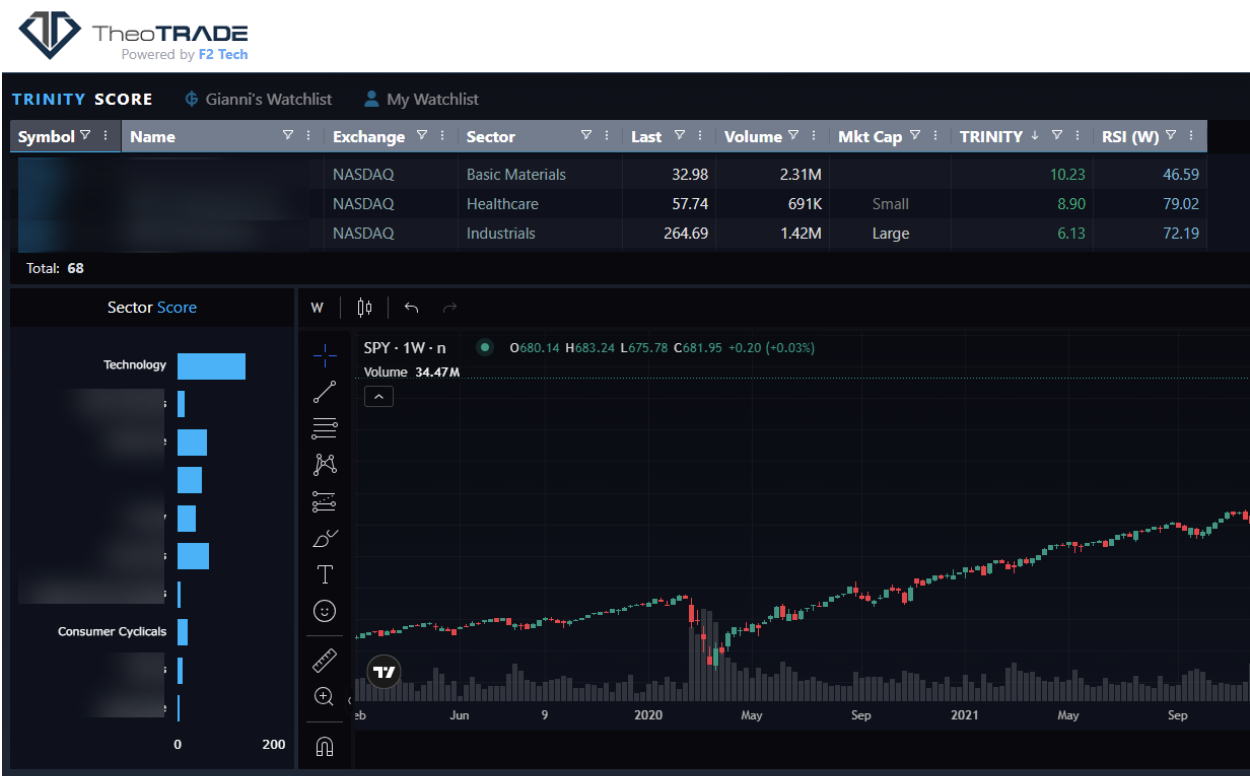
Throughout this article, I've referenced watching for institutional accumulation in energy names and monitoring sector leadership shifts. These aren't signals you'll find on CNBC until the move is already over.
The Trinity Terminal monitors institutional tides, waves, and ripples in real time. It ranks setups with a Trinity Score so you know which names have the highest probability to move.
I call it "the signal before the story."
The sector rotations I've described today were visible in the data weeks ago. By the time these shifts hit mainstream headlines, the move is already underway.
The Trinity Terminal helps identify these developments as they're forming, not after they've played out.
Stay tuned,
Gianni