

Make no mistake, there really was no getting this “right” for the Bank of Japan.
When you’re monetizing the entirety of gross JGB issuance, buying up 60% of the ETF market, and rates are already negative, there’s not much you can do in the way of “shocking and aweing” the market.
So they got “creative.” Essentially, they’re going to try and manipulate the yield curve so that the long end stays anchored. Additionally, they’ve dropped the whole 2% inflation target and are now committed to overshooting it, which is amusing because they’re nowhere close to 2%. It’s kind of like committing to making a million dollars, getting to $100 and then announcing you’re committed to “overshooting” a million.
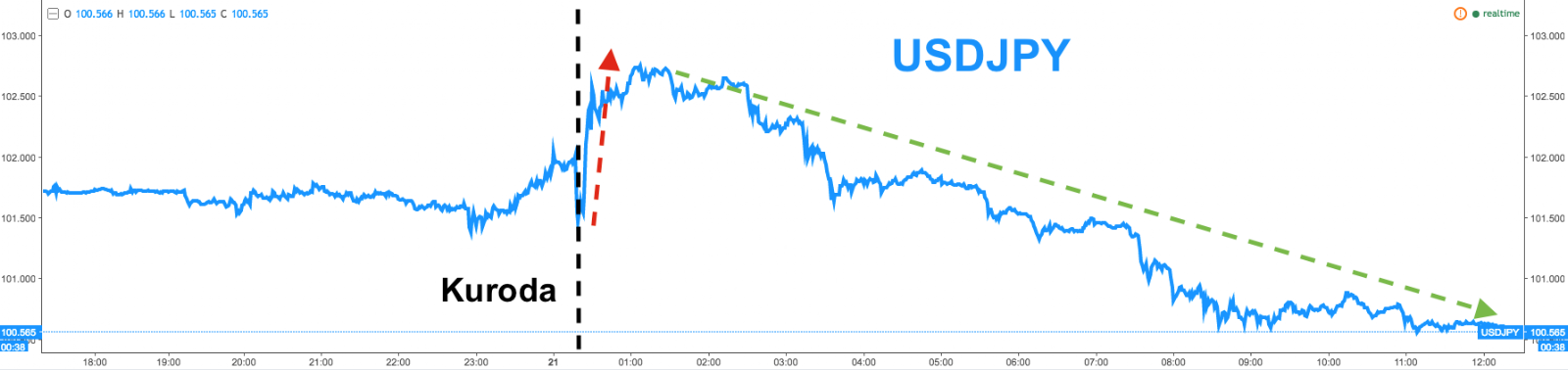
In any event, the yen simply isn’t buying it. Have a look:
Mercifully, the Nikkei cooperated, rising nearly 2% - we’ll see how long it takes stocks to realize what the currency knew within minutes of the announcement.
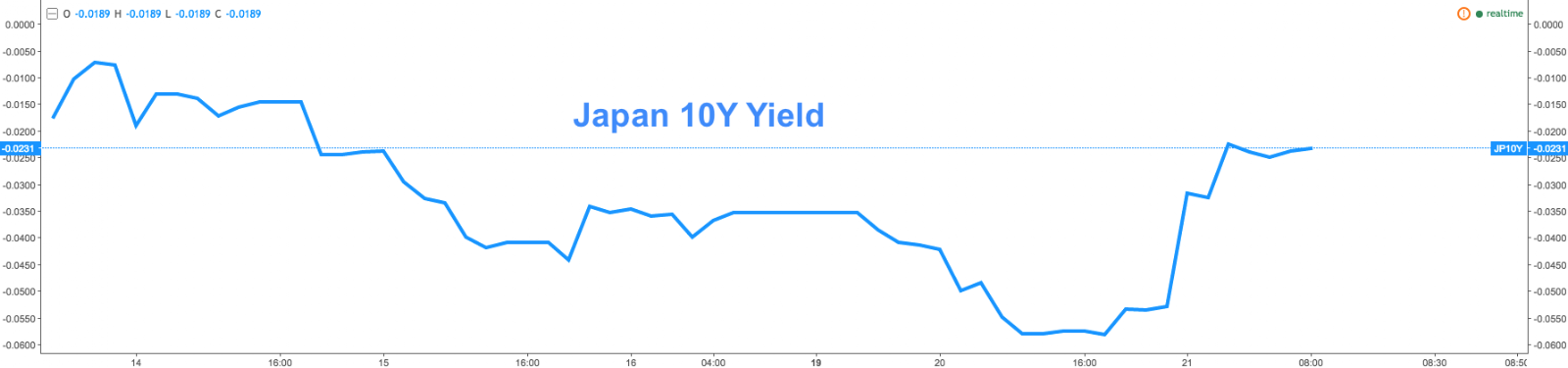
As for yields, we did get a pop in the 10Y, which is good news in terms of what the BoJ wants to accomplish, but it’s hard to imagine the market won’t test them going forward:
For their part, Goldman is optimistic:
“We do not believe so and see scope for $/JPY to start moving higher in the wake of this announcement. For one thing, the switch to yield curve targeting puts an end to the JGB scarcity debate, given that – with a credible commitment – actual purchases to maintain 10- year yields around current levels may be quite low. This is conceptually similar to the SNB floor for EUR/CHF at 1.20, which allowed intervention to be scaled back sharply after its introduction. Now, we can already hear people say that the EUR/CHF floor ultimately failed. But this was because of Switzerland’s proximity to the Euro zone and the shift of the ECB to QE in the course of 2014. The situation in Japan is obviously different in this regard. For another thing, the “inflation overshoot” language is a fundamental and dovish change, which – together with the switch to yield targeting – essentially sets the stage for QQE infinity. Going into this meeting there had been lots of speculation that QQE is not sustainable. We believe that Governor Kuroda with these actions has clearly and effectively responded to his critics.”
Well then - QQE infinity is now a reality. Great. It’s not entirely clear why that’s something to be particularly excited about. In any event, Goldman is also optimistic about the prospects for yen weakening despite today’s action. Here’s a visual:
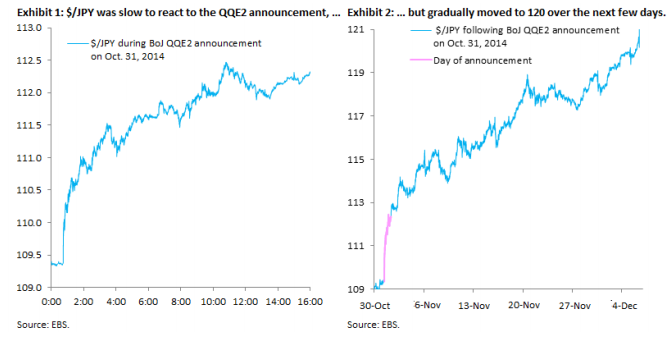
(Charts: Goldman)
Count us skeptical. Barclays, on the other hand, expects more easing:
“We have changed “further easing at the next MPM on 31 October-1 November” to our baseline forecast, a scenario we previously regarded simply as a risk. Specifically, we expect the BoJ to lower the interest rate on the policy rate balance of BoJ current account deposits to -0.3% from the current -0.1%.”
“In forecasting further easing, we view the following as key focal points. First is the September BoJ Tankan (release on 3-4 October). Here the inflation expectations of enterprises (released 4 October) will be particularly important. If these expectations continue to weaken, we believe there would be a mounting risk of weaker wage hikes at next spring’s annual wage negotiations. If wage growth slows, it would narrow the channel for stimulating household inflation expectations, making it even more difficult to achieve 2% y/y CPI inflation on a stable basis. Considering this relationship, if the BoJ is to ease further, we believe it needs to do this in time to influence the annual spring wage negotiations between labor and management. In our view, this means easing at the MPM on 31 October-1 November.”
In the end, there’s really only one chart you need to know where all of this is ultimately headed. This one:
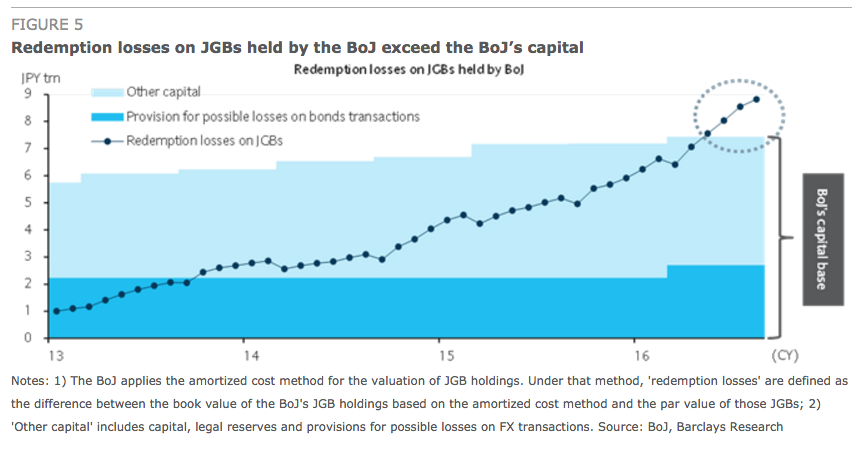
(Chart: Barclays)