

On Friday we noted that according to BofAML’s latest weekly flows report, every asset class saw inflows last week. Equities, loans, high yield, investment grade, and munis. It was all bid.
We also observed that 50% of the bank’s clients expect the divergence between near record low Treasury yields and record high stock prices to persist. In other words, respondents to BofA’s survey think the world will remain upside down for the foreseeable future.
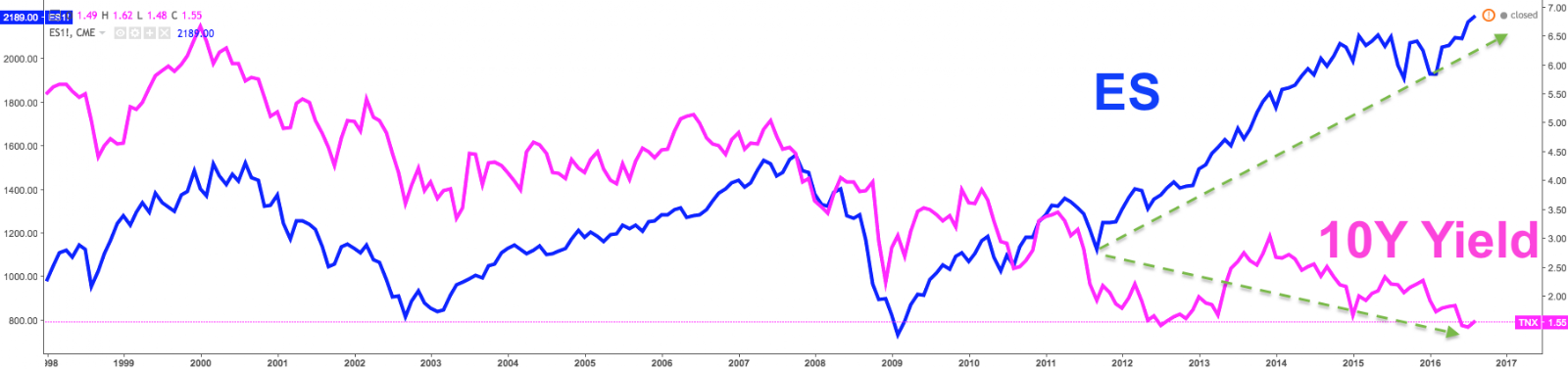
Clearly, that’s a rather anomalous looking chart.
Alas it’s the product of central banks. The punch bowl stays in place emboldening equity investors and perpetuating the greater fool theory of trading while the race to the bottom in Europe and Japan ensures there’s a perpetual bid for longer-dated US paper because hey, at least yields aren’t negative stateside.
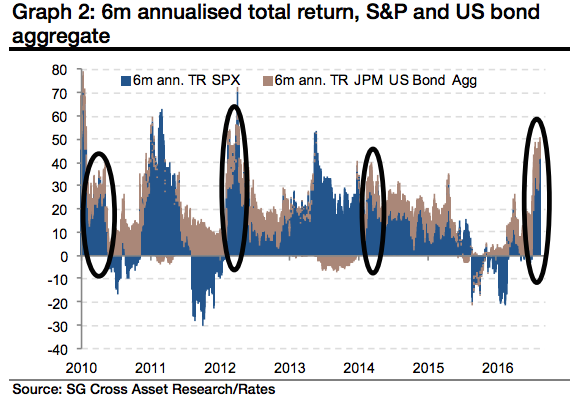
SocGen is out with an interesting take on this phenomenon. Have a look at the following:
(Chart: SocGen)
Here’s another way to visualize it:
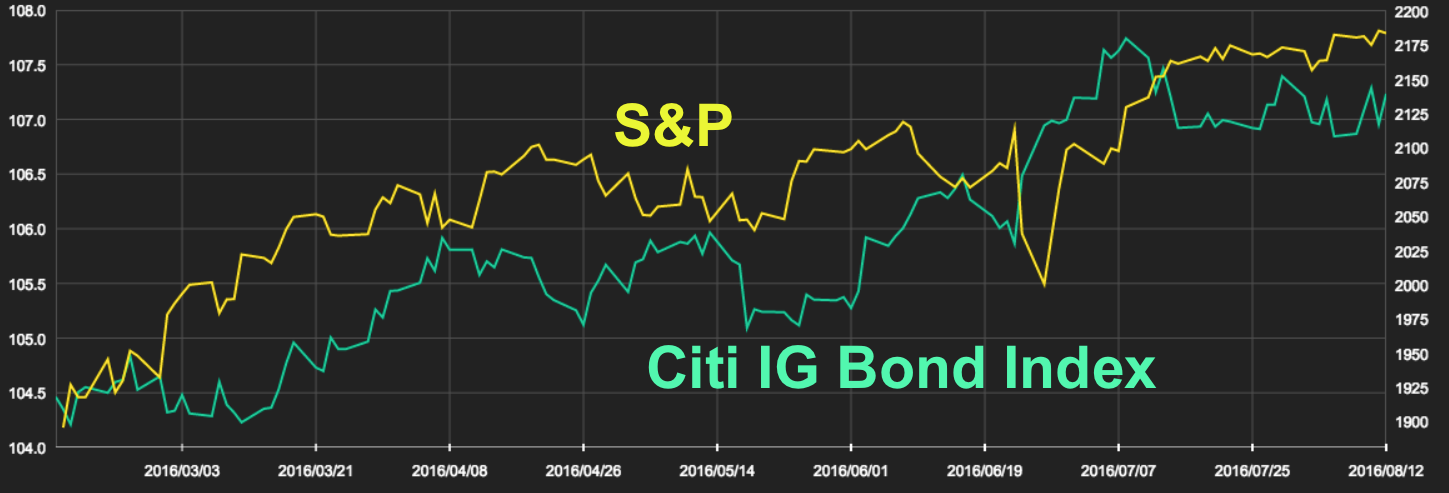
That, SocGen says, is “as good as it gets.” This is the bank’s take:
“We are in yet another sweet spot whereby bonds and stocks rally in tandem. It is not that often that we see bonds rally through a 20%+ annualised gain in the S&P 50 (black highlights in Graph 2). For that matter, the SPX has returned a staggering 44% p.a. over the past six months, while US (aggregate) bonds have delivered 6.6% p.a. The latter are cooling off, after delivering 12.0% p.a. over 1H16. Two months ago, we argued in our mid-year outlook that, with valuations stretched, average total returns over the coming years would prove much lower. That has not been true over the past couple of months, but still is a near certainty over the medium run, in our view.”
Yes, a near certainty. Of course you have to question the whole “medium run” thing. After all, the Bank of England is just getting started again with QE and now they’re buying corporates too. Meanwhile, the ECB has managed to drag yields on some EUR corporate debt into negative territory. SocGen also mentions a hilarious paradox that we’ve often poked fun at in these pages and elsewhere:
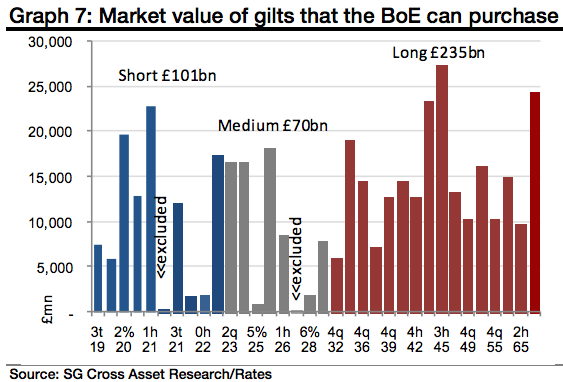
“The uncovered BoE APF purchase operation ignited demand for long gilts, with 30y yields falling around 40bp so far in August. The market has priced in a lot of ‘good’ news ahead of long-dated supply. The irony is that the price rally has made it easier for the BoE to fulfil its remit to purchase £1.16bn of gilts per operation.”
(Chart: SocGen)
By “the uncovered operation,” SocGen is referring to the “failure to launch” that we described here. But note what they say about the gilt price rally. Basically the more overpriced UK government debt becomes (i.e. the lower yields go), the easier it is for the BoE to claim it’s meeting its targets because those targets are set in nominal terms. The ECB “benefits” from the same dynamic. Of course logically speaking that’s completely ridiculous. Basically, central banks are hoping and trying to overpay so that they don’t end up running out of bonds to buy.
For the ECB, that’s meant loading down the balance sheet with all types of negative yielding debt, which ensures that the central bank will take a loss if held to maturity. It would be like promising to buy $50 worth of bananas (we’re not sure why you would do that, but bear with us), going to the store and discovering that there are only two bananas left, and then paying $25 each just so you can keep your promise.
But as crazy as all of the above most certainly is, we’d be cautious on SocGen’s “as good as it gets” call. After all, it got better today.