Argentinian Peso - Argentina May Default
Argentinian Peso - Emerging market stocks and currencies plummeted further even with the decline in the dollar.
The MSCI emerging market equity ETF fell 2.66% on Thursday. One of the catalysts for the decline was the chaos in Argentina as its central bank hiked rates to 60%.
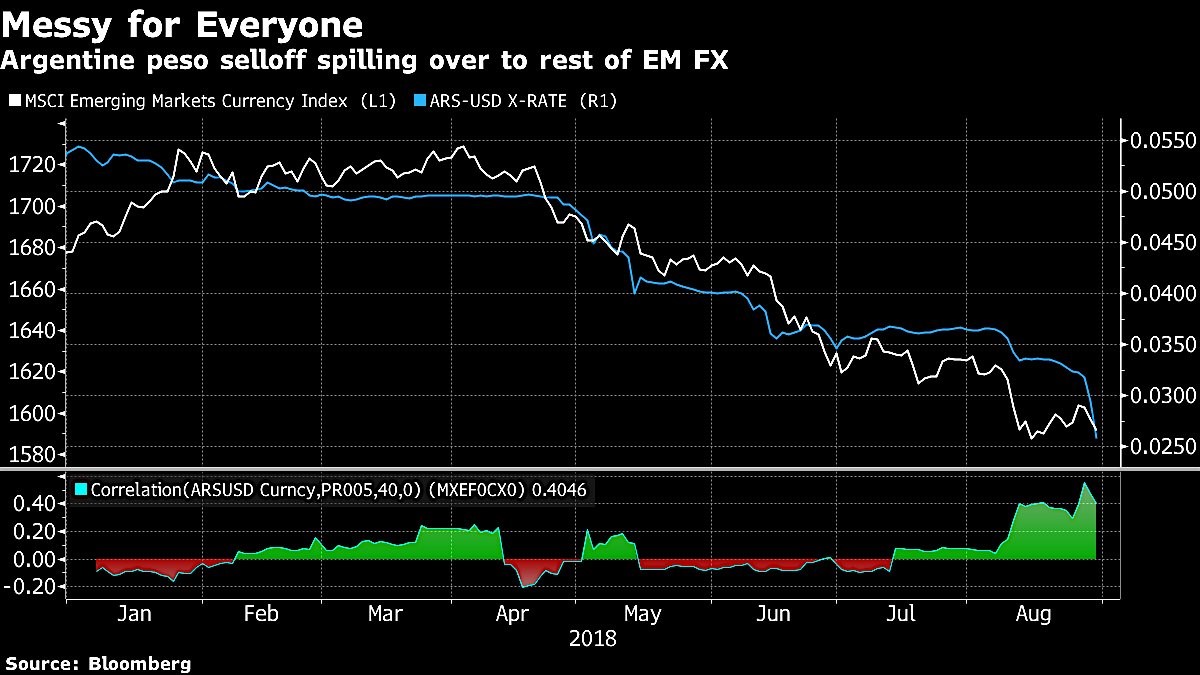
The country’s inflation rate is 25.4% and the peso is down 45% versus the dollar this year.
With weakness in Venezuela, Turkey, and Argentina, emerging markets are suffering a death by 1,000 cuts.
As you can see from the chart below, the Argentinian peso crisis is spilling over to the rest of the emerging market currencies.
Argentinian Peso isn't the only one in trouble - Gains Rescinded: Dollar Tree Crashes 15.5%
After a 4 day winning streak where records kept being broken, the stock market finally fell on Thursday. The S&P 500 was down 0.44%.
After the Argentinian Peso crisis the biggest loser was Dollar Tree. It fell 15.5% on disappointing earnings.
EPS were $1.15 which missed estimates by one cent. Revenues were $5.53 billion which missed estimates by $10 million.
Same store sales growth was 1.8% which missed estimates by 4 basis points. This is much different from the other great retail earnings reports.
It’s fair to speculate that the economy is so good that less people need to spend money at the dollar store. It can be a bad thing that the dollar store is doing well.
As I mentioned in a previous article, the working poor are very optimistic about the economy; maybe they have upgraded from the dollar store to a department store or supermarket.
Argentinian Peso Versus The Dollar - Stocks Are Still Overbought
The VIX was up 10.45% to 13.53. With this small decline in stocks, the CNN Fear and Greed index already fell from extreme greed to greed.
It is now at 73 out of 100. Another couple of down days will push the market away from being overbought.
I am eternally intrigued whether the market conveniently finds reasons to fall when it is overbought or if the news really drives the market.
Even if I was a bull, I would have pulled back from buying at such an extremely overbought level. Either way, there were negative events which drove stocks lower which I will get to later in this article.
Argentinian Peso Versus the Dollar - Materials Sink The Most
Every sector was down except utilities which were up 0.13% on this ‘risk off’ day.
The worst sector was materials which fell 1.25%. This decline occurred even though the dollar continued its recent downtrend.
With a strong positive reversal in the commodities ETF driven by the weak dollar, the CRB index is now only down 0.55% year to date.
Argentinian Peso Versus The Dollar - While President Trump Backs New Chinese Tariffs
There wasn’t any positive news on the negotiations between American and Canada. And there was bad news on the Chinese American front; it was a double whammy of bad news.
Bloomberg reported that Trump supports tariffs on $200 billion of Chinese goods. However, he hasn’t made up his mind on if they will be implemented.
One good bit of news on the trade front is that 16 Asian economies are trying to forge a new trade deal with America called RCEP. This stands for Regional Comprehensive Economic Partnership.
The Philippines Secretary of trade and industry said "By the end of this year, everybody is looking at a very good outcome. In other words, we're referring to a possible substantial conclusion given the momentum that we're all having right now."
The RCEP will become the largest trade bloc in the world as it will encompass about one third of the global economy.
Argentinian Peso Versus the Dollar - And An Update On The Treasury Market
The American stock market is a safe haven play with such volatility in emerging markets and deceleration in China. The American bond market is also a safety play.
Despite the highest core PCE inflation since April 2012 and 4.2% GDP growth in Q2, rates are still low. It’s an interesting thesis to claim global markets are the reason for such low American yields.
The bond investors who are economic bears claim the economy isn’t doing well because the long bond yield is so low. However, that goes against the stock market and most economic reports.
The 10 year bond yield was down 2 basis points on Thursday to 2.86%. The 2 year yield fell 3 basis points to 2.65%.
And the 2 year yield matched its cycle high at 2.68% earlier in the week. 2 year yield should continue to climb for the rest of the year as the 4th rate hike December gets fully priced in.
That will mean the market will come perilously close to inverting. The latest difference between the 10 year and 2 year is 21 basis points. The 10 year minus the 3 month yield is the most accurate at predicting the business cycle. The spread between those bonds is now 76 basis points.
Argentinian Peso Versus the Dollar - Homebuilders In US Having A Tough Year
The housing market has been weak this year. Homebuilder stocks are down 9.65% year to date as they have been hurt by rising commodity prices.
Even though housing prices have gone up, these stocks haven’t done well because it isn’t easy to build new homes in the cities seeing the most price appreciation.
Recently appreciation has slowed, because of rising mortgage rates, but prices are still going up. The U.S. Case Schiller index was up 6.2% year over year in June. The growth rate peaked at 6.5% in March.
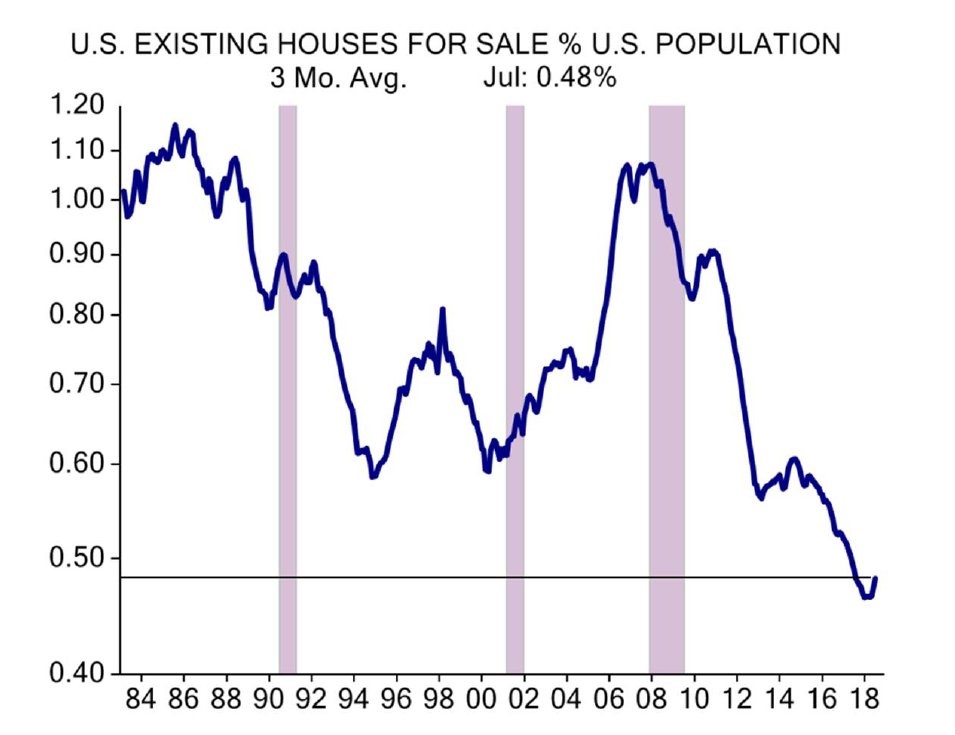
The chart below is a bit shocking.
As you can see, the existing homes for sale as a percentage of the American population has fallen to the lowest level in over 30 years.
Argentinian Peso Versus the Dollar - Conclusion
Just when it looked like emerging markets may have put in a temporary bottom, more cracks have begun to show.
It seems like the emerging markets will continue to underperform as the Fed keeps raising rates.
Lucky for them, the Fed should be done hiking in less than 12 months.
However, that doesn’t sound good to an economy which is collapsing. Even the Indian rupee is crashing as it recently hit an all-time closing low versus the dollar.