


Apple just made another perfect flag pattern.
The stock ripped 25 points. Then went sideways for three weeks…
…Then ripped another 25 points. Then sideways again.
Every technical analyst sees this and thinks momentum is dying. They assume buyers are exhausted and start looking for the top.
They're completely wrong about what's happening.
This isn't about buyers disappearing or fundamentals weakening. This is about portfolio managers being legally forced to sell. Not because they want to…
…Because their investment policy statements mandate it.
When Apple gains 25 points, institutional weightings are automatically adjusted.
A position that was 4% of a portfolio becomes 7% without the manager buying a single additional share.
The managers have no choice. They must sell back down to their maximum allowed weighting.
This creates the exact pattern you're seeing. Rip, consolidate, rip, consolidate.
It looks like exhaustion.
It's actually mandatory rebalancing happening across thousands of portfolios simultaneously.
Understanding this distinction changes everything about your timing.
You:
- Stop mistaking forced selling for trend reversals
- Recognize when sideways action precedes breakouts versus actual tops
- Position where institutions will defend you rather than fighting their systematic exits`
Here's exactly how rebalancing works and why it matters for every position you hold.
Most hedge funds and mutual funds operate under investment policy statements.
These aren't suggestions. They're legal requirements.
The IPS specifies exact position limits. Maximum 5% in any single technology stock. Minimum 3% in defensive sectors. You cannot deviate.
When Apple runs 25 points higher, something changes automatically. That 4% position becomes 7% without the manager making any purchases.
The stock price increase alone pushes the weighting above the legal limit. The manager must sell.
If they don't, they violate their fiduciary duty. They open themselves to lawsuits. They risk trouble if regulators audit their 13-D filings.
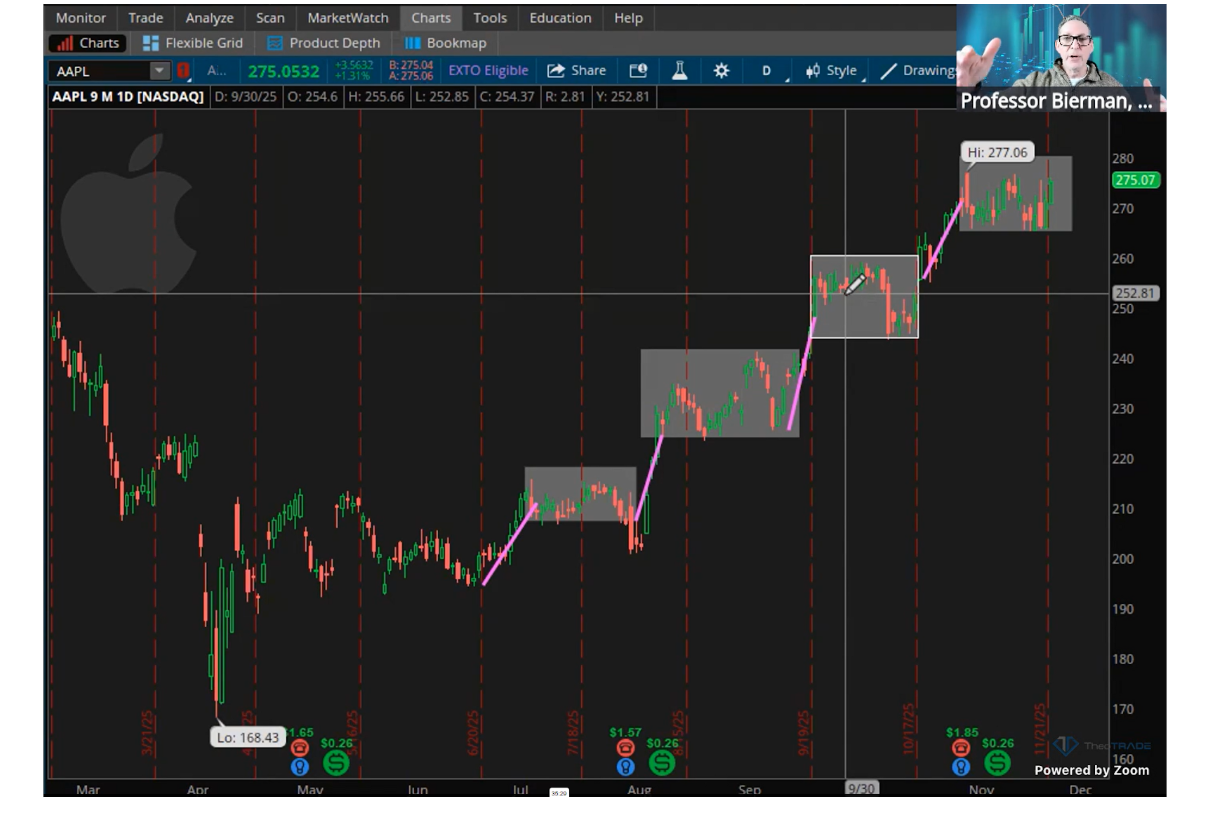
Every 25 points Apple gains, managers hit this constraint. They sell systematically to bring weightings back to 5%.
The stock consolidates while this forced distribution happens across the entire institutional universe. Then the selling pressure exhausts itself. Weightings normalize. Buyers return. The next leg begins.
Why The Pattern Repeats Perfectly
Look at Apple's recent action.
Flagpole. Three-week consolidation. Another flagpole. Two-week consolidation. The cycle repeats.
The intervals aren't random. They correspond to the percentage gain that triggers rebalancing requirements across major funds.
Those 25-point moves push institutional positions from comfortable weightings into violation territory. So they sell. All of them. At the same levels. Creating identical consolidation zones.
Retail traders see this and think the stock topped. They assume something changed fundamentally. They sell their positions or avoid buying breakouts.
Wrong. The fundamentals didn't change. The legal constraints didn't change. Only the stock price changed enough to trigger systematic forced selling.
Once that selling completes, the stock breaks out again. Everyone who sold during consolidation watches it run another 25 points without them.
The Flip Side Traders Miss
Rebalancing cuts both directions.
When stocks crater, institutional weightings fall below their required minimums. Managers who bought at higher prices watch their position weightings compress as prices decline.
The same investment policy statement that forced selling on the way up now forces buying on the way down. Managers don't want to buy into declining stocks. But they have no choice.
Their IPS specifies minimum sector weightings. They must maintain those allocations regardless of market conditions.
This explains why certain support levels hold with mechanical precision. It's not because the valuation suddenly became attractive. It's because thousands of portfolio managers simultaneously hit their minimum weighting thresholds and start buying to rebalance.
This forced rebalancing appears across institutional portfolios regardless of the specific stock. Medtronic ran from 80 to 102. Managers who held 4% weightings initially found themselves at 5% after that gain. They had to sell it back to 4%.
They don't want to. They have to. It's written into their investment policy statements.
How To Trade This Pattern
Stop buying stocks during their consolidation phases after 15-25% runs.
When Apple gains 25 points and enters a sideways channel, that's forced selling happening. You're fighting institutional distribution mandated by legal constraints. You will lose.
Wait for the consolidation to complete. Watch volume dry up during the channel. Monitor the accumulation distribution line for signs that forced selling exhausted itself.
Then position for the breakout. That's when institutions finish their rebalancing. When new money can drive the next leg without fighting systematic exits.
The same applies in reverse. When stocks crater and form bases, wait for the consolidation to develop. That's when institutions satisfy their minimum weighting requirements through forced buying.
The breakout from that base has institutional support underneath. Not because fundamentals improved. Because managers finished their mandatory rebalancing and stopped supplying selling pressure.
The Genesis Cog Scanner identifies exactly when these rebalancing zones form and when the forced buying or selling exhausts itself. It tracks volume patterns and momentum shifts that reveal when institutions finished adjusting their weightings and systematic pressure ends.
Your Positioning Right Now
Don't mistake sideways action after 15-25% runs for trend reversals. That's rebalancing. It's temporary. It's mechanical.
It exhausts itself once portfolios return to their mandated allocations. Position for the next leg once consolidation completes.
Not during the forced selling. Not before institutions satisfy their legal requirements. After the rebalancing finishes and systematic pressure disappears.
Stop fighting legal constraints you can't see. Start trading where portfolio managers defend you because they have no choice.
See how Genesis Cog detects institutional rebalancing before the next breakout confirms →
Professor Jeffrey Bierman
Creator of the Genesis COG System