Apple & Goldman Sachs - Stocks Crater On Veteran’s Day
The market was open on Veteran’s day. But the bulls wish it wasn’t as the S&P 500 fell 1.97%. Nasdaq fell 2.78%, and the Russell 2000 fell 1.98%.
I was wrong to suggest stocks were a buy on Friday as the CNN Fear and Greed index was incorrect. Investors have always postulated that oscillators don’t work in bear markets. Stocks become oversold and then fall further. I disagree with that narrative.
Every oscillator is only going to be right a certain percentage of the time. There are no guarantees. That’s why these are tools and not indexes you blindly follow.
The index fell from 18 to 11 which is extreme fear. Corrections are more prevalent in economic slowdowns like we’re in now.
If this slowdown leads to a recession, there will be a bear market. If stocks lead the economy, there could be a bear market next year.
It’s a big call, but I’m close to thinking the record high in September was the peak of this bull market.
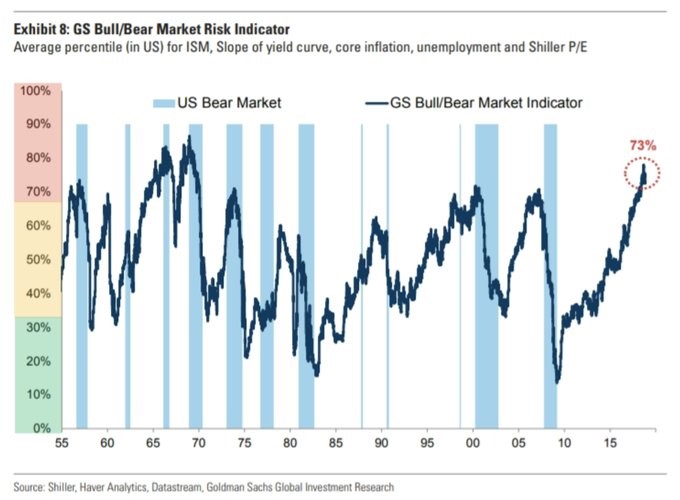
As you can see from the chart below, the Goldman Sachs Bull to Bear ratio recently peaked at 73% which is the highest level since the peak in the late 1960s. This percentile is based on the ISM, yield curve, core inflation, unemployment rate, and the Shiller PE.
Apple & Goldman Sachs Were Big Losers
The big losers were Goldman Sachs and Apple. Apple stock fell 5.04%. Its facial recognition supplier, Lumentum, lowered its outlook for the quarter. This was due to reduced shipments from one of its biggest customers. Which investors think is Apple.
Apple accounts for 30% of Lumentum’s revenue. It’s disconcerting for Apple that consumers might be balking at the higher prices for its iPhones.
That was the last trick up Apple’s sleeve to grow revenue.
If iPhones are going to cost over $1,000 and the new devices are going to have small improvements, consumers will delay purchasing new smartphones. Because Apple can’t keep raising iPhone prices, I’m a long term bear on Apple.
Goldman Sachs stock fell 7.46% which was its largest decline since November 2011.
The stock declined because Malaysia’s finance minister demanded a full refund of the $600 million in fees it paid to Goldman tied to a failed Malaysian state investment fund called 1MDB.
Interestingly, Goldman Sachs stock is down 24.6% from its record high in March. It fell 33.46% in the last slowdown from 2015-2016. Some investors don’t even realize the economy is in a slowdown. Yet Goldman Sachs has already declined almost as much as it did in the last slowdown.
Apple & Goldman Sachs - All Sectors Except Real Estate Fall
The worst 2 sectors were technology and consumer discretionary as they declined 3.54% and 2.31%. Apple brought down the technology sector and Amazon brought down consumer discretionary as it fell 4.41%. The real estate sector rallied 0.2%, but the home builders have regained their negative momentum. After rallying 9.07% from October 24th to November 5th, the ITB ETF has fallen 4.98%. It’s closing in on its 52 week low again.
Apple & Goldman Sachs - Oil Craters Again
Oil fell again on Monday which marks its 11th straight decline. That’s the longest on record. It’s down because of the strong dollar, global economic weakness, and the increased supply because of the sanctions on Iran were partially lifted. WTI fell 26 cents $59.93. At this point, every decline is a big deal because of the streak. Furthermore, after the settlement WTI fell over 2% to below $59.
This time oil re-correlated with stocks as both fell. It’s amazing that oil fell even though the Saudi energy minister, Khalid al Falih, stated OPEC and its allies might need to cut production by 1 million barrels per day to prevent oil from being in oversupply. He also stated on Sunday Saudi Arabia’s shipments will fall 500,000 barrels per day in December. Usually, these statements move the market. This shows how much oil traders fear the global economic slowdown.
Apple & Goldman Sachs - The Dollar Soars
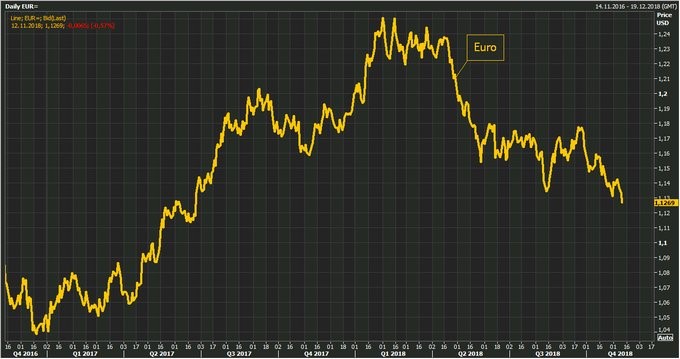
The dollar has been spiking in the past few weeks as the Fed funds rate is much higher than other developed markets’ interest rates. The hawkish Fed is sending down emerging markets and commodities. The Bloomberg commodities index is down 3.03% year to date and 1.91% in the past 12 months. The emerging markets ETF EEM was down 1.41% on Monday. After rallying 9.55% from October 29th to November 7th, it’s down 4.4%. It’s going to make a new low on the year if the dollar keeps increasing. The dollar hit a 16 month high on Monday as it increased from $96.91 to $97.68. As you can see from the chart below, the euro versus the dollar hit a 2018 low as it fell to 1.1269. That’s the lowest point since June 2017. The European economy is slowing quickly. The Fed has been hiking rates for years while the ECB is still contemplating its first hike.
Apple & Goldman Sachs - Treasury Action
The treasury market was flat on Monday. As of early Tuesday morning, the 10 year yield was at 3.17% and the 2 year yield was at 2.90%. This makes for a difference of 27 basis points. Despite the fears of a slowdown, the curve hasn’t flattened recently. The latest odds show there is a 75.8% chance of a hike in December. The Fed fund futures appear to be following the Fed’s latest statement which ignored the stock market volatility. We’d probably need more than a 10% correction in stocks to take this hike off the table.
Apple & Goldman Sachs - Conclusion
Monday showed us the correction phase isn’t over yet. It shouldn’t be over because the American economy is weaker than it was in early 2018 in terms of business investment. The 11 day decline in oil isn’t all about supply. If it was, oil prices would have increased on the Saudi energy minister’s comments. There are fears of a slowdown in Europe and China gripping the global economy. This justifies Ned Davis’ chart which shows a global economic recession is likely in the next 12 months.