
As the pre-Christmas period ends today, investors begin to look forward to the new year and the potential for a Santa Claus Rally. While the concept of a Santa Claus rally has been corrupted to some degree, the next seven days could be big for more than just 2021 window dressing. That’s because Santa’s delivery has historically impacted the next year’s performance.
What is the Santa Claus Rally?
The term “Santa Claus Rally” was first used in the early 1970’s. The theory is based on a historical observation that the market tends to rally from December 25 until the first two trading days of the new year. In fact, according to the 2019 Trader’s Almanac, the market has been higher 78.9% of the time and yielded an average return of 1.3% over those seven trading days!
Given the melt-up we’ve seen in 2021, some investors may be scoffing at that return. However, they would be wrong. That level of consistent return for a 7-day period is significant when you consider the average returns for the market over time.
Unfortunately, the media has moved the goal posts a fair bit with the rally concept. The 24-hour news cycle has caused the discussion of this period to be the month of December. Since we like to keep things consistent at TheoTrade, we’re holding true to the original 7-day period.
What happens if Santa doesn’t come?
I’m glad you asked that question! Given the significant move this week off the December 20, 2021 lows, the market finds itself near the $4700 resistance that has held since November 5. A 1.3% move in the next seven days would stage a significant breakout in the S&P 500.
While a 1.3% move is only about 60 points in the SPX and the SPX has already rallied over 194 points from the December 20 low. That expectation can’t be too much to ask, is it?
Given the $72 expected move for the SPX next week, the answer is no. However, a move toward the upper end of the expected move and a break of $4700 is a tall order when investors seemed to pile back in this week. The chart below reflects the current position of the S&P and the 68% probability range next week.
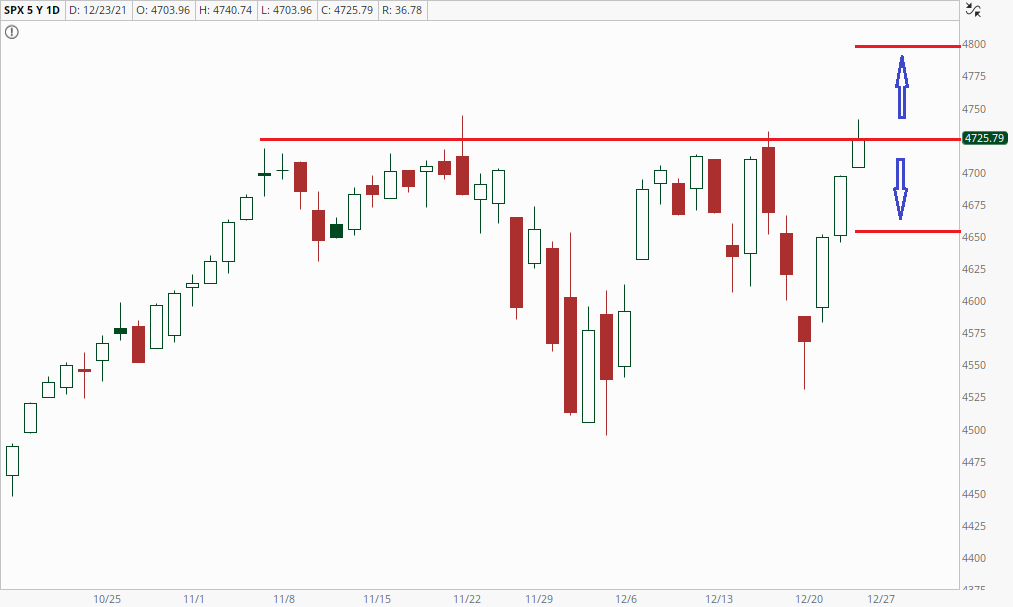
We can place wagers on what will happen, but a failure to see a Santa Clause rally materialize, although infrequent, hasn’t provided the best returns in January or the coming year. The following chart below from LML Financial provides a little perspective.
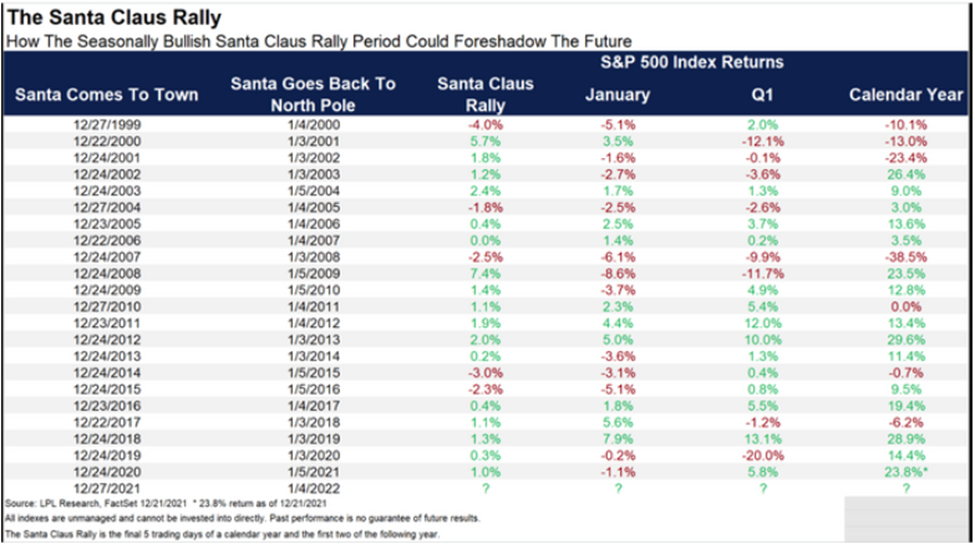
Since 1999, there have only been five times that the rally hasn’t happened. During those five episodes, the market has fallen on average 2.72%. All five of those instances produced a negative return in January. On Three of the five years the market produced a negative return the next calendar year.
Conclusion
The Santa Claus Rally has been a market standard for decades and expectations are high that he will deliver again this year. However, history shows the potential for a negative year for the S&P 500 without a good finish to 2021 and a start to 2022. The timing is apropos given the expectation the Fed will finish tapering next year and begin raising interest rates. A failure to rally the next 7 trading days may end up meaning a whole year without Santa.
Wondering when to hedge? See how unlocking the Vomma Zone can help you better understand when volatility is about to rise.
Want learn more about how to work with me? Check out Trader by Your Side!
Not a subscriber? Become a TheoTrade member