

Christmas Eve morning, I did something most traders never do.
I went backward.
Not to relive trades I missed or second-guess decisions I made. I went back to validate the setups themselves. To answer a simple question that separates confident traders from uncertain ones.
"All we're doing in this homework process is we're going back and validating the setups."
Why Homework Exists
Trading is emotional because money is involved.
"Money creates emotion. There's just no doubt about it. We want to avoid pain. We want everything to go our way at all times."
When things go against us, emotions creep in. We make decisions based on feelings instead of probabilities. We override our system because something feels wrong.
Homework is the antidote.
"I want to react based on a probability, based on price action."
The homework process removes the guesswork. You go back through historical price action and ask one question. Did the setup pay?
Not whether you took the trade. Not whether you managed it perfectly. Just whether the setup itself delivered at least four points if you had executed it correctly.
Fixed Entries, Fixed Risk
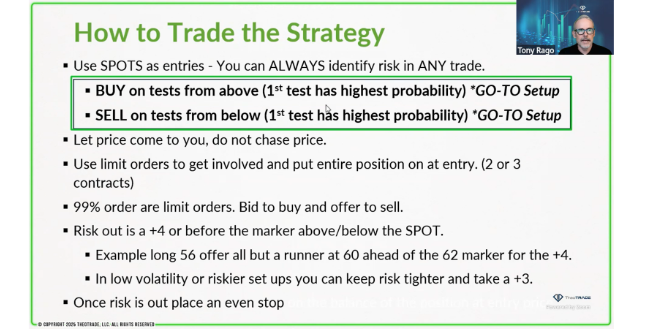
The Golden Setup methodology uses fixed entries and fixed risk.
That structure makes homework possible. You know exactly where you would have entered. You know exactly where your stop would have been. All that remains is checking whether price reached your target.
"If we buy on a test from above, does it pay us? Does it reach up to pay us at least four points?"
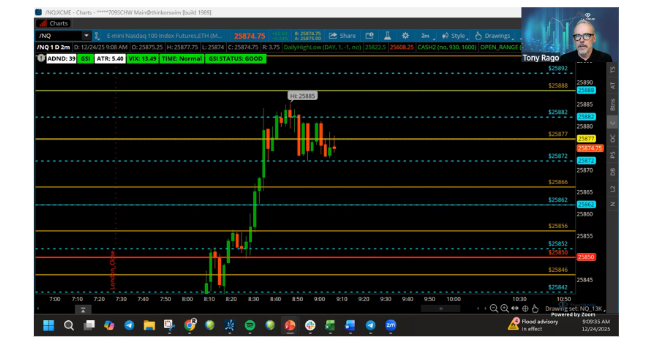
I asked traders in the room to pick a random day. Andre said November 10th. Pete said December 10th. We pulled up the charts and walked through each setup mechanically.
Short from below at the 46. Did it pay? Yes.
Long from above at the 26. Did it pay? Check the chart.
"We're just going back and looking to see if in fact, this would have quote unquote paid us."
What Homework Actually Reveals
December 10th brought big volatility. Bars measuring 50 points each. The kind of tape that makes most traders nervous.
"If the ATR is plus 40, because these bars are all 50 points each, I'm not even trading this."
So we pushed out to 7:00 AM when volatility settled. Then we started counting.
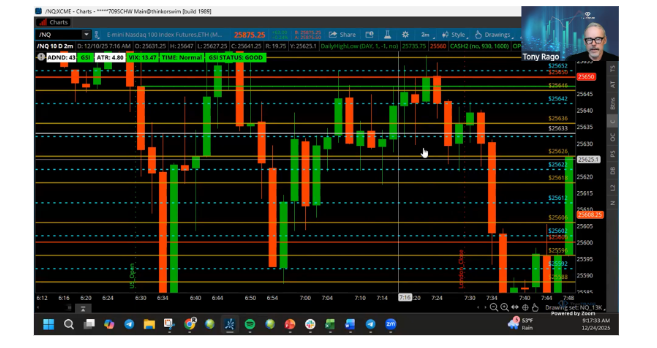
One setup caught my attention. A long from above that failed. The bar opened high, came down to the level, balanced briefly, then broke lower.
"Why do you guys think that this failed?"
The answer was sitting right there on the chart. That level had already been tested three times. First test, it held. Second test, it held. Third test, it held.
By the fourth approach, the probability had shifted.
"First test has the highest probability."
The Pre-Flight Checklist
This is why homework matters. It teaches you to look left before you click.
"There's like a pre-flight checklist when you're gonna trade like this. We are accepting risk, but we're trying to put our best foot forward."
Has this setup already worked? How many times has this level been tested? Is the probability still in my favor?
"Has this setup already worked? Yes, it has three fricking times basically. Can we expect it to work again?"
The answer on that fourth test was no. And the homework proved it.
Validation Builds Conviction
Most traders struggle with execution because they lack conviction.
They see a level on their chart. They think they should take the trade. But something holds them back. Doubt creeps in. They hesitate. Price moves without them.
Or worse, they take the trade but bail at the first sign of heat. The setup would have worked, but they didn't trust it enough to let it play out.
Homework solves this problem.
When you have validated the setups across dozens of days, across different market conditions, across volatile and quiet tapes, you know what to expect. You've seen the levels work. You've watched price respect the 50s and the round numbers over and over again.
"What I have done with the NQ specifically is I've mapped out fixed entries and fixed risk. Trying to remove like, hey, should I buy, should I sell? Just probability."
The doubt disappears because you've already done the work.
Stay in Trades That Work
Homework also revealed a common mistake.
One trader asked about flipping from short to long after hitting a target. He wanted to catch every move in both directions. Maximize the opportunity.
I pulled up a chart where a short from the 46 was working beautifully. Price breaking lower, momentum on his side, trade in profit.
"If this situation affords us an entry short and price is going that way, stay in the trade."
Why would you exit a working trade just to flip the other direction? That's not trading. That's video gaming the market.
"There's no reason whatsoever to say, hey, I'm going to flip long right here, right now after shorting this right here."
Homework teaches you this. When a setup works, you see how far it can run. You learn to hold winners instead of cutting them short to chase the next trade.
How to Do This Yourself
Pick a random day from the past two weeks.
Pull up your chart. Mark the levels. Then walk through bar by bar asking the same questions I asked on Christmas Eve.
Did the short from below pay? Did the long from above reach the target? How many times was the level tested before the setup fired?
You're not trying to replay your actual trades. You're validating the methodology itself.
"All you're doing by doing this homework, you're not, I'm not telling you guys that I did this this morning. I'm just going back and looking to see if in fact, this would have quote unquote paid us."
Do this for ten days. Then twenty. Watch the patterns emerge.
Watch how first tests have the highest probability. Watch how levels get exhausted after multiple touches. Watch how the setups work when you give them room and fail when you're too tight.
The conviction follows naturally.
The Work That Pays
Friday brings a full market session. The levels will be marked. The setups will appear.
The traders who did their homework will execute with confidence. They've seen the methodology work across multiple conditions. They know what to expect. They trust the process.
Everyone else will be guessing.
"We can dovetail on this little exercise of homework that we had today. Or if we have a market to trade, we will do that. Because that's a lot more fun."
See you in the room.
Tony Rago
Creator of the Golden Setup