Don Kaufman here.
I was staring at two butterflies this morning and the market wanted to charge me $1.15 for a call butterfly that I could get for 35 cents on the put side.
Same damn trade.
This is exactly why most traders lose money - they don't understand how skew is robbing them blind.
Here's what happened.
We were in one of those "slop fest" days where the S&P was basically dead flat, down a whopping 9 handles.
Perfect butterfly weather, right?
So I looked at two butterflies: one targeting the downside around 6560, another targeting 6730 on the upside. Both $15 wide. 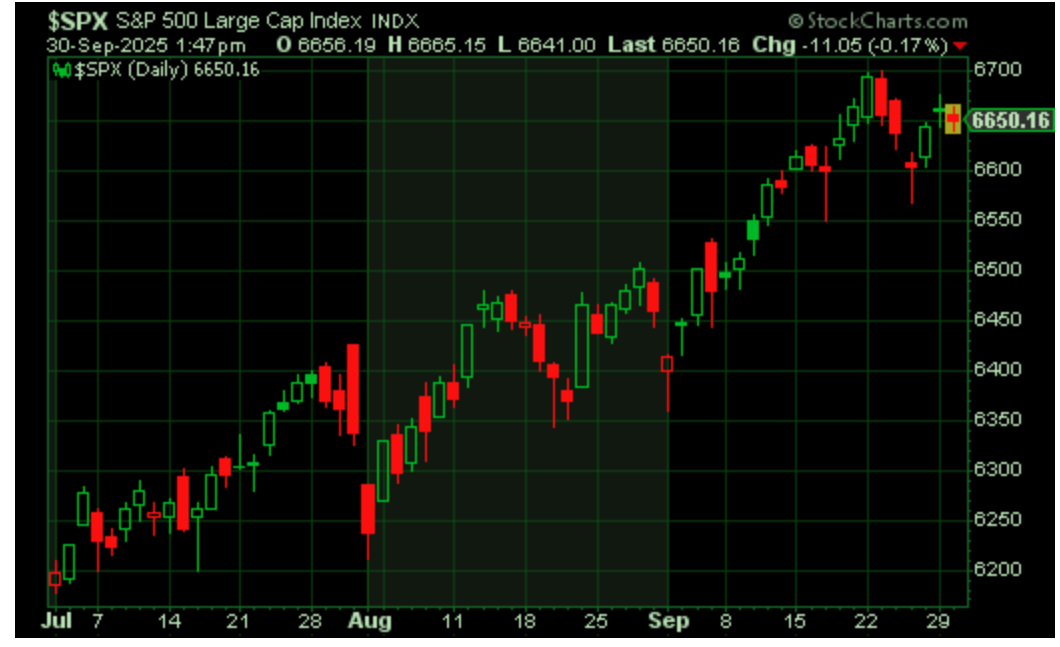
Both targeting roughly the same distance from current levels.
The put butterfly? Trading for 35 cents.
The call butterfly? Over a dollar.
Holy crap.
How can you make a logical argument that you should buy the call butterfly over the put butterfly?
You can't. I wouldn't do it, and I wanted to show you exactly why.
The Trade I Actually Made
Here's what I did instead in our main chatroom:
SPX Put Butterfly - October 3rd Expiration
- Bought 6575 puts
- Sold 6560 puts (2x)
- Bought 6545 puts
- Net cost: $0.35
This is my "low probability shot of the week."
But when you're getting 3:1 better pricing on one side, that's where smart money goes.
I mean, you'd be paying three times more for the same damn trade on the call side. I will not do it.
Why This Pricing Existed
Here's the thing - when skew was elevated like it was this morning (sitting at 143, which is historically high), the market was basically screaming: "We're more worried about crashes than melt-ups."
That fear premium gets baked into every call you buy and every put you sell.
So when everyone was buying calls because "NVIDIA to the moon," you were paying for their optimism.
Meanwhile, puts were relatively cheap because nobody wanted crash protection when everything felt good.
The Setup
We started the week at 6644.
I'm targeting 6560 - that's about where the lower expected move sits for this week.
If SPX trades down to that level by Friday, this 35-cent bet could work out.
Maybe we'll get some selling pressure from government shutdown noise, end-of-quarter positioning, who knows.
The beauty of butterflies? I know exactly what I'm risking (35 cents) and exactly where I need the market to go (6560 by expiration). Limited risk, defined reward.
This Reminded Me of Something
I've been trading for decades, and this skew differential reminded me of what Dell was doing in the 1990s.
They were literally making more money selling puts on their own stock than selling computers. That's not a typo - they made more on option premiums than their core business.
The financial engineering happening right now with NVIDIA makes Dell's strategy look quaint.
We're talking about trillions in interconnected deals where NVIDIA buys stakes in companies that exclusively buy NVIDIA chips. It's the circle of life, but with semiconductors.
What You Should Take Away
Before you place any trade, especially in this environment:
First, check both sides. Always price the bullish and bearish version of the same trade.
Second, respect the skew. When premiums are this lopsided, the market knows something you don't.
Third, take the path of least resistance. Why pay $1.15 when 35 cents gets you the same risk/reward profile?
Look, this trade will work if we get some selling pressure this week. Given all the noise out there and the fact that September didn't really happen volatility-wise, there's a decent shot we'll see some movement.
But remember: This is a low-probability shot. I'm not betting the farm. It's 35 cents of defined risk for a specific directional view. Sometimes the market gives you gifts in the form of skew differentials. When it does, you take them.
I put this trade on in the TheoTrade Main Chatroom, if you’re not a subscriber, and would like to follow along on this trade and others, click here to join.