


The ES needs to hold $6575.
That’s what I told Gianni Di Poce.
Otherwise, we’re heading to $6300.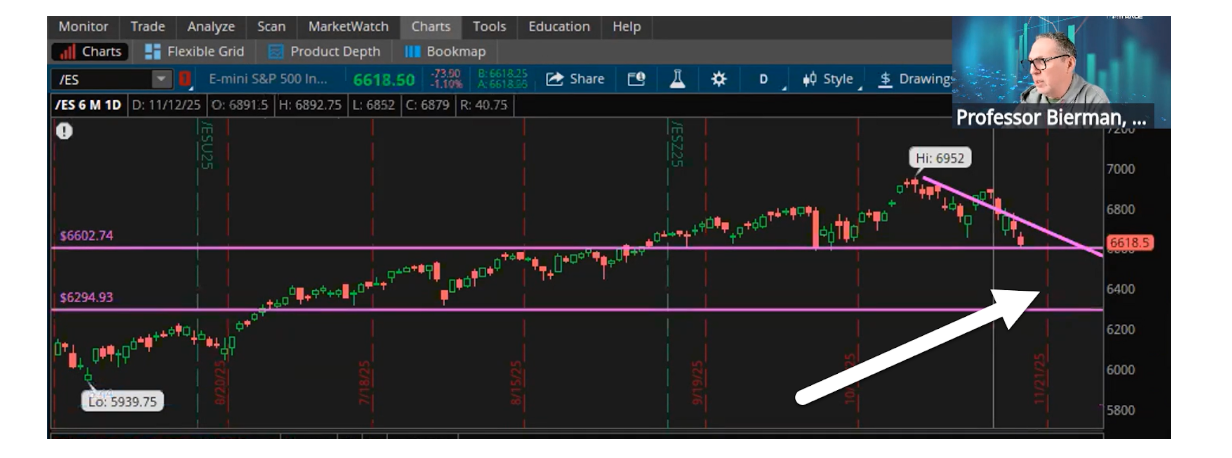
I track the Genesis COG across three timeframes: Weekly, daily, and intraday.
For seven months, all three pointed up. Algorithms defended every dip. Systematic buying rescued every selloff.
That ended yesterday. All three timeframes broke below their critical thresholds simultaneously.
The S&P dropped through 6,575. Three weeks of selling accelerated into systematic liquidation.
When all three timeframes break together, algorithmic behavior shifts from accumulation to distribution. The buying support disappears.
Give me five minutes to show you how and why, so you survive this correction rather than let it destroy you.
The Three Timeframes That Just Broke
The Genesis COG measures algorithmic momentum across three distinct timeframes.
- Weekly shows the long-term trend direction.
- Daily captures intermediate moves.
- Intraday reveals immediate order flow.
For seven months, all three pointed up. Machines bought every dip.
That coordination just shattered.
The weekly broke first. Then the daily accelerated lower. Now intraday confirms the breakdown. When this convergence happens, algorithms flip from buying dips to selling bounces.
I call this a glacial move. Like a glacier grinding forward, nothing stops it until mathematical gravity points force a pause.
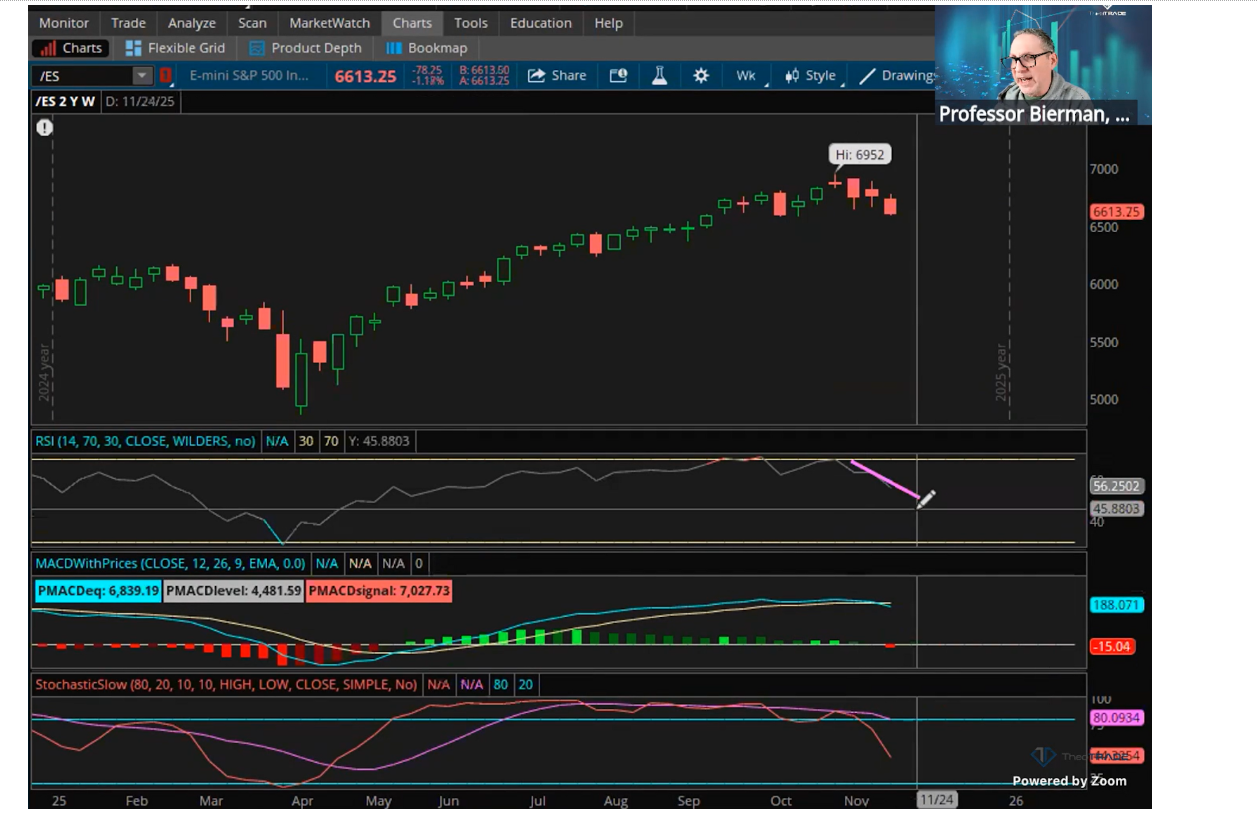
There are two potential stopping points.
The 50 level sits around 6,500 on the S&P. The 40 level drops to 6,300 if the first support fails.
These aren't arbitrary numbers. They represent mathematical thresholds where algorithmic buying programs historically reactivate.
But here's what matters right now. We're at negative 10 on my indicator scale. The full correction cycle needs to reach negative 28. We're not even one-tenth through this move.
Even if we bounce off 6,500, it won't change the thesis. Once you cross the Rubicon, temporary victories don't reverse the war.
Window Dressing Won't Save This
Fund managers will try propping this market up over the next few weeks. They need decent fourth-quarter numbers. They'll pump sacred cow stocks. They'll create temporary rallies.
Don't be fooled.
Year-end window dressing creates noise. It doesn't change algorithmic tide. The machines controlling 90% of daily volume don't trade quarterly performance metrics. They follow momentum confirmation signals.
Until the Genesis COG recrosses above its threshold on the weekly chart, every bounce is a selling opportunity. Period.
I've watched this pattern play out dozens of times. The 2000 tech bubble. The 2008 financial crisis. The 2022 inflation correction.
Once all three timeframes break simultaneously, the selling doesn't stop until mathematical reversion completes. This correction needs to cycle all the way down and retest the bottom.
The Defensive Rotation Already Started
Healthcare just hit 40-year low valuations. Pharma trades cheaper than it has in four decades. Everyone abandoned defensive sectors to chase AI.
That's reversing now.
Money has been bleeding out of tech for a month. Systematic selling in mega-cap growth. That capital moved directly into healthcare and biotech.
This isn't random. This is algorithmic repositioning for correction environments.
When markets correct, machines rotate into defensive sectors with stable earnings and low valuations. Healthcare fits both criteria. Medtronic just broke to new highs on strong earnings. Sequential growth from $1.26 to $1.36. Confirmed guidance.
In correction environments, certainty becomes the most valuable asset. Healthcare provides that certainty while tech multiples compress.
The rotation pattern shows up clearly in the data. Tech bleeding for weeks. Healthcare building bases and breaking out. Biotech showing relative strength despite broader weakness.
You don't need 60% portfolio allocation to healthcare. But zero defensive exposure right now means fighting the algorithmic tide.
Your Position Right Now
Don't try to time the exact bottom. You'll fail. I've been doing this for decades and I can't predict the day or hour when this correction ends.
What I can tell you is this: the Genesis COG crossed its Rubicon. All three timeframes broke. The systematic selling has begun. This correction will cycle down to at least the 50 level and probably the 40.
Position accordingly. Reduce exposure on any rallies. Take profits on extended positions. Stop buying dips in broken stocks just because they worked for six months.
The rules changed. The algorithmic programming shifted from systematic buying to systematic selling. If you don't adjust with it, your account will pay the price.
I'm rotating into healthcare names with strong fundamentals and low valuations. I'm watching the Genesis COG for signs the 50 level might hold. I'm prepared for this to grind lower until the indicator completes its full cycle.
That's how you survive corrections that destroy unprepared accounts. You recognize when the Rubicon has been crossed. You adjust your strategy accordingly. You don't fight glacial moves that can't be stopped.
The Genesis COG System provides the framework for navigating these transitions. It shows you when algorithmic behavior shifts from buying to selling.
When short-term noise matters versus when multi-timeframe breaks signal systematic repositioning. When corrections are temporary versus when you've crossed a point of no return.
Stop fighting the algorithmic tide. Start tracking the mechanical signals that tell you when the machines have changed their programming.
Professor Jeffrey Bierman
Creator of the Genesis COG System