


Hey trader,
Nobody is buying calls right now. Not on equities.
Dealer desks are reporting a near-total absence of call buying at the institutional level. The Ghost Prints Surveillance Console confirmed it today.
When I filtered for block trades across all names, nearly every significant print was bearish.
Puts on Colgate, puts on Procter & Gamble, puts on XLF.
Then gold showed up.
The Console flagged a call spread in GLD involving 55,733 contracts on each leg, all executed in a single print.
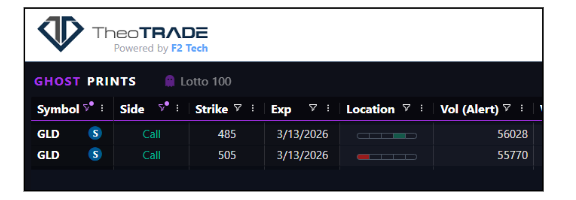
The long side bought the $485 call. The short side sold the $505 call for March 13 expiration.
In a session where every other institutional print pointed down, this was the one massive bullish bet on the board.
It landed in the one asset class that has significantly outperformed the S&P 500 over the past several months.
We are going to break down why this trade was built as a spread, what the surrounding bearish equity flow tells you about where capital is rotating, and how to structure your own exposure around the setup.
What the Console Caught
The Ghost Prints Console flagged this as a spread trade in GLD.
The $485 calls were bought near the ask. The $505 calls were sold at the same time.
When I opened time and sales and filtered for trades above 100 contracts, the picture became clear. Someone executed 55,733 contracts on each leg in a single print.
The $485 call carried a 36 delta. The $505 call carried a 15 delta.
These are not far-out-of-the-money lottery tickets. A 36 delta means roughly a 36% probability of expiring in the money.
That places the long leg close enough to the current price to carry real directional force.
GLD was slightly below $485 when the trade hit. The long strike sits just out of the money and the $505 short strike sits roughly 4% above the current price.
The March 13 expiration gives this position about 17 days to work.
Why a Spread and Not Outright Calls
GLD implied volatility sits at the 66th percentile. Options are priced in the upper end of their recent range.
When implied volatility is elevated, outright call purchases carry expensive premium. Theta decays more aggressively because you paid more to get in.
A vertical spread manages that cost. Selling the $505 call against the $485 long call collects premium that offsets the inflated price of the long leg.
The tradeoff is a capped upside. The spread cannot be worth more than $20 at expiration regardless of how far gold runs.
But the net cost drops substantially. The breakeven level moves closer to the current price.
For a 55,733-contract position, that cost reduction is not minor. At this scale, even a small improvement in net debit translates to millions of dollars in reduced capital at risk.
The Macro Context Behind the Bet
Gold has significantly outperformed the S&P 500 over the past several months. Equities have churned sideways while gold has trended higher.
That divergence is showing up in institutional flow. Equity call buying has dried up at the dealer level.
Skew on the S&P 500 broke higher on October 10 and has remained elevated since. The VIX has been grinding higher for over a month as put buying outpaces call selling.
The rest of the Console was dominated by bearish positioning:
- Colgate-Palmolive saw 7,300 put contracts in two prints
- Procter & Gamble absorbed 3,850 puts at the $155 strike
- XLF had 20,000 puts rolled from $48 down and out to $40
Against that backdrop, a 55,733-contract bullish call spread in GLD stands out as the most convicted directional bet of the session.
How to Structure Exposure
The institutional trade provides four inputs: symbol (GLD), direction (bullish), target ($505), and timeframe (March 13).
GLD's implied volatility at the 66th percentile makes spread structures the more efficient vehicle. Here is a call vertical worth examining at approximately 37 days out:
- Buy the $492 call at 31.8% implied volatility
- Sell the $494 call at 32% implied volatility
- Cost: approximately 65 cents as a debit
- Skew edge: slight, with the short leg carrying marginally higher volatility
- Maximum risk: 65 cents paid
- Target: GLD reaching $492 or above
Liquidity is not a concern. GLD options carry open interest in the hundreds to thousands across active strikes, with tight bid-ask spreads even in the weeklies.
If GLD pushes through the $485 long strike on the institutional trade, delta on that leg accelerates. The short leg remains further out of the money, and the spread expands.
What This Print Means for the Broader Market
Every equity block trade today was bearish. The only major bullish print landed in gold.
Institutions are not positioned for an equity breakout. They are hedging downside across financials, consumer staples, and broad indices while committing significant capital to gold.
The Ghost Prints Console caught every one of these prints as they happened. The bearish flow in CL, PG, and XLF alongside the massive bullish bet in GLD.
That combination paints a clear picture of where institutional capital is flowing and where it is not.
As long as equity uncertainty persists and put buying dominates the options landscape, gold remains the asset class absorbing the flow. The Console will show you whether institutional money adds to this position or lets it expire.
See exactly how Ghost Prints reveals institutional positioning before the crowd catches on.
Brandon Chapman, CMT
Creator of Ghost Prints