


Hey trader,
Iran saber rattling is back.
While most traders are watching crude futures, someone just made a 47,000-contract bet in American Airlines.
The Ghost Prints Surveillance Console flagged the trade this morning. The size alone makes it one of the largest single-session prints in AAL in recent memory.
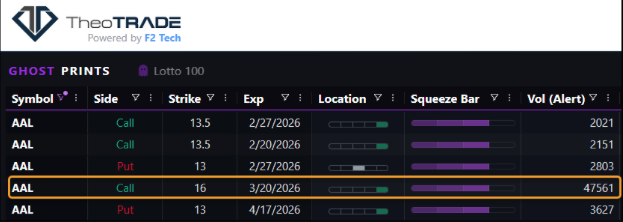
This is not a retail trade.
Retail traders don't move 47,000 contracts in a single session. The read on this positioning is a bet on one of two things: oil prices declining from current levels, which would relieve cost pressure on airlines, or rising consumer demand that fills seats regardless of fuel costs.
Either outcome is bullish for AAL.
But the trade itself reveals something more important than the directional bet.
Understanding why AAL was chosen as the vehicle tells you more than the trade size alone.
You can avoid the trade setup where most traders get trapped.
The squeeze trap. It happens when a short squeeze gets started, only to evaporate. Miserably.
A gamma squeeze play can be great. The Ghost Prints Surveillance Console lit up opportunities on KSS (375% in 13 days), PLUG (206% in 5 days), and on VFC (100% in just 24 hours).
Of course you want to find these excellent opportunities.
Along the way you need to skip over the pit of despair, the trap waiting to suck you in.
👉 Check out my latest Squeeze Traps secession to see the Console in action live.
Why Airlines Price in Oil Before Oil Moves
Crude prices respond to headlines. Airlines respond to crude.
That chain of causality means airline stocks often absorb the expectation of an oil move before the futures market fully prices it in. Fuel is the single largest operating cost for a carrier like AAL.
When institutional money expects oil to decline, airline equities become the leveraged expression of that view. The stock moves faster than crude because it translates fuel cost savings directly into margin expansion.
The inverse is also true. A spike in crude from an Iran supply disruption hits AAL quickly.
Defined-risk options structure means the downside is capped regardless of which way oil moves.
That is what makes this an institutional vehicle rather than a speculative swing.
The choice of vehicle matters.
American Airlines is one of the most liquid options markets among airline stocks. Open interest runs into the tens of thousands of contracts across active expirations, and the bid-ask spread on standard strikes runs just 4 to 6 cents wide.
A 47,000-contract trade needs that kind of liquidity.
Illiquid markets penalize large buyers through wide spreads and price impact. AAL absorbs this size without significant slippage, which is exactly what a large institution needs when building a position around a fast-moving catalyst.
What the Console Caught
The Ghost Prints Console flagged this print in real time this morning, before the oil headlines finished circulating.
That sequencing matters.
By the time a trade like this shows up in the financial press, the entry has already passed. The Console works at the speed of institutional order flow, not the speed of commentary.
It surfaces the footprint as it's being placed. That gives you the context to evaluate the setup while the window is still open.
AAL has been trading around $13.32.
The January 29 session established a clear support level at $13.17. Buyers showed up there and defended it.
That level is the technical anchor for any bullish position here.
If AAL closes below $13.17 on follow-through volume, the bullish thesis weakens. The distance between current price and that level is narrow, which means the risk of being wrong is quantifiable before you enter.
How to Structure Exposure
The April 17 expiration offers a $12 strike call with a 73 delta at current prices.
That option moves approximately 73 cents for every dollar AAL moves, making it a close proxy for owning the stock itself. The mid price sits around $1.91.
Of that $1.91, $1.32 is intrinsic value. The remaining 59 cents is extrinsic, the portion that decays with time.
With 57 days remaining, that extrinsic decay is manageable. You have enough time for the oil catalyst to develop without theta consuming the position before it has a chance to work.
The defined risk means you can size the position without worrying that an overnight headline gap takes you past your intended stop.
The Bigger Picture
A 47,000-contract institutional print in an airline, timed to active Iran tensions, is not a coincidence.
It reflects a specific view about how geopolitical risk interacts with fuel costs, consumer demand, and equity pricing.
The Ghost Prints Console caught this trade as it was happening. That is what forensic-grade pressure detection does.
It doesn't wait for price confirmation. It reads the footprint while the position is being built.
By the time price confirms the thesis, the best entries are gone. The Console puts you in the conversation early, when the setup still has room to develop.
The Iran situation is still unresolved. The oil market is still pricing uncertainty. And a 47,000-contract institutional bet is sitting in AAL right now.
The question is whether you see that information when it's actionable, or after it's too late.
Brandon Chapman, CMT
Creator of Ghost Prints