


Hey trader,
After all my presentations yesterday, I noticed something on the Ghost Prints Surveillance Console that caught my eye.
Someone knew the selloff was coming…
…and they bought almost 400 at-the-money contracts of QQQ 607 strike expiring the very next day.
It is a dramatic overnight hedge capable of protecting losses on a $24 million position.
While the buyer of those contracts is celebrating their success for today, perhaps they shouldn’t celebrate too early. More selling is coming.
The Breadth Signal Most Traders Ignore
Market breadth measures what's happening beneath the surface. When the market truly capitulates, you see extreme readings. Nine declining stocks for every advancing stock. Nine dollars of volume in declining issues for every dollar in advancing issues.
That's a 90% day. That's when sellers exhaust themselves. That's when smart money starts buying.
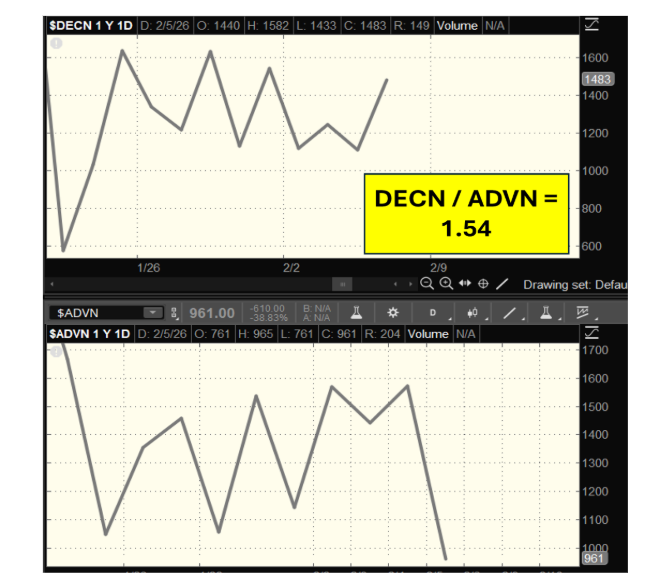
We didn't get close yesterday. Not even halfway there. A DECN to ADVN ratio of 1.54 means declining issues only outnumbered advancing issues by 54%.
The DVOL to UVOL ratio of .58 shows declining volume was actually less than advancing volume.
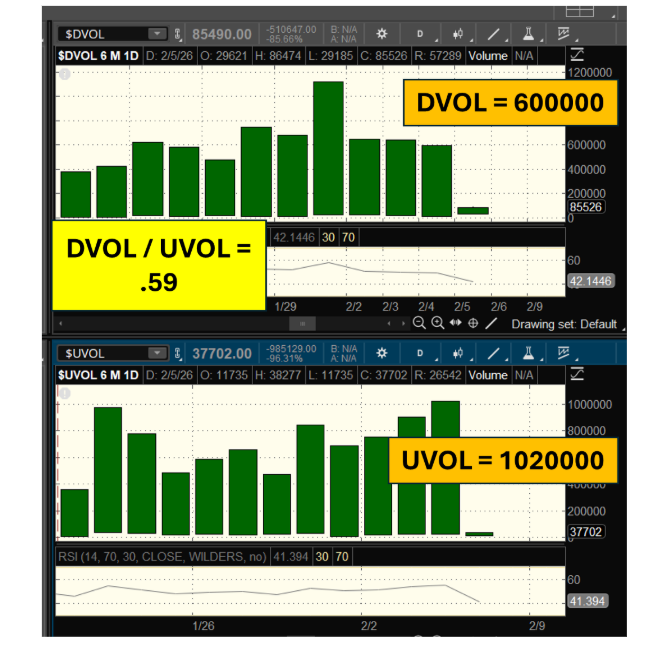
This wasn't capitulation. This was a garden-variety selloff that got bought up at the end of the session. The kind of action that happens when the real pain hasn't started yet.
Why 90% Days Matter for Your Trading
During the 2020 volatility, four distinct 90% days marked major market lows. June 11th. June 24th. September 23rd. October 28th. Each time the market hit that extreme breadth reading, it marked a significant turning point.
Those dates would have been perfect entries for bullish positions. But you needed the breadth data to know when to pull the trigger.
The indicators are straightforward. Take declining NYSE issues and divide by advancing issues. If the ratio exceeds nine, you have extreme selling pressure. Do the same with volume. DVOL divided by UVOL. When both indicators spike above nine simultaneously, you've got your signal.
Right now, we're not even close. Yesterday's readings suggest the market has plenty of room to fall before we see true capitulation. Institutions haven't panicked. Retail hasn't capitulated. The selling pressure that defines a bottom simply isn't there yet.
The Trade Setup Hiding in Plain Sight
While breadth indicators point to more downside, option flow is telling us where smart money is positioned. Massive put buying in miners. Bearish activity in silver. These aren't random trades. They're institutional hedges against what's coming next.
The Ghost Prints Console caught these signals in real time. Not after the fact. While most traders were looking at price charts, the surveillance system flagged unusual activity that telegraphed the move days early.
This is why breadth matters. You can't time bottoms with price action alone. You need to see what's happening across the entire market. When 90% of stocks are declining on 90% of the volume, that's your signal. Not before.
Until we see those extreme readings, every bounce is a gift. A chance to reduce exposure. A chance to position for the move lower that breadth is forecasting.
The current setup favors bears, not bulls. Forward volatility expectations remain elevated. Hedging costs are high. The market is telling you to be cautious, even as price tries to rally.
What Happens Next
We're in the middle innings of this correction. Not the end. Yesterday's weak breadth readings confirm it. The market needs to flush out more participants before it can establish a sustainable low.
That means more volatility ahead. More whipsaw moves that shake out weak hands. More days where the market rallies in the morning and sells off by the close.
Smart traders are watching breadth, not price. They're waiting for that 90% day signal. They're positioned for downside while everyone else is buying the dip.
I'll break down the specific option trades that work in this environment during tonight's Ghost Hour at 7:00 PM EST. You'll see how to structure bearish spreads that profit from continued weakness. How to use breadth indicators to time entries. How to identify when the real bottom finally arrives.
The market failed its most important test yesterday. The breadth numbers prove it. The question is whether you're positioned for what comes next.
Join me to see the exact trades smart money is making right now.
Brandon Chapman, CMT
Creator of Ghost Prints