
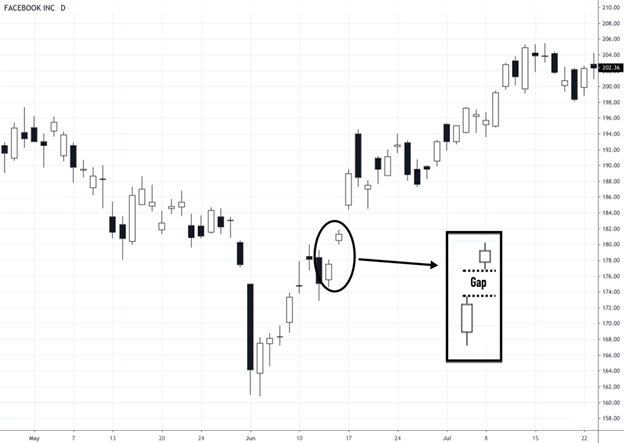
Since we’re in the midst of earnings season, many companies announce either after the market closes or before the market opens. As a result, the opening price may be disconnected from the rest of the chart. The failure to overlap trading ranges is called a gap or window. Window’s can give you an indication of directional sentiment and an area of support. Using rising windows may give you an idea of how to trade overnight and gaps in the price.
Rising window Basics
Since the equity market is closed for most of the day, the opportunity for news and other events to move the price the next morning is high. Frequently, the price will open differently than it closed, and an opening gap or window is established. However, most of the time the price volatility will cause the shadows or body to overlap. One of the biggest takeaways of the rising window is that the low of the candle that gapped should act as support.
Overall Rating: 3 Star
Directional Bias: Bullish Continuation
Number of Candles: 2
Frequency Rating: 4 Star
Pattern Description:
This rising window pattern occurs within an uptrend in the price. The pattern begins with a gap from the previous day’s closing price with no overlap in the shadows. Both of the candles in the formation should be open candles, closing higher than the open.
Volume Description:
Rising volume throughout the formation of the window increases performance.
Statistical Notes:
Price will frequently trade into the gap following the formation. Rising windows that occur early in a bullish primary trend are stronger than one’s that occur late in a trend.
Measuring Technique:
This type of window pattern will typically occur at the midpoint of the move. The target is calculated by subtracting the movement from the middle of the gap to previous low. That value is added to the middle of the gap.
Conclusion
Rising windows provide an excellent want of determining risk on a trade that is overextended already. The understanding of the support provided, and the potential measured move helps a trader analyze the opportunity and the risk. This is a key point for any trade taken.
Wondering when to hedge? See how unlocking the Vomma Zone can help you better understand when volatility is about to rise.
Want learn more about how to work with me? Check out Trader by Your Side!
Not a subscriber? Become a TheoTrade member.