One the hallmarks of a frothy stock market are when a litany of stocks are going parabolic. A parabolic move is when the angle of stock price movement is north of 60 degrees. While that is a general definition, it doesn’t speak to the potential unsustainability of movement without other considerations.
While price is “king,” it doesn’t tell the full story and may not alert the trader to major potential reversals in the price. Incorporating volume helps add depth to the price action by seeing the number of shares being traded.
Adding volume helps. But that only gives you two-thirds of the picture. This is where float analysis comes in. Incorporating float allows you to see how frequently the ownership of the company is turning over.

What is the Float?
The float is the number of shares that are available to be traded on any given day. These are the shares held by the general public that don’t have the same restrictions as shares held by insiders.
The float is calculated as follows:
Float = Shares Outstanding - Restricted Shares – Closely-Held Shares
The shares outstanding is the total number of shares issued when a stock goes public. This represents the total number of shares and factors into the market capitalization calculation for valuing a company.
Restricted shares represent the unregistered shares owned by executives and directors. These shares are non-transferrable and has rules provided by the SEC that dictates when they can be traded. An example of restricted shares is during a lock-up period after an initial public offering (IPO).
Closely-held shares are those held by insiders, major shareholders and employees that carry restriction on when they can sell. For example, these rules restrict insider selling after the financials are prepared before an earnings announcement, etc.
Float Analysis
Once you understand float, you can begin to incorporate that information using float analysis. This type of analysis allows you to relate the volume and price action with the size of the float. This provides a key point of analysis when you’re seeing parabolic movement.
The first thing to understand about the float is the size. Stocks like Microsoft Corporation (NASDAQ: MSFT) have large floats in the billions. Whereas FuelCell Energy Inc (NASDAQ: FCEL) has a relatively smaller float of around 213.5 million shares. Other companies have even smaller floats of maybe 40 million shares. Companies with smaller floats have greater potential for volatility than companies with larger floats.
A key point of float analysis is float turnover. During parabolic moves, the volume will typically escalate to historically high levels compared to its average volume. Incorporating float turnover provides even more depth as to how extreme the volume is. The float turnover indicates how many days it takes, using current volume, to fully turnover the floating shares of the company. The float turnover is calculated as follows:
Float Turnover (# of Days) = Float / # Shares Traded (per day)
After completing this calculation, it gives you a perspective as extreme the current market conditions are for a stock. Seeing the entire float turnover in one day is a major indication of a top if selling is beginning to enter into the shares. However, seeing the float turnover every five days or less would indicate unsustainable levels of activity. Seeing a single day turnover is a major heads up for a large reversal in the trend.
Parabolic Example Using Float Analysis
A great example of this type of float analysis on a parabolic stock is FCEL. This stock made a major breakout on November 16 on nearly 100 million shares. That breakout initiated a move from around $3 to the high of $11.31 in seven trading days!
As of this writing, the stock is at $6.68 with the price trading down over 25% today. This move may have caught some bulls by surprise but not if you understand float analysis and the technicals of topping patterns.
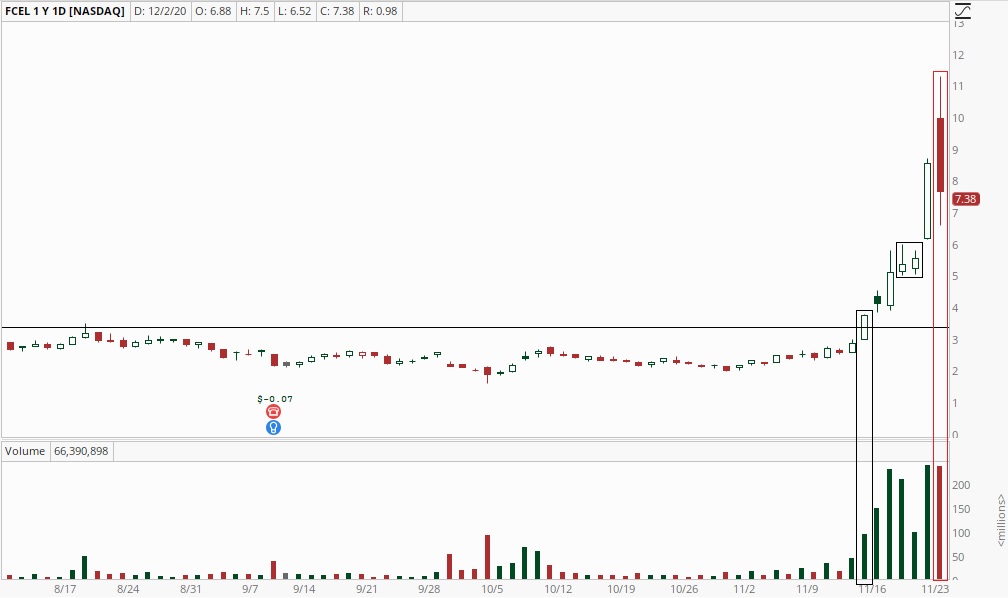
Following the breakout, the volume continued to escalate reaching 231 million shares on November 18. Looking back historically this volume looks significant, but looking at the float gives a whole new perspective. With a float of 213.5 million shares, the entire float turned over in one day!
The float analysis tells you that the parabolic move is in an extreme phase, but the price itself hadn’t indicated a major reversal yet. The previous day was an example of profit-taking with the spinning top candle, but the price quickly closed at a new high on November 18.
As the price progressed to November 19 and November 20, the price was forming similar neutral candles as the buyers and sellers were relatively balanced. On November 19, the entire float nearly turned over that day with nearly 211 million shares traded. The volume dropped to nearly 100 million the next day before breaking out on November 23 on 239 million shares.
While November 23 was very bullish, it was very extreme. That extreme movement finally began to reverse the next day as the price formed a $4.73 range on 237 million volume. This was the first major indication of a likely reversal. If you were long, you’re suddenly looking for an exit.
Parabolic Moves After the Selling
When the selling begins in a parabolic move, there is a pattern that is typically followed. The major distribution day on November 24 set the stage for the trend reversal. Placing lines at the high and low for the that day gives a range for the price to trade in during the coming days.
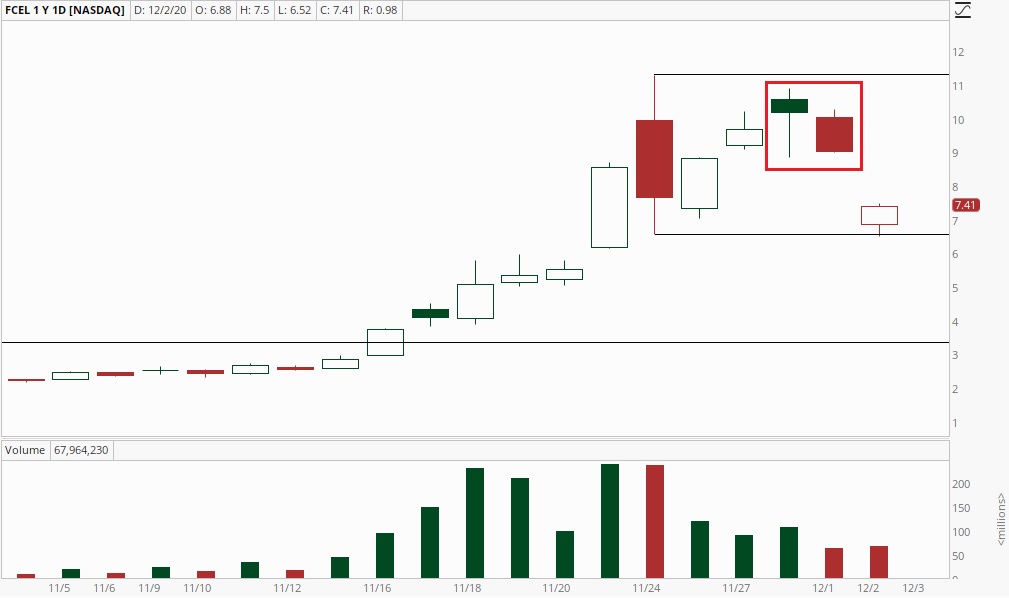
The first point is that the price will test the low of the day. If the price holds, it is highly probable that the price will retest the high of the that session near $11.31. In this case, the price opened slightly lower on November 25, but rallied to close near the high of the day. This led off the rally to retest the high on November 30.
On November 30, the price failed to close above $11.31 and ended with a hanging man candle formation. This is a neutral candle near resistance that reversed the next day. The reversal signal given on December 1 was the indication that the retest phase was over. It’s this type of signal that is a major indication of a trend reversal.
Conclusion
It’s easy to get caught up in a high float turnover, parabolic move. The hard point is understanding when it’s reaching an extreme and when to sell or begin to short. Using float analysis along with price and volume will give you a cipher in decoding these types of trends and identifying major reversals.
Learn how to deal with uncertain markets by learning about the Vomma Zone. Not a subscriber? Become a TheoTrade member.