AGNC Unusual Option Activity Report
The benchmark 10-year U.S. Treasury note saw its biggest intraday sell-off in a while and option traders for AGNC Investment Corp (NASDAQ: AGNC) appeared to take notice. AGNC is a company who invests in mortgage REITs and finds itself in a precarious position since selling off during the Corona Crash.
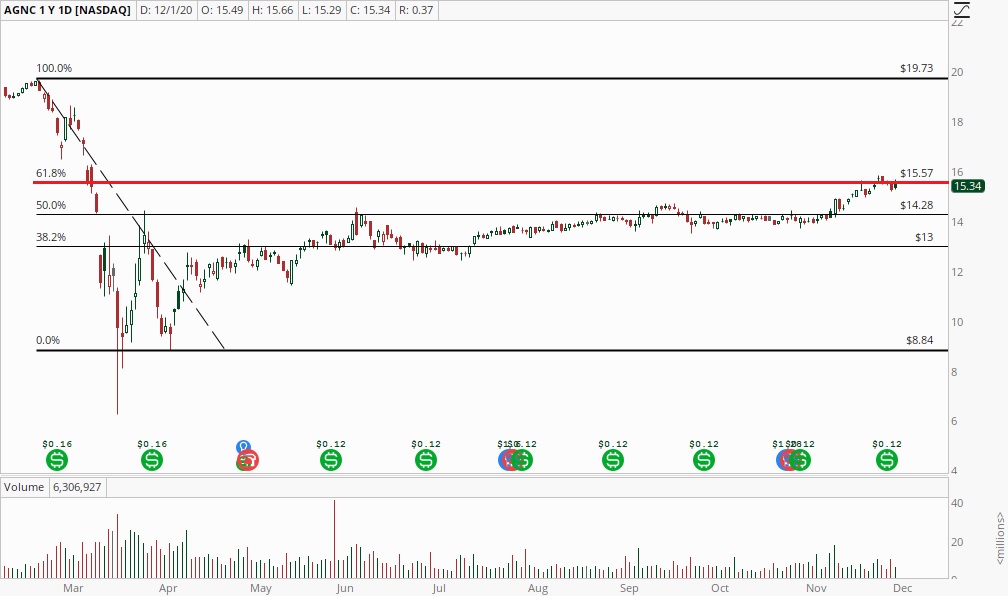
Since the March lows, the stock has rallied from nearly $6 to $16. That’s quite a move but it still hasn’t made back its losses from earlier in the year. The company has certainly been a benefactor from the U.S. Treasury and Federal Reserves programs to buy mortgage backed securities, but the future is still dimly lit for interest rates, income, risk of default, and housing market prices.
Understanding the risks of Mortgage REITs is pivotal to understanding the difficult situation that is presenting itself.

AGNC Mortgage REIT Risks
In order to understand the risks, it’s important to understand why people look to REITs like AGNC in the first place. AGNC currently pays a 9.41% dividend yield. That is certainly an attractive yield! However, with great yield, comes higher risk.
Here is the breakdown of the risks:
- Borrowing costs
- Interest rate risk
- Reinvestment risk
- Default risk
Borrowing Costs
You might be wondering how AGNC that invests in mortgage bonds could generate enough return to pay that high of a yield. Certainly, mortgage holders aren’t paying that amount to borrow and REITs.
This is where the risk lies. These companies are heavily leveraged. They take the predictable return these bonds provide and borrow against them. If borrowing costs rise, the net return of their investment declines.
Right now, the Fed buying programs have eased the risk premiums that many companies are paying over Treasury yields. However, this isn’t a gravy train that will last forever and a sharp rise in the 10-year today should be a warning sign.
Interest Rate Risk
If the 10-year Treasury yield were to rise above 1% to 2% or 3%, there will be an effect on mortgage REITs. I already discussed the issues regarding borrowing costs, but there is another issue. Rising Treasury yields will cause the origination of new mortgages to carry a higher yield.
That means that mortgages held at lower yields will lose value. This is because investors are going to be less willing to pay full price for a bond that is paying a 3% yield compared to a 4% yield. For AGNC, rising yields would typically be bearish for the stock.
Reinvestment Risk
When the 10-year yields began to fall significantly in 2018, the decline in mortgage rates wasn’t as positive for AGNC as you would have anticipated. Typically, the falling yields would make the company’s existing portfolio worth more money since those mortgages would carry higher yields.
Part of the reason for the negative impact on REITs like AGNC was refinancing. This new cycle of refinancing caused many of the existing mortgages to be refinanced and paid off. The previously higher yield was being replaced by lower yielding bonds or other investments like U.S. Treasuries.
The result of falling yields on Treasuries resulted in an overall lower return for these types of companies.
Default Risk
At this point, we haven’t had to deal with a large-scale default in the U.S. Part of the reason for that was the forbearance initiative that was part of the CARES Act. This allowed mortgage holders to suspend their mortgage payment for up to six months. This timeframe could potentially be extended, but there are a significant number of mortgages at risk of defaulting on their loan.
AGNC Option Activity
The overall option volume today was only about 66% the average. However, the put option volume was nearly twice the 5-day average. Most of the put activity got filled between the market at 65% and out-of-the-money with a 0 to 0.20 delta. Here’s a break down of the significant activity:
- 5,646 15 JAN 21 $15 puts BOT @ $0.32 to $0.34 mostly in one print
This activity was against an open interest of 2,191 and has 45 days to expiration. The breakeven on the trade is around $14.66.
AGNC Chart
AGNC has had an easy ride higher over the past 8 months with only periods of consolidation and no major corrections. However, the price has carried to a key level at the 61.8% retracement level. This is a pivotal point where the price will either retest its February highs of correct from here. The answer may be more fundamental, but the chart provides a key point of awareness the important technical positions it’s in.
Conclusion
This is a point in the trend of AGNC where you analyze the upside opportunity versus the downside potential. At this point, it would be reasonable to conclude that the downside is likely considerably more than the upside at this level. That is clearly what this trader concluded and I guess myself as well since I have a bearish position on too.
Learn how to deal with uncertain markets by learning about the Vomma Zone. Not a subscriber? Become a TheoTrade member.