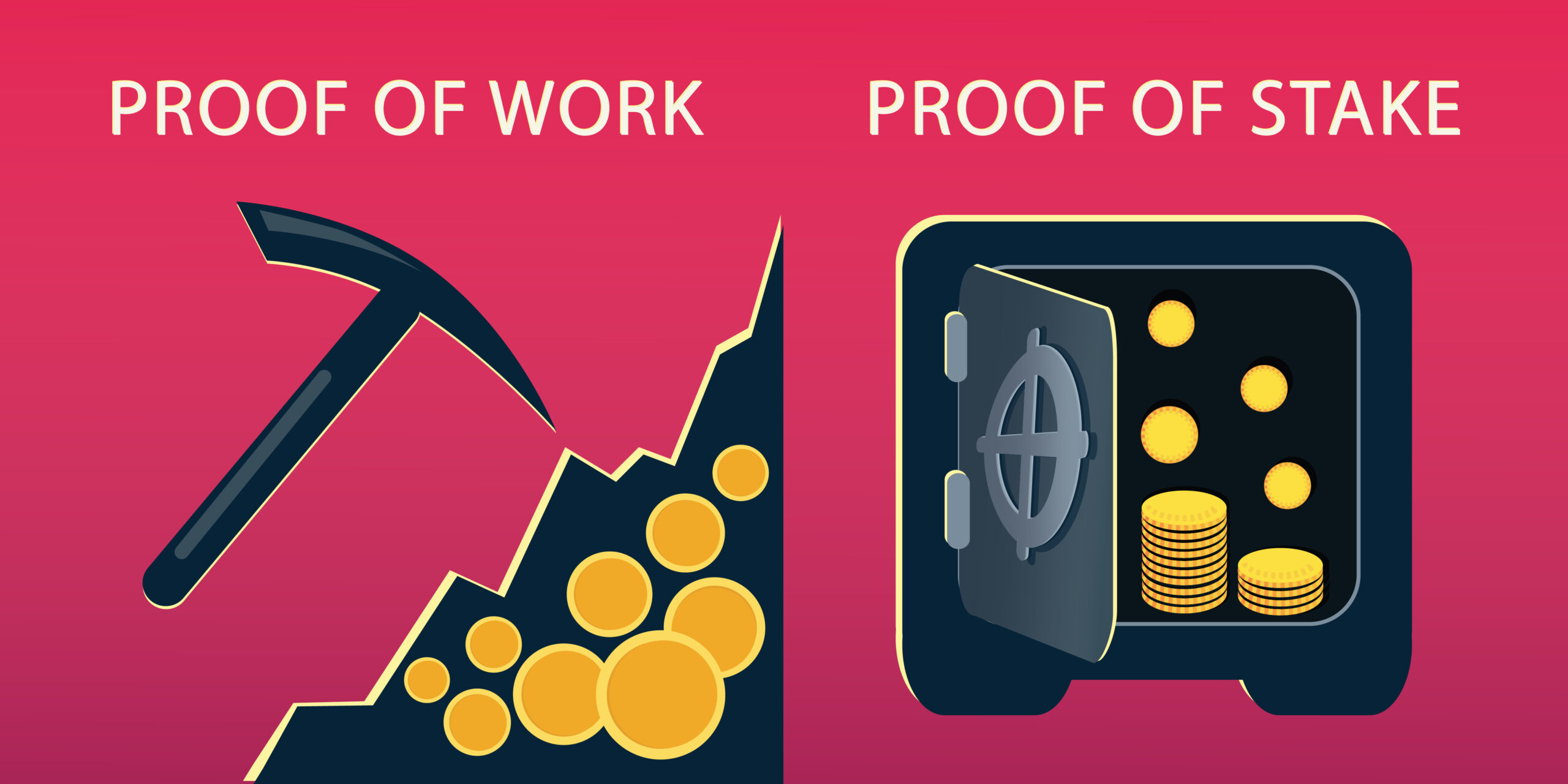
Proof of Work vs Proof of Stake
If you’ve never heard of the terms of proof of stake (PoS) and proof of work (PoW) you’re probably in the super majority of investors. That’s because you’ve probably never entered the realm of cryptocurrency. Entering this world opens you up to a whole new set of investing terminology and mind-boggling concepts.
It's been four years since my employer asked to learn about the cryptocurrency market. I began reading about blockchain and wasn’t getting it. Learning about cryptocurrency was a painful reminder When I was introduced to the internet in 1993. I had an engineer with Hewlett Packard trying to explain it to me and showed me on his computer. For me, it was unfathomable to grasp the internet in 1993 and crypto in 2017.
However, I pressed forward and then began to understand how it works and some of the truly life-altering potential that it has in store (like the internet). A few months later, I began writing a daily newsletter on crypto and did that for over a year.
Today’s post compares the two of models that are used to underpin how cryptocurrency is awarded.
Proof of Work & Blockchain
The concept of the proof of work model pre-dated Bitcoin and the white paper published by Satoshi Nakamoto in 2008. The PoW protocol allowed for a trustless and distributed consensus using a distributed denial-of-service attack (DDoS) that is able to deter cyber-attacks. This process allowed networks to become decentralized and wouldn’t require any third-party verification.
For example, purchasing something with a credit card requires third-party verification. In this example, the person accepting the card for payment trusts that Visa has properly verified with your bank that the funds are available. They trust that the verified funds are there, and you take your goods without the store actually receiving the funds at the point of sale.
Using a PoW protocol would allow the entire transaction to be made without any third-party verification. The protocol utilizes a decentralized network that has no central authority. This system is virtually unalterable and prevents someone from double spending their cryptocurrency. This decentralized ledger system is called a “blockchain.”
Proof of Work Rewards
You may wonder why someone would lend their computer and other resources to support a proof of work blockchain like Bitcoin. This is where the differences between the PoW and PoS models diverge. Here are the steps to processing a blockchain transaction.
- A block is created—this is a set of transactions bundled together
- Transactions are verified with a block—this is done by miners
- Miners complete complex mathematical puzzles to verify the transactions
- Miners are rewarded with cryptocurrency, like Bitcoin, for every block completed
You may have heard about the significant power resources used by cryptocurrency and this is why. Verifying blocks requires a significant amount of energy. These high-powered computers are running 24/7 and the first to solve the puzzle gets the award of the coin. This system rewards those who have the most processing power and can provide the right answer to the problem the fastest.
The central risk of a PoW process is a 51% attack. Centralized databases are prone to hacking. A blockchain requires a hacker to access 51% of all computers on the network to alter the ledger system used in blockchain. However, if one group controlled 51% of the processing power they could alter the ledger. This would be unfeasible for large blockchains like Bitcoin.
Proof of Stake Awards
A proof of stake award follows a similar process. There is a blockchain and a cryptographic consensus algorithm, but the awards are based on your stake and not processing power. The award is based on the most coins staked rather than processing power.
Instead of miners, a PoS system used validators. A validator is anyone willing to stake their coins on the blocks created. The consensus algorithm randomly selects a validator for each block based on the amount staked. The validator receives part of the fees included in the block proportional to what they had staked. This process is more sustainable because it doesn't have the same power consumption issue that PoW systems do. Power consumption is lower because it doesn't require computers to run 24/7.
While the PoW model has the 51% attack issue, the PoS models have a similar problem. In this case, the validator doesn't need 51% of the computing power but rather 51% of the coins. Owning 51% of the coins is unlikely because the cryptocurrency community wouldn't trust a blockchain with that level of concentrated holdings.
Comparing Proof of Work vs Proof of Stake
The long-term viability of a proof of work or proof of stake protocol is security and speed.
Security
A PoW protocol provides the most security since every computer in the network contains the entire historical ledger. Bitcoin and Ethereum are some of the most well-known blockchains and both use this protocol. That being said, Vitalik Buterin, Ethereum’s creator, is planning to do a hard fork of Ethereum utilizing the PoS protocol.
Speed
The capacity of a protocol to process transaction is a big deal. For example, Bitcoin can handle about seven transactions per second and takes about 10 minutes to confirm. This makes the process to validate transactions really expensive, as much as $40 per transaction. Ethereum is a little better in that it can process 15 transactions per second and the process takes about 16 seconds. PoS protocols like Dash, Stellar and NEO allow users to send and receive funds in just seconds.
Conclusion
As with all systems and products, there will always be disagreement over whether a proof of work or proof of stake network is better. The PoW protocol seems to be more secure and costly to operate. The PoS protocol may be slightly less secure but has the advantage of being able to process more transactions more quickly. For crypto traders, there may not be much concern over which to choose, but for investors in crypto this is a major consideration.
Learn how to deal with uncertain markets by learning about the Vomma Zone. Not a subscriber? Become a TheoTrade member.
2 Comments
Rod
December 7, 2020Thank you Brandon for a great explanation into the Crypto discussion. Will definitely delve into this more. Have a 30 year old son who believes this it the future, crypto that is ..Its hard for a 67 year old to look at this like an early Apple, Intel, Microsoft or any of the EV stocks now. Thanks for your time writing this
Brandon Chapman
December 9, 2020I'm glad you liked it!