Unchanged Large Caps (Great Week)
Large caps barely moved on Friday as we ended a very strong week. S&P 500 and Nasdaq were up 7.3% and 9% this week as they had their best week since April. This was the biggest election week gain since FDR was elected in 1932. That only occurred because of hedges unwinding.
Investors were scared of the election going poorly. Technically, it was close and they didn’t officially declare a winner as of Friday, but the hedges still needed to be unwound.
It looks like stocks rallied before even a projected winner was known. This market is invincible. It doesn’t care about the election or COVID-19. That’s because a GOP Senate will prevent the Dems from passing a corporate tax hike or a capital gains tax hike. Furthermore, the market hopes a vaccine will save the economy by next year.
However, a vaccine isn’t fully priced in. It could cause big declines in the software stocks and increases in the banks, energy, and industrials. On the negative side, with the stock market doing so well, there is less of a chance of a stimulus.
GOP Senate majority leader, Mitch McConnell, believes the latest jobs report signals a big stimulus isn’t needed. That’s partially a mistake because the economy is still missing 10.1 million jobs. On the other hand, by the time a stimulus passes (early next year) we will probably already have a vaccine. If we get good phase 3 results, we could get vaccines sent out to healthcare workers in December.
Small Cap Selloff
S&P 500 fell 3 basis points and the Nasdaq fell 4 basis points. It was a relatively boring day except for small cap value. Russell 2000 fell 0.96% as it was driven lower by the banks. It was a weird situation because the 10 year yield rose 4.5 basis points, yet the banks did poorly. Usually, they are correlated, but this has been a confusing week dominated by options unwinding.
Even though the bond bulls claimed victory after the election, the 10 year yield is still in an uptrend as it is at 81.5 basis points. We are still close to my target of 1%. KRE regional bank index fell 2.3% and the small cap value index fell 1.4%. Furthermore, the oil services index fell 2.2%.
Same Story For Value
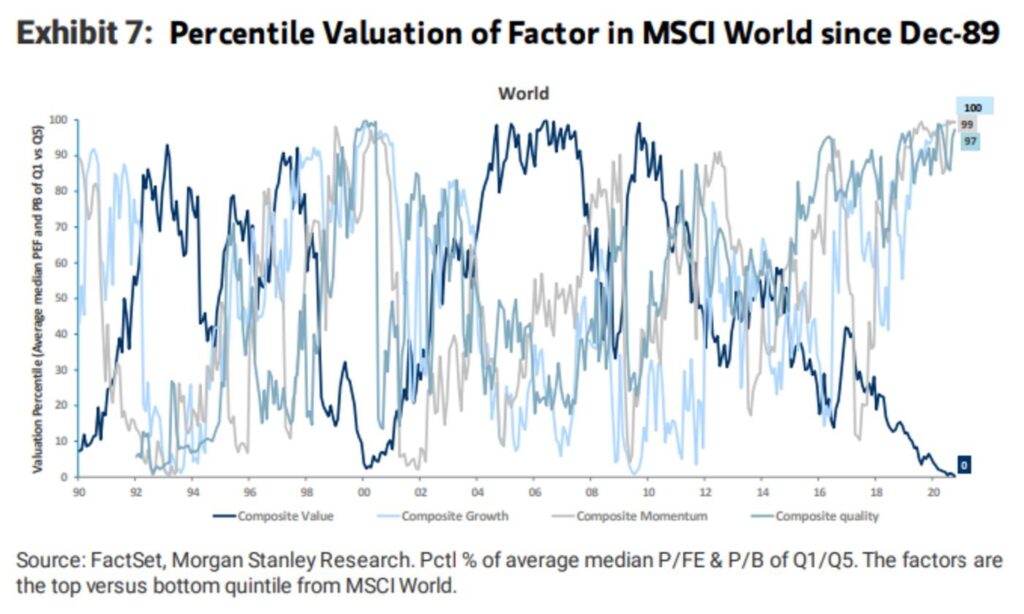
The market is telling the same story it has for the past few months. Namely, value stocks are cheap versus the market and growth, quality, and momentum stocks are expensive. An amazing thing seen in the chart below is that value stocks are in the 0th percentile and growth stocks are in the 100th percentile. This makes perfect sense because the 10 year yield is near its record low and no one thinks yields will increase.
Personally, I did a poll on Twitter where I asked people if the 10 year yield could get to 1.5% in 2021. 38.6% said it was almost impossible. Even getting a hint above record low yields was thought to be highly unlikely. However, if the economy reopens and we get a mini stimulus ($500 billion), yields could increase.
Even I, the value stock bull and long bond bear, don’t think the 10 year yield will get much above 1.5% in the next few quarters. However, a decline in work from home software demand combined with moderately higher yields will be enough to pop the bubble. Even record low yields don’t justify +30 price to sales multiples. Frankly, we shouljd still look at earnings when value stocks.
Yield Curve Set To Steepen
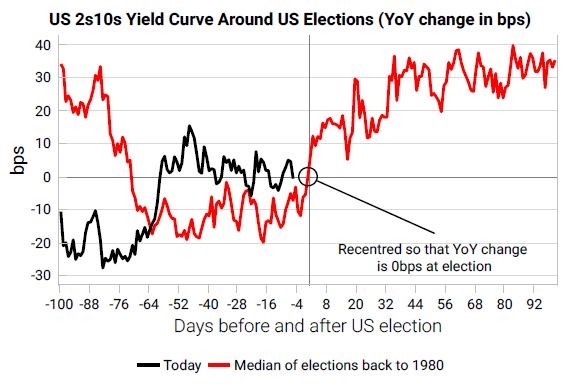
Oviously the yield curve will steepen because the long bond will likely sell off. This expectation falls in line with the historical average following elections. It’s not unusual for a new or even re-elected President to head into his term with motivation to help the economy because the economy is always the voter's most important issue.
As you can see from the chart below, the median of elections back until 1980 shows within the first 3 months after the election, the yield curve steepens by over 30 basis points. It wouldn’t be surprising if it steepens further because we are about to get vaccine news this month.
COVID-19 Gets Worse Every Day
COVID-19 spread has reached epic proportions. It appears the number of people in the hospital will surpass the July high. It’s virtually a guarantee. This virus shows no sign of stopping. You can always use Wisconsin as a leading indicator because it was the first hotspot of the 3rd wave. There was a record high number of new cases on Friday which pushed the 7 day moving average to 5,139 which was up from 4,990.
No one can predict the intermediate term future, but some think that the next 2 weeks are going to be awful for the country. There were 125,552 new cases on Friday which is a record high. There were 1.534 million tests. Apparently, we need to get to 14 million tests per day to stop the spread of the virus. That’s about a 10 fold increase.
If the vaccines and treatments don’t work out, that will be attempted, but that’s not achievable in the near term. Surely, the vaccine will be given out before we have time to increase testing by that amount. It's not really feasible to test that many people per day within the next few months.
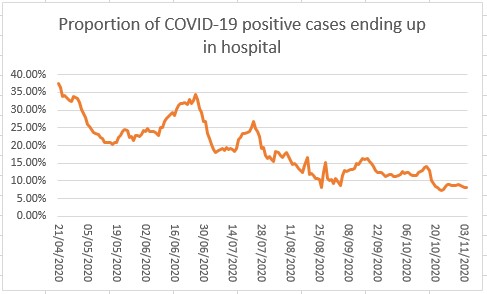
There were 54,824 people in the hospital on Friday. This coming week we will surpass the summer high of 60,000. Only good news is less people who get the virus are going to the hospital as the U.K chart above shows. Less people that go to the hospital are dying. Despite record high cases, the 7 day average of deaths is 905. It peaked at almost 1,200 this summer. A vaccine may not come in time to prevent December from being a deadly month.