Another Rally For Small Caps
The stock market increased slightly on Friday as the small caps outperformed again. Trend has been in favor of banks because the yield curve has been steepening and the long bond has been selling off. This hasn’t exactly been bad for growth tech stocks.
Yields aren’t high enough for them to care. Snap lost $200 million this past quarter, yet its stock was up 10.8% on Friday and was up 51.7% in the past 3 days. This market is like earlier in the year where all stocks would go up and tech stocks would outperform except now it’s the banks outperforming. We aren’t seeing the consequences of higher rates.
We’re in a weird scenario where reopening stocks and shutdown stocks have done well. It’s a party and almost every stock is invited. This can’t last. Growth tech stocks won’t keep this up if the 10 year yield rises above 1% and the phase 3 vaccine trials are successful.
Steeper Yield Curve
Regional bank index is up 25.2% in the past month because of the selloff in the long bond and the steeper curve. Before this rally, sentiment was so negative that people were claiming the banks wouldn’t exist anymore. Of course, brick and mortar banking is less useful, but the banks are still going to exist. Square isn’t taking over the world. Now that banks have rallied, you don’t hear that insane critique as much.
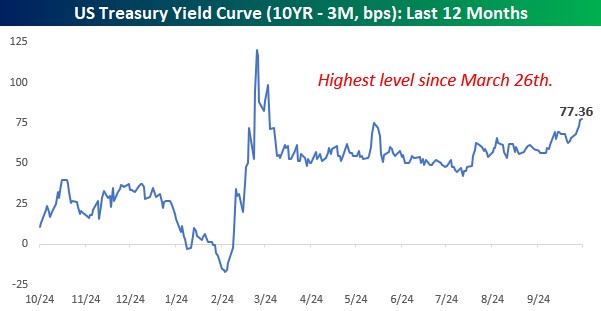
As you can see from the chart above, the 10 year 3 month yield curve is the steepest since March. The inversion perfectly predicted the Fed’s coming cuts and the recession. U.S. 10 year yield is 141.5 basis points higher than the German bund which is the greatest differential since March as well. This shows one of the main reasons U.S. yields are rising is the stimulus.
If this was just about reopening the economy, we wouldn’t see such a differential because Germany will be reopening as well. To be clear, the fact that reopening stocks and yields aren’t crashing in the midst of having the most cases in one day ever shows the market is looking towards life after COVID-19.
Sectors Impacted By Higher Yields
10 year yield was down 2.4 basis points to 84.2 basis points, but obviously it has risen a lot in the past few days which drives this discussion. It was at 65.8 basis points 1 month ago. The chart below will help you navigate a rising yield environment if it happens.
As you can see, the banks do the best when the yields rise. Second is energy. These are very obvious as rates and inflation are correlated; inflation and energy prices are correlated. Higher rates mean better interest rate spreads for the banks.
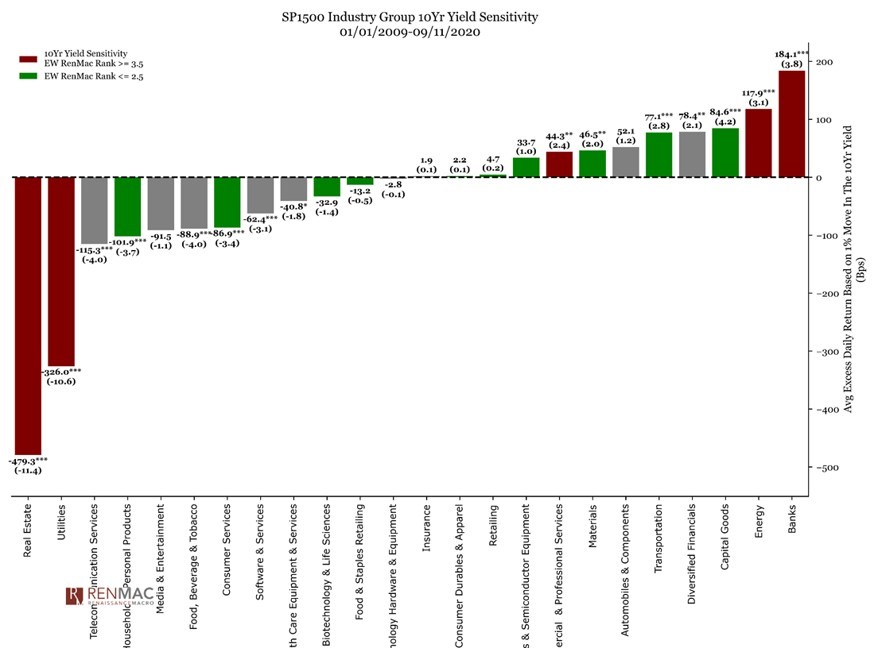
On the other side, higher rates hurt real estate the most. Homebuilders are more optimistic than ever because the average 30 year fixed mortgage rate is below 3%. Utilities also do badly because they are the most like bonds. Investors own them for their yield. When rates rise, there is more competition. Utilities were soaring before the recession, but they have been mediocre since because tech has taken their place as the safety trade.
Software hasn’t been that hurt by higher rates. This uses data since 2009. However, unlike the past 10 years, when rates rise, the economy will reopen which will lower demand growth. Therefore, you have two fundamental negatives combined with the burst of the retail bubble. That spells disaster for the work from home and online shopping plays.
Ark Invest Leads The Pack
Ark Invest was a smallish fund from 2014 to 2019 that focused on disruptive innovation. Its main play was owning Tesla, although, that has only been 10% of their portfolio. Obviously, Tesla has done well for them, but that’s besides the point. Their ethos is driving the market.
They are the perfect fund for this market. Rates are low. Investors are willing to speculate on any company that can grow sales regardless of its business model. That probably isn’t the best way to invest long term especially if rates rise.
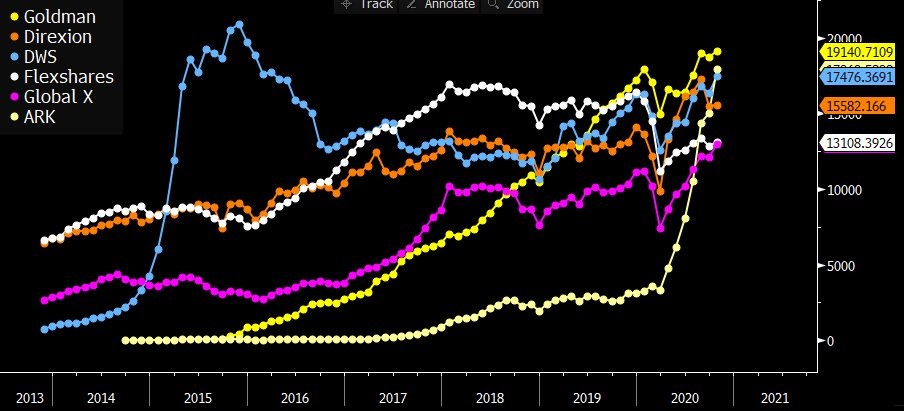
A rise of Ark Invest is a case study on speculative bubbles. As you can see from the chart above, their ETF business has passed Xtrackers, Global X, Flexshares, Direxion, and is $1 billion away from Goldman. Problem with being a popular fund is your success leads to your demise. Speculators buying their active ETFs are causing the stocks in this field to become too expensive.
That means they are essentially forced to buy expensive stocks. They can’t buy value stocks. On the other side, there have been numerous value funds closing their shops. This is the best signal you can get to buy value stocks. There is less competition. They offer great returns now that no one is buying.
Uncertainty Is High
The U.S. presidential election is about 1 week away. There isn’t much uncertainty about who will win. Normally, there is more uncertainty about the challenger, but in this case, investors are very familiar with Joe Biden. It’s almost as if there are two incumbents facing off. Stocks should be fine no matter who wins. The biggest uncertainty is over whether the election is clean and fair.
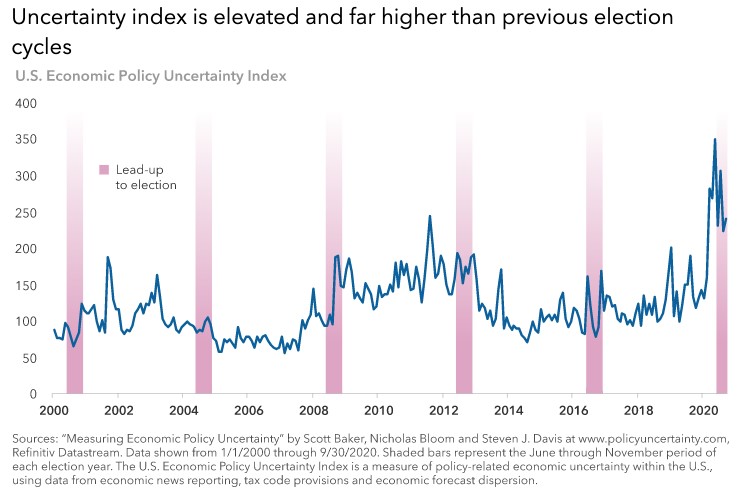
Despite that assessment, the chart above shows there is more economic uncertainty in the lead up to this election than there has been in the lead up to any election in the past 20 years. That’s because we are about to get a massive stimulus and we don’t know what will be in it.
The market probably will be fine even if there isn’t a stimulus. A disaster would only occur if there was no stimulus and no vaccine/treatment. Politicians have successfully run out the clock to January. By then, there should be an effective vaccine/treatment approved by the FDA.
To be clear, not passing a stimulus has been terrible for those in need. Most people firmly support a stimulus as soon as possible, this is just commenting on how the market has been reacting.