Not The Best Jobless Claims Report
The jobless claims report from the week of October 3rd wasn’t that great probably because many businesses are on their last legs. Independent movie theaters are going bust now. COVID-19 situation is about to get a lot better. But that doesn’t help small businesses that have been hanging on for dear life for a few months. It impacts the stock market of course because public companies are in better shape than small businesses and equity investors are forward thinkers.
Specifically, there were 840,000 seasonally adjusted initial claims which was 9,000 below last week. It was actually 3,000 above the initial report from last week though. It also was much higher than the consensus of 819,000. Remember, California wasn’t included in this data point again as its results were paused for 2 weeks. Next week, we will get an updated number. Everyone is curious if there is a wave of new claims in the state which manipulates the data higher for a week.
Unless California’s claims would have fallen sharply, it wouldn’t have been enough to turn this report around. States in the Midwest that are dealing with outbreaks are seeing weakness in their labor markets. Obviously, states like the Dakotas don’t have huge labor markets, but it’s certainly a factor to watch out for.
On a non-seasonally adjusted basis, initial claims actually rose slightly from 799,000 to 804,000. There has hardly been any improvement in the past few weeks. That’s only a 35,000 decrease since the first week of August. In other words, since the first week of extra unemployment benefits stopped going out, claims stopped falling sharply. That’s ironic because so many people wrongly said people weren’t going back to work because of these extra benefits.
Reality is that more payments increase demand which helps the labor market. No one wants to be on unemployment benefits because it’s such a financially precarious situation. Government can easily take the money away. We saw that happen with the $600. That proved the point correct once again.
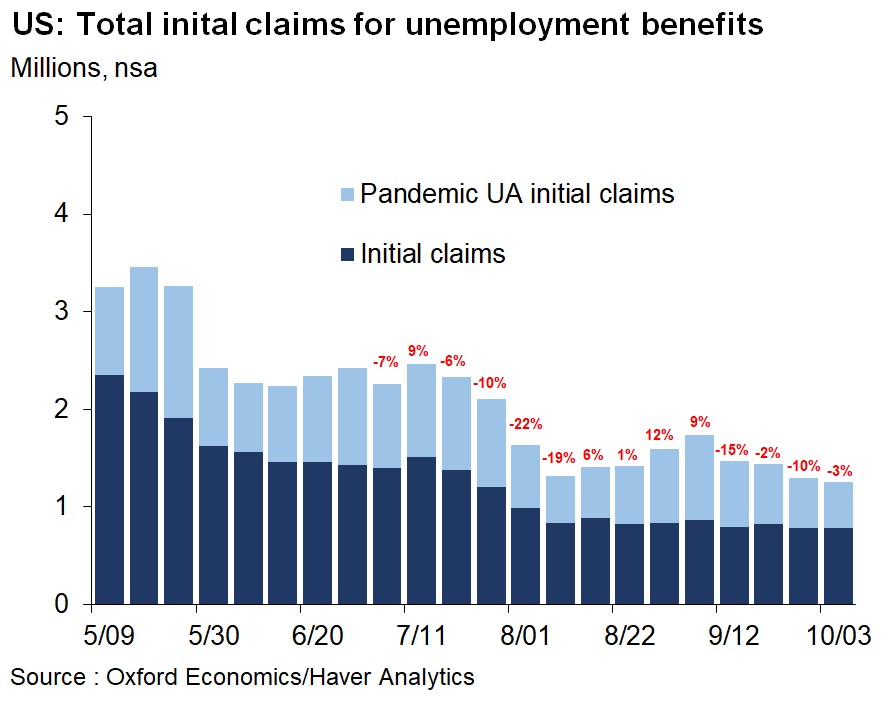
As you can see from the chart above, the combination of PUAs and non-seasonally adjusted claims fell 3% from the prior week. It’s the 3rd week in a row of decreases. Unadjusted PUAs fell 44,000 to 464,000 which brought the combination of the 2 to a new expansion low. PUA data isn’t great. There was a massive revision in last week’s data from 650,000 to 509,000 which is why you see the 10% decline.
That decline was largely driven by Arizona which revised claims lower by 126,000. Arizona’s revision was about 1/6th of the data. That’s wildly different from its share of the labor market. Next week’s PUA data will be very interesting because California will come back online. California is working on cleaning up the fraud. We can expect a large decline in PUAs next week.
Huge Decline In Continued Claims
There was a huge decline in continued claims in the week of September 26th especially when you consider that initial claims didn’t fall much. This decline may unfortunately related to people running out of their 26 weeks of unemployment benefits.
Then they either drop out of the labor force or go onto extended benefits/pandemic benefits. Due to this effect alone, continued claims are going to fall extremely quickly within the next few weeks as most people went on benefits in the spring around the same time.
Specifically, continued claims fell 11.979 million to 10.976 million which is a drop of 1.003 million. With the labor market starting to stall out, it's unlikely that 1 million people suddenly got a job. We could see a very sharp recovery as the COVID-19 treatments and tests start to allow people to go back to normal. We’re not at that point yet. People went off normal continued claims, but onto other benefit programs.
PEUCs jumped from 1.8 million to 2 million and extended benefits went from 268,000 to 352,000. That data is updated as of September 19th which means it is one week behind continued claims data. If the same trend continues, 1/3rd of the decline in continued claims could have been caused by people going onto other programs. Some people dropped out of the labor force and obviously some people got jobs.
Restaurants Need A COVID-19 Fix Within A Few Weeks
Restaurants won’t be able to survive if they rely on outdoor dining when the weather gets colder. Goldman Sachs gave us the details on this as you can see in the chart below. Obviously, it’s non-linear because going from 70 degrees to 55 degrees is going from perfect conditions to mildly uncomfortable.
On the other hand, going from 55 degrees to 40 degrees makes things very uncomfortable. Restaurants are investing in heaters especially in NYC where places are still limited to 25% indoor capacity. They will make it as comfortable as possible, but it’s not going to be as comfortable as being indoors.
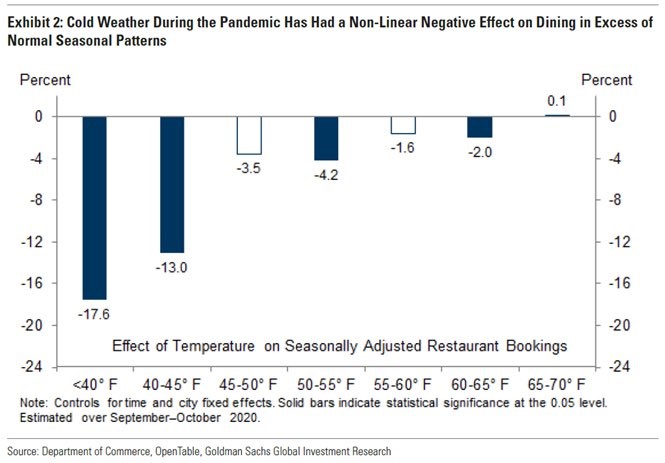
As you can see, when the weather is 40 to 45 degrees, there is a 13% decline in seasonally adjusted restaurant bookings. Restaurants need a fix to COVID-19 in the next few weeks before most of the country gets colder weather. This Saturday, it will be 66 degrees in Minneapolis which is one of the coldest cities in the country. Within a few weeks, it will be in the 40s. By the end of November, only people in warm weather states will want to eat outside.
There has been a mad scramble to increase manufacturing of the Abbott test and the Elly Lily treatment. Let’s see if they come in time to solve the incoming crisis. Abbott has so far shipped 12 million test kits to all 50 states. Of course, there is a difference between shipping them and administering them. But we are getting closer to rapid testing being a critical factor in reopening the country.