No Rate Hikes For A Long Time
In an analysis of the Fed’s decision to delay setting targets and not control the yield curve, it's notable that the Fed doesn’t need to convince people rates will be lower for longer. Fed has now convinced everyone that rates won’t be raised for the next few years.
That’s why tech stocks have done so well and banks have done so poorly. It’s critical to understand what’s priced in. Don’t act as if it’s a big deal that the Fed won’t raise rates for a few years. That’s already known. Buying tech and selling financials based on that is foolish. Everyone knows the Fed is as dovish as it can get.
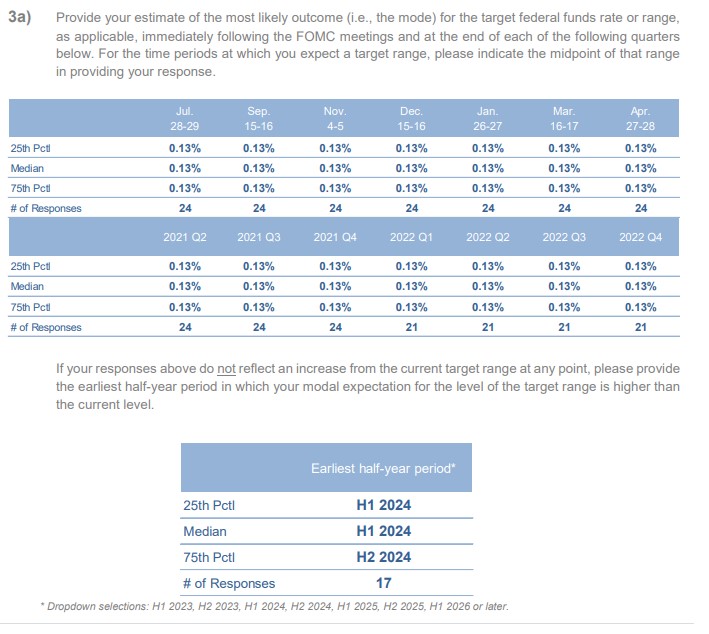
As you can see from the top table above, every single analyst thinks the Fed won’t raise rates from the July meeting which just passed to Q4 2022. That’s no rate hikes for the next 1.5 years. Amazingly, all 17 analysts think the Fed will hike rates in 2024. That’s a very long time from now.
If the government passes a stimulus, the economy could get back to normal in early 2022. If it doesn’t, some say it could take years to rebound. The economy recovered quickly in the first few months after the bottom, but now the recovery has slowed.
If COVID-19 is completely gone by early to mid-2021, there will still be long term impacts on the economy because of the permanent job losses and small business closures.
Fund Managers Love Tech
Investors love technology stocks like they did in the late 1990s. As you can see from the chart below, a net 40% are overweight tech which is the highest by far. Consumer discretionary is at about net 25% (up 16 points from last month), which is because of Amazon. The internet giant is about half of the sector. On the other side, energy and utilities are hated the most as they are about -20%. It’s a unique situation for rates to be very low while utilities are under-owned.
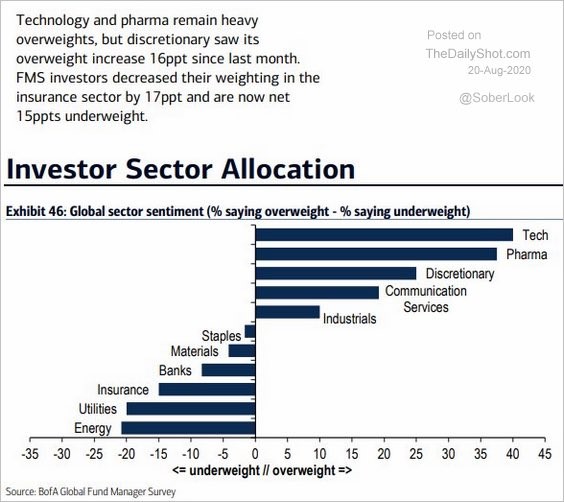
It seems like there is a new sector that gets a turn being loved when rates are low. First the staples were loved in 2016, then the utilities were loved last year and early this year, and now tech is loved. It was weird for there to be a bubble in Campbell Soup in 2016 because it’s such a boring company. The stock got so expensive that it’s still down 21.7% from its peak 4 years ago.
We will likely see the same situation for Clorox now. I think Clorox will provide negative returns for the next 5 years because it’s so expensive. Clorox currently has a 30.8 PE multiple and has temporarily boosted earnings because of COVID-19.
Tesla Is A Huge Bubble
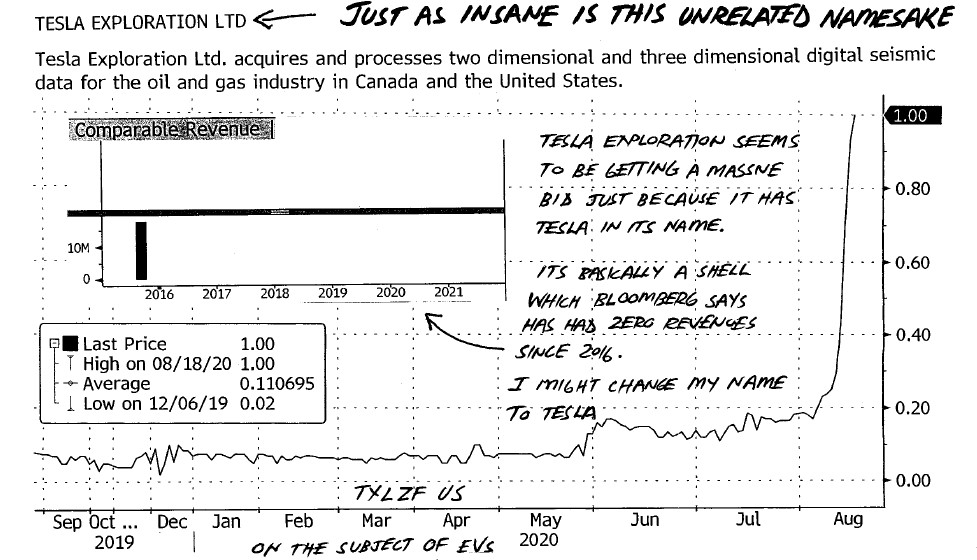
We have seen so much speculation in Tesla stock that a company with the same name even saw its stock spike. It's not Nikola, but rather Tesla Exploration seen in the chart below. This is a shell company with no sales since 2016. This stock isn’t even available on Robinhood. It must be retail speculators on other platforms buying the stock.
Most professionals can’t invest in penny stocks with market caps below $50 million. The stock went from 17 cents on August 5th to $1.15 on August 19th. In the following 2 days, it fell 58.3% down to 48 cents. And the stock likely will be delisted or get a name change to avoid confusion. This is similar to the rally in a Zoom offshoot that had no relation to the Zoom used for teleconferencing.
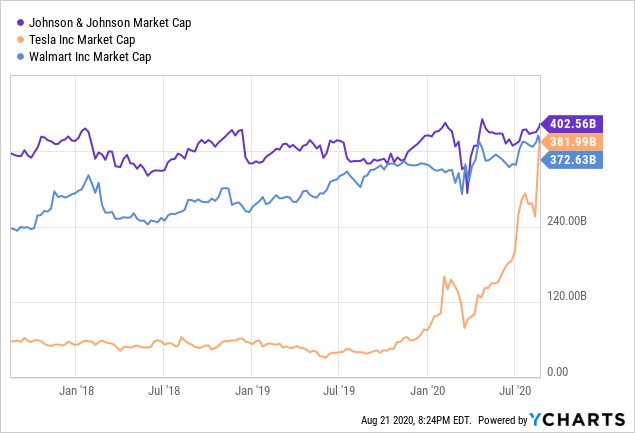
Tech stocks are close to a top because now the only explosive stocks are Tesla and Apple. Breadth has narrowed considerably. Tesla stock was up 2.4% on Friday as it is up 49.2% since it announced its split. It became the 9th biggest American company this week. As you can see from the chart below, it passed Wal-Mart. Tesla has $25 billion in revenues and Wal-Mart has $523 billion in sales. One is not like the other.
Next company it can pass is Johnson & Johnson. That stock is either going to continue to explode or crash. It won’t plateau. Frankly, it will probably do both as it might rally leading up to battery day on September 22nd and decline afterwards.
Tesla is being driven up by money managers, not retail traders as the money flow from traders with less than 10,000 shares has been plummeting in the past few months.
Apple Bubble
Apple and Microsoft make up the same amount of the S&P 500 as the entire financial sector. Apple’s market cap is just $96 billion (the size of Boeing) smaller than the entire Russell 2000. Apple has added $20 billion to its market cap in the past month which is the size of 493 companies in the S&P 500. Apple stock was up 5.2% on Friday and it’s up 33.4% since July 28th.
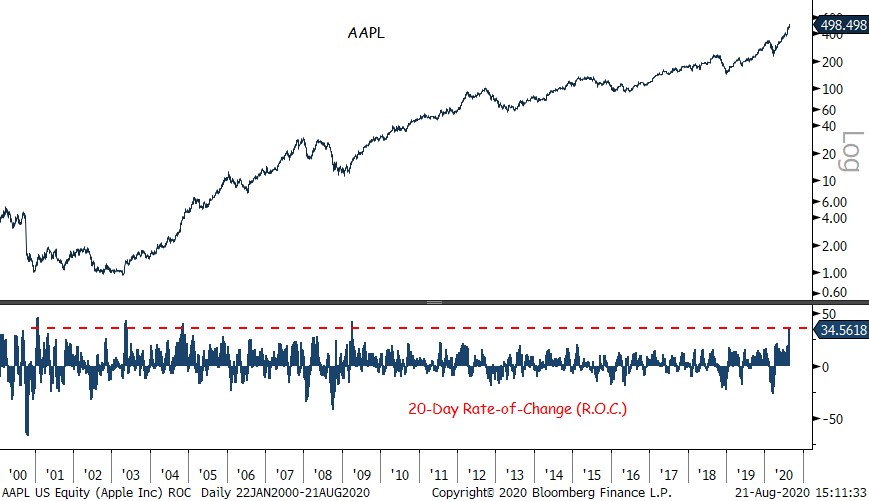
Apple’s monthly RSI is above 85 which is rare. It has occurred 5 other times in the last 35 years. They are September 1987, March 2000, November 2004, October, 2007, and this March. After the 2000 reading, it fell 80%; after the 1987 reading, it didn’t move for 10 years. It will likely fall over 50% and never reach this peak ever again. As you can see from the chart below, Apple’s 20 day rate of change is over 34%. This has only happened 4 times since 2000.
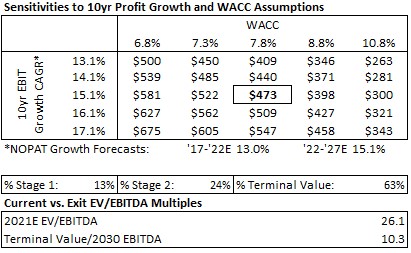
Apple’s 8.1 price to sales ratio is the highest it has ever been. It only got above 3 in the 1990s tech bubble. The table below shows with a 7.8% weighted average cost of capital and a 10 year compound average EBIT growth rate of 15%, the stock is worth $473. It’s now at $497.48.
In the past 5 years, Apple’s EBIT has fallen 2.6%. That means the stock isn’t even worth $409 which assumes 13.1% growth per year. This explains why some think the stock will fall over 50%.