Tech Rally Continues
Nothing can stop tech stocks. According to a survey of investors, 70% think the big tech stocks will rally at least 5% in the next year. Only 13% see big tech falling. Only 3% seeing it fall 20% or more. In essence, no one sees a big decline coming. This is extreme recency bias. It’s been so hard to go against the onslaught of speculation, that even the bears have gone home. Tesla shorts were the most ardent bears I’ve ever seen in my life. Even they had to cover.
An analyst put a $480 price target on Apple. That would give it the same market cap as the entirety of the Russell 2000. That’s just like the recent price target of $4,200 on Amazon which would also give it a market cap the size of all the small caps. Some people think these big tech stocks will be taken down by anti-trust. They do face litigation, but the only thing that will take them down is a market crash.
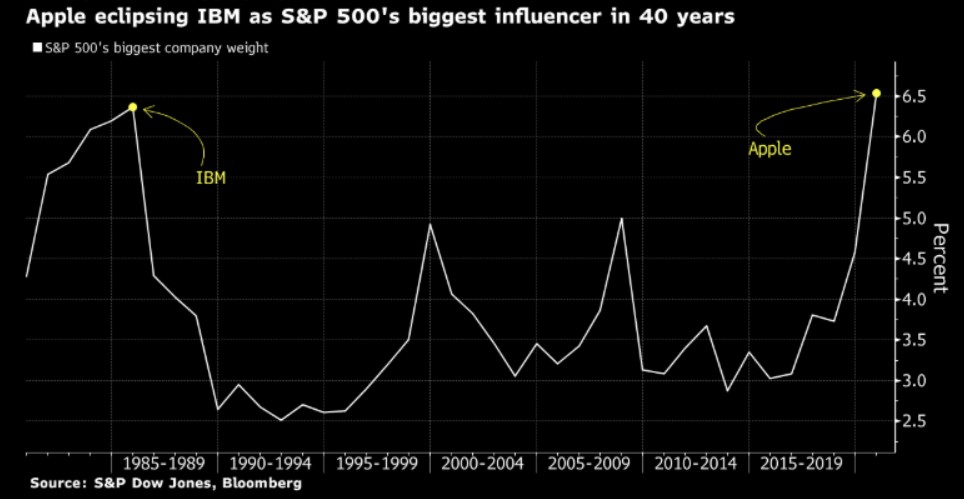
Nothing will catalyze the decline. Nothing needs to catalyze it when speculation reaches this level. As you can see from the chart below, Apple is 6.5% of the S&P 500 which puts it at IBM’s peak in the mid-1980s. No company became this large as a percentage of the market in the late 1990s tech bubble.
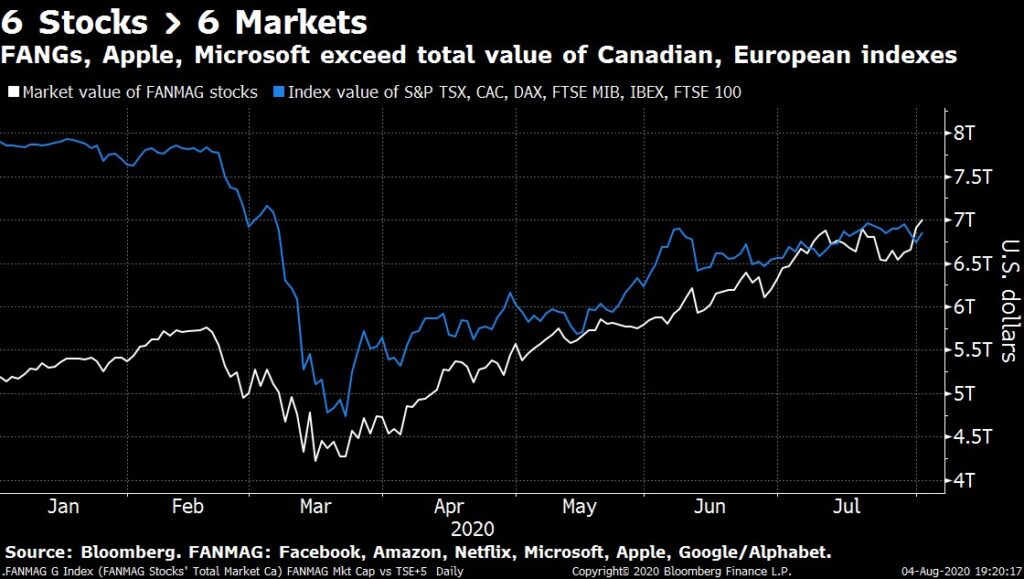
The chart below is even more amazing. As you can see, the combined market cap of the FAAMNG stocks is $7 trillion which exceeds the size of all European and Canadian stocks combined. Canada itself has a bubble stock. Shopify is Canada’s biggest company as it has a $130 billion market. That’s even though Shopify has no profits. Its stock is up 16% since July 24th.
Our financial world has transformed from February even though the S&P 500 is almost at the same value. As you can see, in February the FAAMNG stocks were worth about $5.75 trillion and all the Canadian and European stocks were worth about $7.75 trillion. Net difference between the 2 changed by over $2 trillion. This is an epic shift unlike anything in human history.
10 Year Yield Plummets
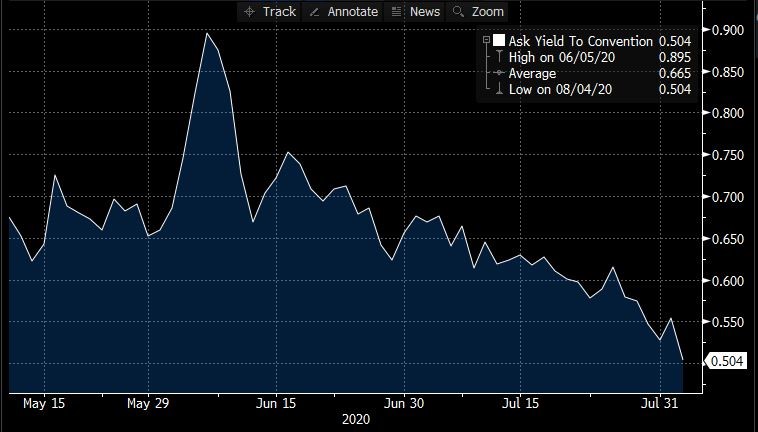
As you can see from the chart below, the 10 year yield fell from 0.75% in mid-June to 0.5% in early August. An initial decline made sense because the number of new cases rose from mid-June to late July. Now with the economy about to have a cyclical improvement due to the decline in cases and the incoming fiscal stimulus, the 10 year yield will rise.
A fiscal stimulus will give people $1,200 and $600 in weekly unemployment checks. After a July hiccup, the economy will surge and generate inflation. In fact, the Fed is planning on getting even more serious about ramping inflation. Eventually, something will give and inflation will rise.
We can predict the 10 year yield will get above 1% within the next year. That's not to say we will have inflation like the 1970s, but we will have more inflation than there is now.
Disney Beats Earnings Estimates
This quarter had the highest percentage of earnings estimate beats ever. That’s because the bar was lowered too much. In recessions, expect more than 50% of firms to beat estimates. Even my prognostication was too conservative. Now there are more beats than ever during a terrible earnings season. That’s putting lipstick on a pig.
Disney reported 8 cents in EPS which beat estimates for a loss of 64 cents. On the other hand, it had revenues of $11.78 billion which missed estimates for $12.37 billion. Disney+ subscribers are going to be able to watch Mulan for $30 starting on September 4th. This shows the importance of movie theaters.
Normally, a family of 4 wouldn’t think twice about paying $30 for 4 tickets. That’s an experience. You get to see the movie on a giant screen with great sound and comfortable seats. Only benefit of seeing the movie at home for $30 is that you can see it early. The movie will come out for a lower price in a couple months.
It's highly doubtful that many people are going to pay $30 for a movie. There are so many other entertainment options for less money. Tentpole films are much better in the theater. This is Disney’s first shot at selling content on top of its $7 monthly subscription fee. This isn’t going to go well. Disney+ reached 57.5 million subscribers which is much below Netflix’s 193 million. Hulu has 35.5 million subscribers and ESPN+ has 8.5 million.
ESPN is a dying business. ESPN’s problem is twofold. First, before cable was unbundled ESPN was getting huge fees. When people who don’t watch sports were allowed to pay for what they do watch, ESPN's revenues fell. It originally wasn’t common knowledge how much of the bill went to ESPN.
Secondly, ESPN used to have a monopoly on sports commentary. 15 years ago, ESPN was practically the only place for sports. Since ESPN is owned by Disney, it is more conservative than other sites such as Barstool sports. It's not about politics, it's about risks.
ESPN commentators don’t have the liberties online commentators do. Taking huge risks may or may not be a good practice, but it does provide intense competition for ESPN. Personally, my time on the website has greatly diminished in the past 10 years.
In response to this report, Disney stock rose 4.28% after hours. Disney is a hybrid because it has a streaming service, but it also has theme parks. It’s not fully a COVID-19 play and it’s not fully hurt by the changes the virus has brought. Disney currently has a 39.6 PE ratio.
Most would stay away from the stock because it's unlikely that it will win the streaming war with Netflix. Also, that’s a bad war to be in because it has endless costs. Netflix has burned billions in free cash flow. It’s not pretty.