Markit Flash PMI Improves
Markit is being criticized because its July flash PMI reading showed no change in the economy which normally implies the economy is fine. However, now it means there wasn’t improvement. Most data actually shows the economy is getting worse on a rate of change basis. This isn’t like a normal slowdown in an expansion where GDP growth falls from 3% to 2% and the unemployment rate stops falling for a couple months.
In the previous expansion, some bears would claim a disastrous economy was coming because the unemployment rate rose a few tenths of one percent even though it was near 4%. This is dramatically different as the unemployment rate is in the double digits. A few ticks are a huge deal when it’s this high. Current rate is 11.1%. I predict it will be near 11.5% in the next report. There will likely be moderate net job losses and the error rate will shrink (pushing it slightly higher).
The economy isn’t fine, but the PMI gives us an idea of where it’s headed on a rate of change basis, so I will review it. Composite flash PMI was 50 which rose from 47.9 and was a 6 month high. Every segment reached a 6 month high. Services business activity index rose from 47.9 to 49.6 and the manufacturing index rose from 49.8 to 51.3.
Manufacturing is growing, while services is contracting. These results paint a rosier picture than most. As predicted, manufacturing is rebounding quicker. Global economy is likely outperforming America’s economy because America is doing the worst at combatting the virus. Finally, the manufacturing output index rose from 47.5 to 52.1.
Comments From Markit
Chief Business Economist at Markit stated, “While the stabilization of business activity in July iswelcome news, the lack of growth is adisappointment. Moreover, a renewed acceleration inthe rate of loss of new business raises concerns thatdemand is faltering.” It’s important to note that after the economy craters, a PMI of about 50 is actually bad because it means there was no improvement from the bottom.
That’s why you see a 6 month high in the PMI paired with such negative comments. Markit economist added, “Thankfully, the job-shedding seen over the prior four months has come to an end.” We can disagree with that, but welcome the possibility that maybe the labor market isn’t as bad as I think it is.
Housing Market Still Looks Good
It’s like a broken record. Housing market looks very strong, while the most of the rest of the economy looks weak. MBA report in the week of July 17th showed the composite index was up 4.1% which followed 5.1% growth the week before. The refinancing index was up 5% after rising 12% the week before.
Last week, the average 30 year fixed mortgage rate fell to 2.98% which was a record low. This week it rose to 3.01%. Purchase index was up 2% weekly after falling 6%. Yearly growth rose from 16% to 19%. There have been 9 straight weeks of double digit yearly growth as the housing market has more than fully rebounded. It’s doing better than it was before the COVID-19 crisis.
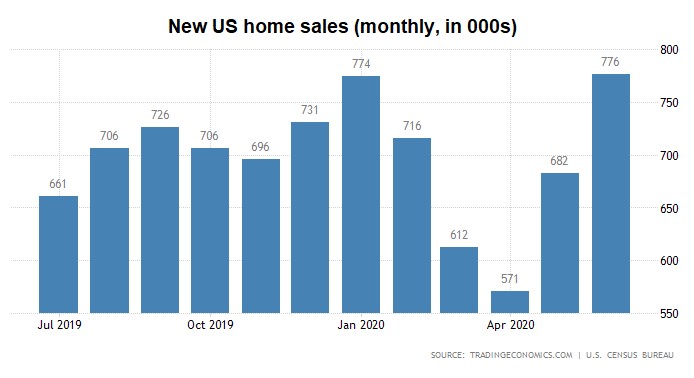
New home sales in June spiked from 682,000 to 776,000 as you can see from the chart above. That beat estimates for 700,000 and the highest estimate which was 720,000. This was the highest reading in 13 years. Obviously, it can be revised lower.
However, that’s irrelevant as it’s likely that the July reading will make another high since the MBA purchase index has been strong. Some people doubted the MBA index because it’s early and not government data. Don’t doubt it anymore. Housing market is the hottest since the bubble in the 2000s.
Consumer Spending Growth Looks Worse
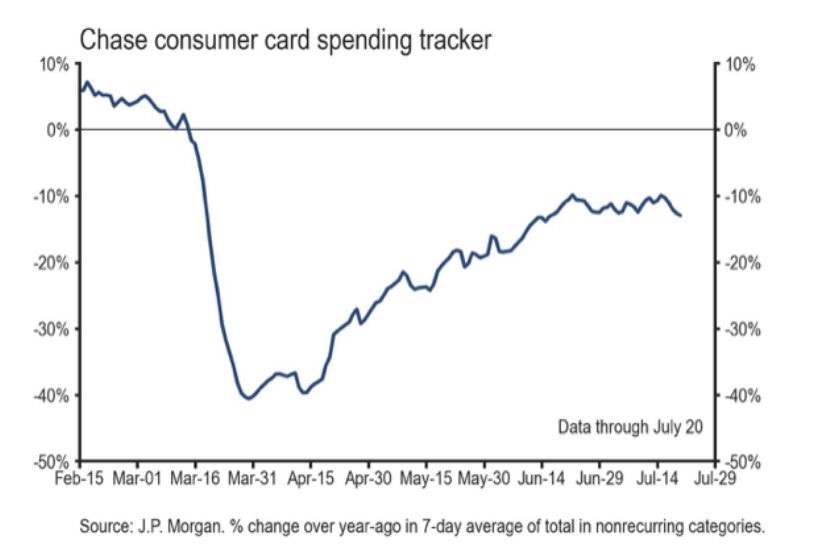
As you can see from the chart below, the Chase card spending tracker shows spending growth hit a 5 week low. You could argue this is range bound, but maybe it’s weakening further. This is as of July 20th. Prognosis has been that the consumer should be doing worse considering the weakening labor market and the impending expiration of the $600 in weekly benefits. Therefore, it’s possible that spending growth will fall further.
Good news is COVID-19 is rescinding which means the labor market might rebound in August or September. If the government passes a $300 weekly stimulus for the unemployed, that will mean they have less money, but at least uncertainty will be gone as the benefits will last until the end of the year. Hopefully, by then the labor market looks better.
Friday COVID-19 Update
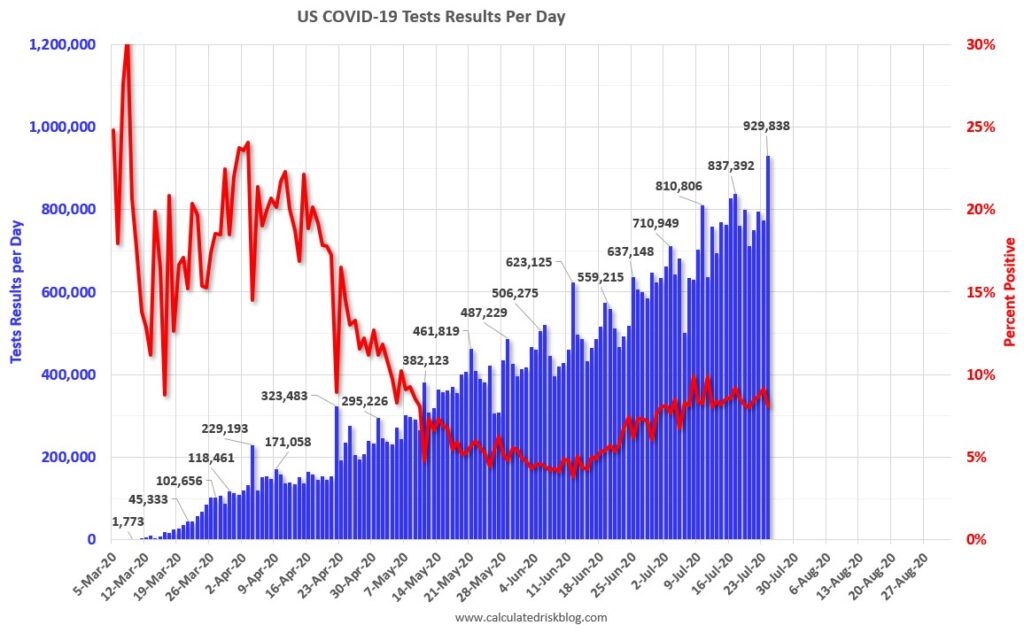
There was a massive burst in tests on Friday which pushed the number of cases higher. As you can see from the chart below, there were 929,838 new tests which is by far a record high. Even though cases increased, the positive rate fell, so we can consider this good news.
And there were 78,009 new cases on Friday which was a record high. If we can test almost 1 million people per day, the economy should reopen soon because it will be possible to trace people who have it and limit the spread.
It’s time to focus on deaths per day because if we have this many tests and not many people dying, life will go back to normal. To be clear, the number of new deaths per day is still elevated, so we aren’t ready to go back to normal yet. Public and policymakers will want things to go back to normal if deaths per day fall near where they bottomed at in early July.
There were 1,141 new deaths on Friday as my prediction for the 7 day average to get to 1,000 is about to come true. 7 day average is currently 918. Number of deaths per day will likely peak in mid-August. Predictions will get more specific in 1-2 weeks.