There Will Be Job Losses In July
Now that we are far enough into July and have enough data, we can predict there will be job losses in the July BLS report. To be clear, the stock market has already priced that in. It’s easier than usual to predict where the economy is headed because COVID-19 outbreaks equal lower growth/bigger declines. A spike in cases in the hotspots starting in mid-June correlates with the peak on June 8th.
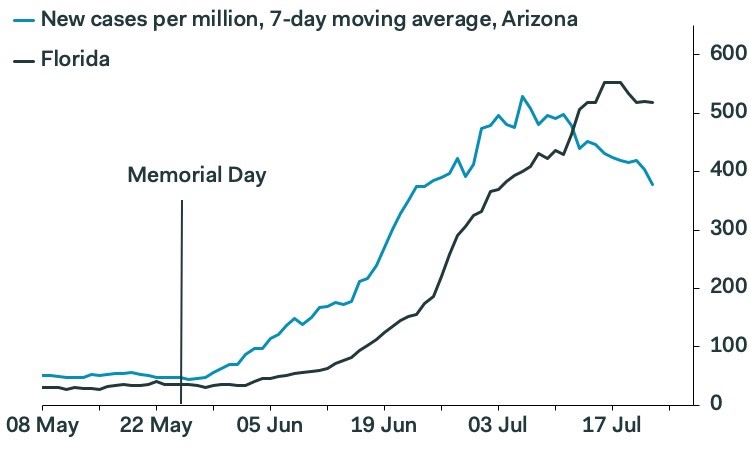
Even though the S&P 500 has made a new high, small cap value stocks and the cyclicals haven’t passed that high. Small cap value index is still down 8.5% from June 8th even though the S&P 500 is up 1.4%. Since July 9th, small cap value is up 9.1% as there have been early signs that cases in the hotspots are starting to slow. There have been outright declines in new cases in Arizona and Florida.
It’s natural instinct to want to predict a big decline in the S&P 500 if the economy is falling backwards. However, the economy being bad is good for stocks. We can predict when the economy starts to improve, the stock market will fall because it has so much tech and momentum growth names. Amazon is much more important than the entire financial and energy sectors combined.
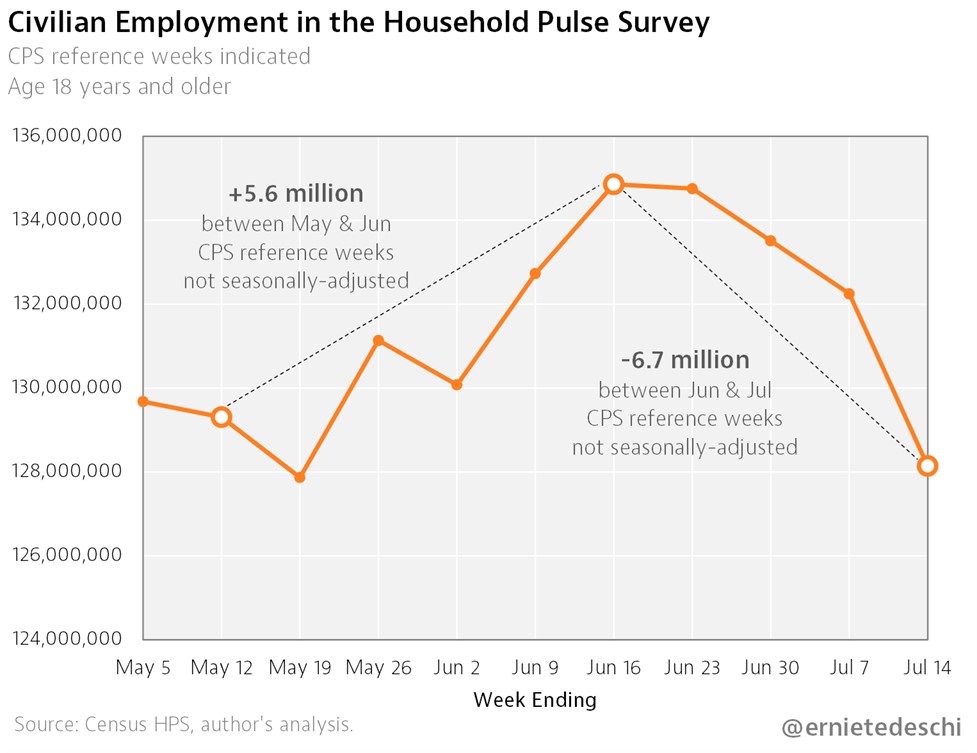
This negative sentiment is based on the July labor report on continued jobless claims, the economic restrictions, and the civilian employment household survey. The chart above shows the latter. As you can see, from the June survey week to the July survey week, there were 6.7 million fewer jobs. This isn’t seasonally adjusted, but it did predict the last month correctly.
Where stocks go on the day of the report and where the labor market goes in August matter more than the precise figure. Stocks will care more about the latest change in COVID-19 cases and the stimulus package when this report comes out then it will about the specific numbers.
If the stimulus isn’t passed by then, this report will motivate Congress to get something done because it will be ugly. In that sense, the worse the report, the better for cyclical stocks. Unemployment rate will probably increase marginally which is terrible since the rate is in the double digits.
Rumor is that the GOP is willing to pass a temporary extension to weekly unemployment benefits. Most don’t care what mechanism is used to get people money as long as they get it. It's likely the labor market will start to improve along with consumer spending sometime in August.
Economic restrictions will start to be lifted and consumers will be more comfortable as more government money is put in their pockets. Obvious variables are the size of the stimulus and the decline in COVID-19 cases.
Consumer Stuck For Now
Consumer spending growth stopped improving in July as I predicted. That’s a bad place to be because as the chart below shows, spending growth is down in the low double digits. This slowdown came way too early in the recovery. The economy is still in big trouble.
Everyone expected the rate of change in the recovery to slow, but not by this much. That’s why even back in May economists were calling for a Nike swoosh recovery.
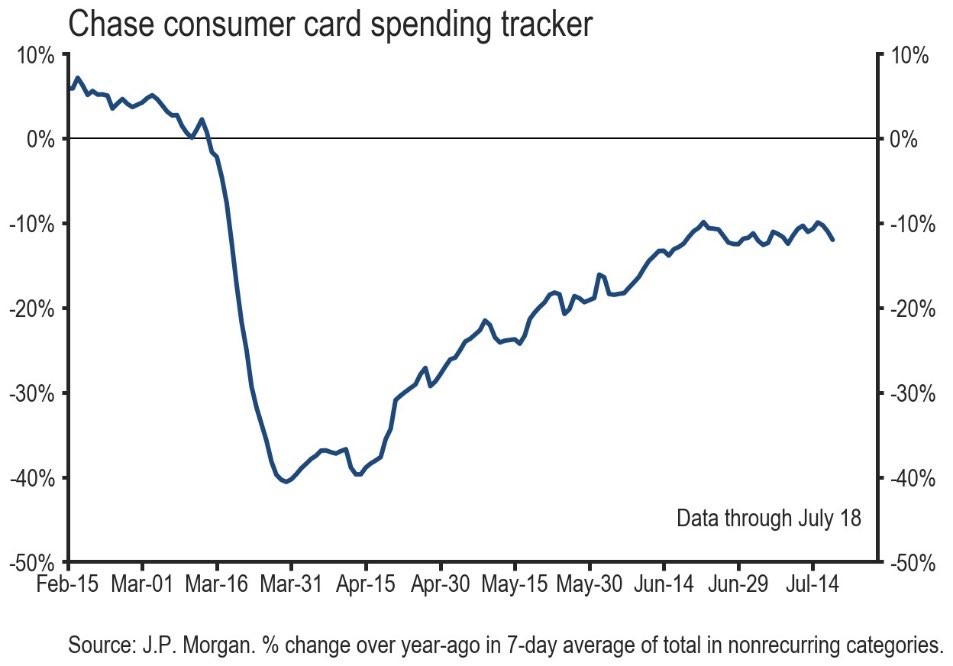
This latest data isn’t in tune with a swoosh because there were 2 negative catalysts. COVID-19 returned and the government didn’t pursue a stimulus fast enough. Government dragged its feet on a stimulus because the economic data in May and June were solid. Plus, the S&P 500 is near a record high. That’s playing with fire.
A recession can easily return without more government help. Furthermore, the tech stocks that thrive in this new economy are driving the index higher. Obviously, Congress doesn’t understand sector rotation. That’s why they shouldn’t ever make policy based on stocks. They should look at COVID-19 cases. As cases rise, economic activity falls which means more stimulus is needed.
Wednesday COVID-19 Update
Wednesday was a bad day for COVID-19 in terms of new cases and new deaths. California is in serious trouble. There were 71,638 new cases and 1,205 new deaths nationally. That’s the 5th most cases in a day ever and the most new deaths since May 29th.
Unfortunately, my expectation for the 7 day average of new deaths to get above 1,000 is coming true. As you can see from the chart below, Arizona is improving and Florida is stabilizing. There were only 1,926 new cases in Arizona and 9,785 in Florida.
California is the most populous state in the country, so if it is in trouble, the entire country’s data looks bad. California is looking like the next New York at this rate. There were 12,137 new cases and 156 new deaths. There have been 8,045 total deaths in California which is the 4th most. It will pass Massachusetts for 3rd later this week. There are 287,737 active cases in California which likely means the death total will increase in the next few weeks.
Any companies that do business in California could be in trouble. Ironically, Tesla, the hottest stock in the market, has one of its main factories in Fremont, California. This isn't necessarily a disaster for the company, but it’s not a positive that the factory might be shut down again and a huge market could close. California is by far the largest market for solar and electric cars. It’s sunny and there is a lot of government support for green technology.
Conclusion
Labor market is going backwards. Just looking at the consumer makes me think the household pulse survey might be a little too negative, but there will still likely be job losses. Unemployment rate should go up slightly. COVID-19 situation appears to be the worst in California. Since the state is huge, it moves the needle on the national numbers.