Relief Rally
Friday’s trading session was the most unusual of the year. That’s saying something because of how extreme the volatility has been. Heading into the day, we expected at least a 1.5% rally as a bounce back to Thursday’s crash. S&P 500 ended up 1.31% which isn’t surprising. A shocking part is how it got there. It was like a week of trading action squashed into one day. The market opened up huge, peaking up 2.8% at 9:45AM.
Then stocks fell 2.63% which was about the break-even level. From 11:25AM to 12:05PM, the S&P 500 rose 1.58%. Then it sold off 2.17% until 2PM. From the peak at 9:45AM, this was a 3.24% decline. And then the market rallied into the close. It was up 1.8% from the trough. We had 5 days of moves in one day. Every move was confusing because you couldn’t tell which way the market would go.
In my opinion, the market wanted to rally because it was oversold, but it wanted to sell off because valuations are still a bit high. You had dip buyers and those following valuations. At least there were dip buyers which was unlike Thursday. On Thursday, buyers completely stepped away.
Even after large drops, stocks only fell to where they were a few days prior. This is why parabolic moves always end badly. You get people buying the market hoping to follow the momentum. When it ends, value investors don’t bail them out because prices are too expensive.
How Are Robinhood Traders Doing?
Robinhood traders didn’t have a good week as the airlines and cruise ships crashed on Thursday. Robinhood traders got way too much credit for the movement in markets. A key here is their extreme confidence was a signaling effect. It showed the market had gone too far.
Some professionals in finance are losing their sanity when it comes to the retail action. Yes, it’s unusual to see bankrupt companies and firms with no revenue doing well, but this can’t cause you to lose sense of valuations and the fundamentals.
The same rules of trading that you had been using still exist. It appears as if some pros are willing to avoid great opportunities just because millions of people are opening accounts with a few thousand dollars in them. Tesla didn’t get to a $173 billion valuation because of small retail traders. Personally, I bought some stocks on Thursday (not Tesla) as markets were crashing. Tune out some of the noise which claims this is a major top similar to the 2000 tech bubble burst. Stocks aren’t going to fall more than 50%.
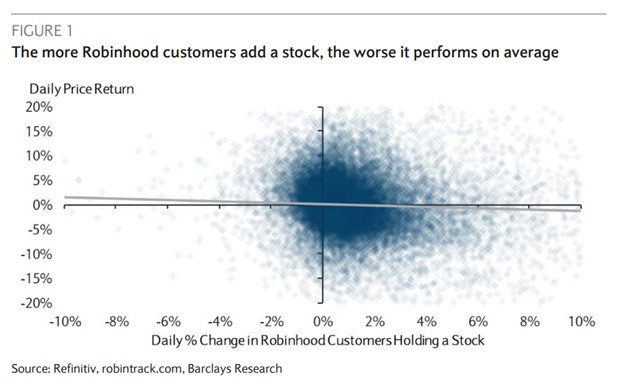
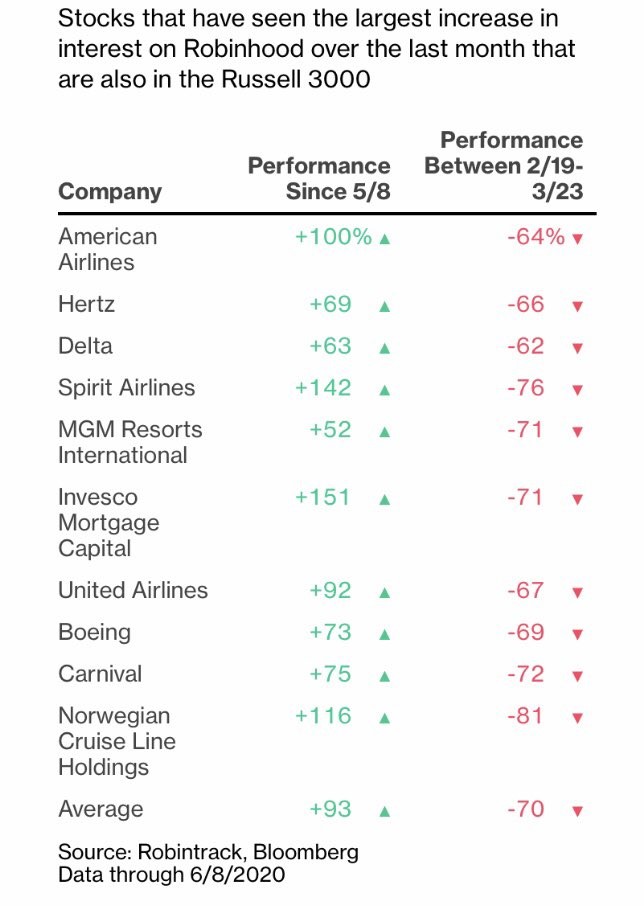
Stories that show how well Robinhood traders are doing are subject to survivorship bias. If 10 people invest and 1 person triples his money, while 5 lose most of their money, the story focuses on the winner. We have 2 charts which differ on the success of these traders.
Firstly, it's notable that if a new trader buys options without knowing what they are doing, it is guaranteed to end poorly. Secondly, if a new trader buys a momentum stock with poor fundamentals such as Draftkings, it likely won’t end well. The situation worked out with Tesla, but you can argue people were wrong to say it had bad fundamentals. Some story stocks work out. They don't all become losers.
As you can see from the chart below, the more Robinhood users add a stock, the worse it does on average. It seems like the hot money in Robinhood manipulates the data. Remember, not everyone on Robinhood is chasing the latest craze. Smarter investors that don’t move their money quickly aren’t as represented in this type of analysis.
The table below gives the opposite perspective. Top 10 stocks in the Russell 3000 that saw their popularity rise the most on Robinhood rose on average 93% on the month through Monday. The table lists these stocks. It’s no surprise the list is populated with airlines and cruise ships.
These groups shouldn't get the most attention. There were other industries that fell more. It might be because new retail traders know these firms better than others. They don’t know anything about regional banks for example. The only stock on this list that’s actually a good business is Boeing. Boeing was hit hard by the grounding of the 737 Max. The corona-crisis came at the exact worst time for this firm.
Coronavirus Gets Worse?
In the past few days, the number of cases has been growing in a few states. Good news is deaths aren’t increasing. This is adding to the confusion the market faces. On June 13th, there were 895 new cases in New York and 50 new deaths. Worst 3 states were California, Florida, and Texas which had 3,135; 2,625; and 2,262 new cases.
As you can see from the chart below, the first wave never ended. Instead the number of deaths fell. There still will be social distancing and different habits than before the virus hit if cases remain elevated.
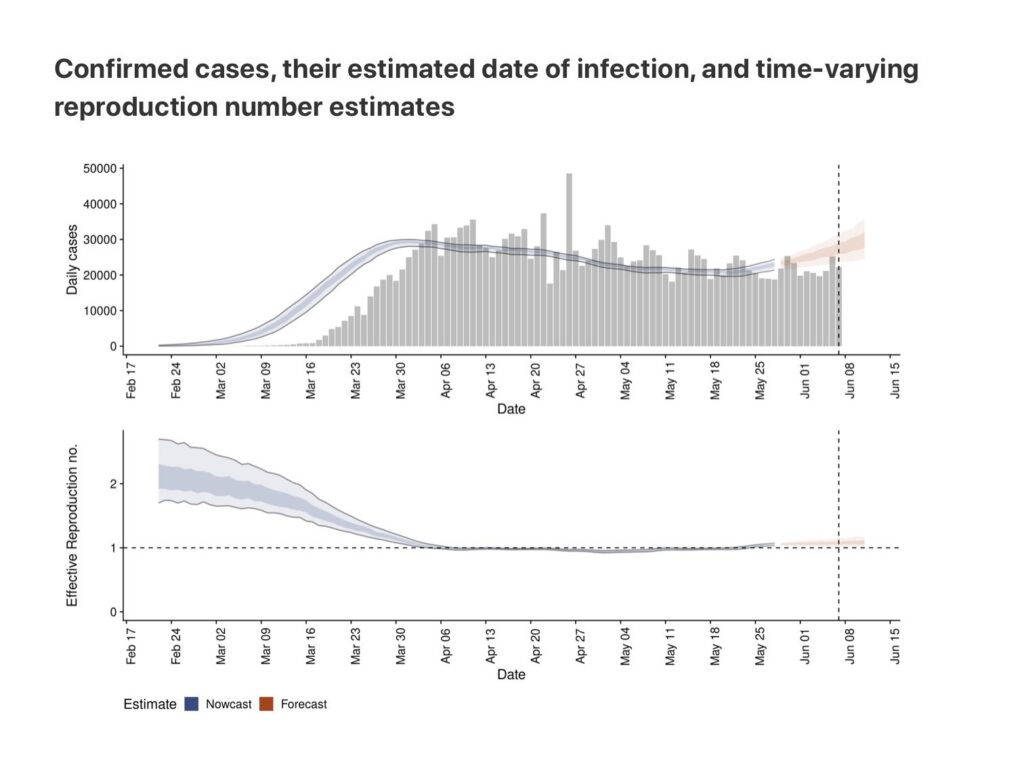
As you can see from the chart above, models predict the virus will get worse. We all were hoping for the 2nd wave to be weak, but now we have a burst in cases in the summer. On June 13th, the 7 day moving average of national cases was 21,954. 7 day average was 31,352 on May 28th, meaning there has been no decline in 2 weeks. Deaths look much better. 7 day average in that period fell from 999 to 776.
Conclusion
The stock market doesn’t need to have a massive crash to shake out the Robinhood traders. They can easily lose money in stocks like Draftkings and Spirit Airlines. It's good to separate the speculation from valuations.
If prices were cheap, like they were in April, many would be buying along with retail traders, like they were through most of this run. Retail traders being euphoric is a negative signal, but let’s not ignore everything and sell because they are bullish. If we do that, we are no better than them.