Craziest Labor Report Ever
This was the craziest labor report we have ever seen or will ever see. It beat expectations dramatically just like the ADP report. The BLS report was even better than the ADP report potentially because of an error. Essentially, jobs started coming back in May instead of June. Workers were rehired due to the PPP loans given out to small firms. This explains why small firms did the best in the ADP report. When you put this report into context that it simply was a month earlier than expected, it doesn’t seem as great for stocks because we always knew a recovery was coming.
Main good news is the bottom isn’t as low as we thought. We thought the unemployment rate would top at above 20% before plummeting in the next few months. Instead it topped at 14.7% last month. It’s easy to see tea leaves in hindsight now that we know this was a better than expected BLS report. Besides the ADP report, we saw a big decline in continuing claims in the survey week of this BLS report. Looks like we should have realized that was a good sign for the BLS reading.
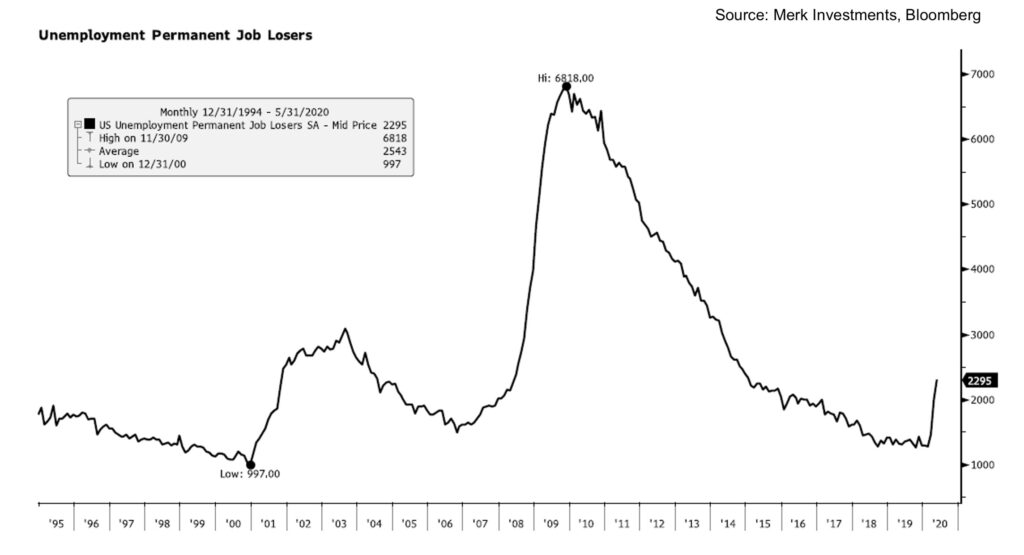
Bad news is there was a spike in permanent job losses. Uncertainty waned, meaning people officially lost their jobs or were brought back. Permanent job losses could increase next month as people stay unemployed for longer. That being said, job creation will also accelerate as temporary unemployment falls. Remember, this recovery was forced by the government. That’s not a bad thing, but it means it’s still on shaky grounds. If the Fed or the government get too confident and takes away the punch bowl, it could get ugly.
A final point in this summary section of the report is that there was a classification adjustment which caused the unemployment rate to look lower than it was. Not all workers who were not working but expect to work were classified as unemployed even though they should be. If all the workers who were unemployed, but absent from work were considered unemployed, the unemployment rate would be 3 points higher.
To be clear, that doesn’t mean the unemployment rate was 3% higher. It’s doubtful all those workers in that category were misplaced. We don’t know the size of the error, just that 3% is the extreme end. It could end up being 1% to 2% higher. Stocks don’t care. They saw the headline reading and rallied. That being said, if the labor market has a hiccup, stocks could fall quickly.
Headline Details Of The May Labor Report
After losing 20.687 million jobs, the economy added 2.509 million jobs which was the best addition ever. This will be the fastest recovery ever. It certainly will be rapid in the beginning because people who lost their jobs are all getting them back and economic activity is getting back to normal.
There is still room for policy mistakes which is why many are bearish. It’s very easy to be bearish because the entire recovery is already priced in. Bulls have little room for error. My opinion about stocks is all about where they are at. Overall opinion on the economy is relatively positive. But it's still important to recognize the uncertainty of this environment.
This labor report was dramatically different from expectations even though the ADP report just said there were 2.76 million job losses. Estimates were for 7.725 million job losses. Most optimistic estimate was for 3.5 million losses which is obviously way below what was reported. Private payrolls were even better as there were 3.094 million jobs added which destroyed estimates for 6.5 million losses.
Manufacturing gained 225,000 jobs which destroyed estimates for 530,000 in losses. There were 1.324 million losses last month which means there are 1.009 million jobs left to be recovered. The manufacturing sector is used to violent corrections unlike services. Obviously, this was the worst ever decline, but manufacturing knows how to recover from weakness.
bigjobcreation CHART
The chart above breaks down the job creation in the rest of the industries. As you can see, leisure and hospitality created 1.239 million jobs which was the most by a lot. Restaurants and hotels reopened. Since this low paying industry led job creation, hourly monthly wage growth was -1% which missed estimates for 0.9%.
Yearly wage growth fell from 8% to 6.7%. Information lost 38,000 jobs. That also hurt wage growth because it pays high wages. Weekly wage growth rose from 7.4% to 7.7% which occurred because the length of the work week rose from 34.3 hours to 34.7 hours.
Labor Force Participation Rate Rises
Labor force participation rate rose from 60.2% to 60.8% which is the biggest increase since June 1983 when there also was a 0.6% jump. It’s still down from 63.4% in February. Prime age labor force participation rate rose from 79.9% to 80.7% which is still below where it was in February (83%). This 0.8% increase was the largest since July 1951 which also had a 0.8% increase. A 1.4% drop in the unemployment rate was the biggest since November 1949. Underemployment rate fell from 22.8% to 21.2%. This 1.6% decline was the biggest ever because the data starts in 1994.
Layoffs Become Permanent
As you can see from the chart below, even though many jobs came back in May, some jobs won’t. There were 295,000 permanent job losses which puts the total at 2.295 million. Those on temporary layoff fell 2.7 million to 15.3 million. Over the next few months, we'll all be watching to see how many permanent layoffs there are.
Many wonder if the PPP loans that became grants if the money went to workers only temporarily maintains jobs. Think about if a small business takes the loans and pays its workers, but then decides to shut down once the money is gone. Plenty of businesses will still be forced to close.