Higher High Denied
The stock market experienced a ‘buy the rumor, sell the news’ trade once again. It sold off when the Democrats proposed a $3 trillion stimulus bill. Plus, the market feared Fauci’s statements on COVID-19. As the subheading says, the S&P 500 failed to hit a higher high for the first time in this recovery. That makes sense because the market is in a stabilization phase not an uptrend. It looks like an uptrend when the market is on a high note, but that’s when the market gets ahead of itself.
For almost a month now, we’ve been calling for a stable market. With the 2.05% decline on Tuesday, the S&P 500 is up just 0.85% since April 14th. That’s an annualized gain of about 10%, but it can easily be wiped away with another decline on Wednesday.
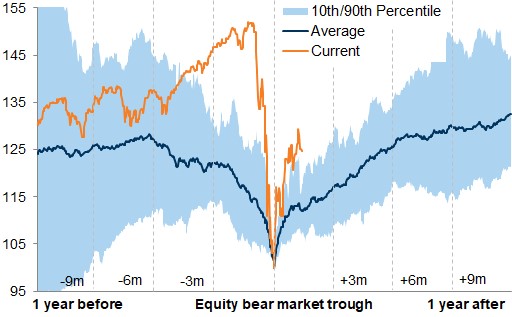
As you can see from the chart below, this was a very quick decline and a quick recovery. It was below the 10th percentile and then above the 90th percentile of bear markets. The stock market is living on borrowed time in that investors are hoping for more stimulus until a vaccine comes out. And the market revisiting the bear market low has been taken off the table. But that doesn’t mean we will see a new high soon. If the cloud stocks decline like they did on Tuesday, we could see a 5% correction from Monday’s high (which was 0.31% below the bear market peak).
Nasdaq Takes A Breather
CLOU index was down 2.04%. Adobe stock fell 1.7% and Salesforce.com stock fell 2.8%. This is nothing compared to the run up they have experienced. It’s tough to tell how far they will fall because they are doing well compared to most companies.
As you can see from the chart below, prior to Tuesday’s decline of 2.06%, the Nasdaq was on a 6 day winning streak in which it gained 0.5% on average. Last time the Nasdaq was on such a streak was in November 2003 which followed the burst of the tech bubble.
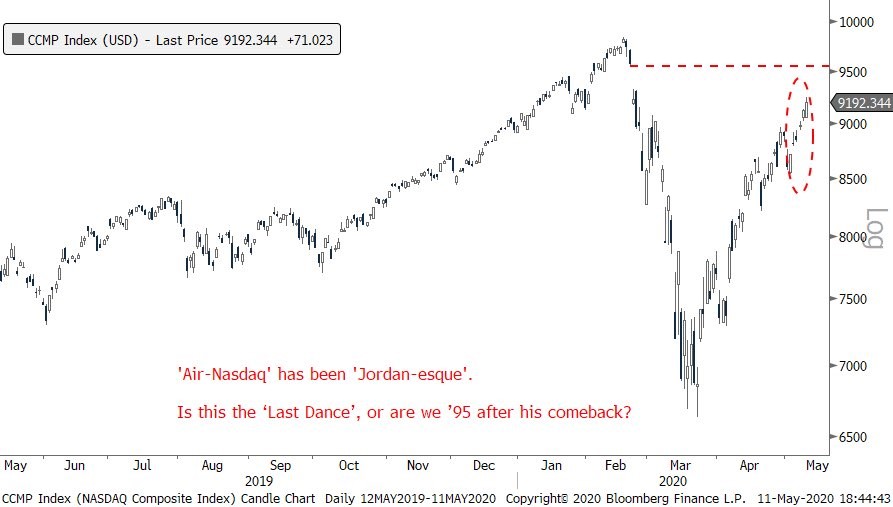
The chart calls this market “Jordan-esque” which is a reference to Michael Jordan who dominated basketball in the 1990s. Biggest potential negative catalyst for cloud stocks is if an elongated shutdown makes SaaS companies discount their services.
Software companies deliver immense value for the price they charge. But if their customers are in immense pain, cost cutting will occur everywhere. Nothing will be left off the table. These companies would still outperform, but they won’t be left unscathed. That means they shouldn’t be at record highs like some of them are.
$3 Trillion Stimulus
Democrats unveiled their latest suggestions for a stimulus plan. The market had already fully priced in additional stimulus if the economy stayed weak for another few months. So the market is in an interesting spot. It will only go back to the lows if the Fed or the government stop the stimulus and it will only reach new highs if economic activity is on a clear path back to normalcy.
It’s no surprise the market didn’t rally in reaction to this plan because it has already come so far. Nothing can surprise to the upside at this juncture as the government has been more supportive of the economy than at any time in history. It’s also political suicide to be against stimulus programs at a time when the unemployment rate is the highest since the Great Depression.
Specifically, the stimulus gives $1 trillion in relief to state and local governments. There is a 2nd round of direct payments of $1,200 per person and up to $6,000 per household. There is $200 billion for hazard pay for essential workers who face health risks in their jobs. We must support those who risk their lives to support the economy. And there is $75 billion for testing and tracing the virus.
Biggest potential aspect is an extension of the $600 jobless claim benefit per week to January. It is set to expire after July. The government is taking no chances with the possibility that the economy doesn’t recover in the next few months. Some people that could find a job will be less likely to do so if they are getting paid that much to not work for that long.
There is $175 billion for rent, mortgage, and utility insurance. Many people have stopped paying their rent because they lost their job and they can’t be kicked out. There’s a special Affordable Care Act enrollment period for people who lost their employment health insurance.
And there’s a 15% increase in the maximum benefit for food stamps. Also, there is $10 billion for emergency disaster grants and the employee tax credit: both for small firms. Finally, there is election safety and support for the postal service.
Personally, I think the stock market will rally modestly when a stimulus bill passes. It would decline at least 5% if nothing is passed. That means, doubts about something passing could cause at least a 2% decline.
Fauci Throws Cold Water On Optimism
The stock market was down as the Democrats stimulus plan was unveiled. It really started to fall at the end of the day after Fauci spoke. Some main points Fauci made were the following: 1) He described the risk of opening the economy too soon without widespread testing and contact tracing measures; it could lead to further outbreaks the government can’t control. 2) New hotspots, which are areas where the pandemic runs rampant, could hurt the ability for local economies to recover. 3) Even though there are 100 vaccines being worked on, “there’s no guarantee that the vaccine is actually going to be effective.” They could also backfire and make the virus worse.
Personally, I have faith in the human ability to fight this virus, but that doesn’t mean I will invest in the market when it acts as if a vaccine being discovered is a guarantee since it’s not.