Slight Rebound On Monday With More Coming Tuesday
From the peak last week to the trough on Monday, the market fell about 4.8%. That was the 5% pullback we called for. Like clockwork, the stock market rebounded from the morning decline to close higher. S&P 500 increased 1.5% from the morning low to close up 0.42%. Plus, the futures market was up, indicating another rally on Tuesday.
This market is range bound because we have no indication the virus will be cured in the near term. And we have no indication the economy is going to ramp back to where it was before this dip within the next few quarters.
Usually, it takes about 2 years for the economy to recover. If a cure is found soon, this could be the quickest recovery ever. If this virus is with us until a vaccine is discovered and delivered in a year, this could be closer to an L shaped recovery than a U shaped one. Obviously, there is risk of a second wave.
Personally, I’d rather not buy stocks all the way up to the record high while facing the risk of another infection. Understandably, I need to be paid for that risk. That’s why stocks will unlikely explode in May. Stocks will likely be range bound for the next few weeks.
Big Tech Makes Index Quality
S&P 500 has become a quality index over the past few years as the highly profitable big tech firms have become dominant. That’s not a bad thing for index funds as Microsoft and Amazon are cloud computing companies. The cloud is a fast growing safe industry because companies rely on it for mission critical processes.
With that being said, if you compare 2008/09 to 2020, the S&P 500 lost $49 billion in earnings power from the 2 largest energy companies which are Chevron and Exxon. It gained $106 billion in earnings power from the big tech firms which are Microsoft, Facebook, Amazon, and Apple. Big tech firms are safer than energy stocks because energy is cyclical. Many are actually bullish on energy now, but that’s not the point.
Low Interest Rates Help Stocks
S&P 500’s dividend yield is significantly higher than the 10 year yield because treasury yields fell and stocks fell. Even with the huge cancelations of dividends, the stock market is a better place for yield than the bond market. Treasuries aren’t a great place to invest for the long term unless you foresee negative yields. Uncertainty in markets and the decline in yields are why gold has had a great year.
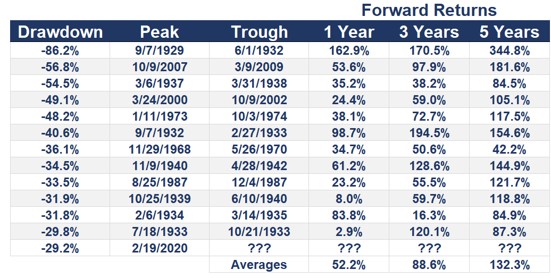
Getting back to stocks, the top table below shows when the S&P 500 initially starts yielding 0.25% more than the 10 year treasury yield, the S&P 500’s median return over the following year is 24.6%. Stocks only fell once out of the 5 other examples. Dividend aristocrats do even better as they rise 28.2% per year with no losses. Finally, the ICE 20+ year treasury index falls 3.3% in the following year. It makes little sense to own treasuries for performance. People should only own them for diversification.
Valuations Are High
As you can see from the chart below, almost every sector is trading at a higher PE multiple than its 25 year average. You’d think with all the uncertainty that stocks would be trading at a discount. On the other hand, rates are very low, the Fed is buying corporate bonds, and the government is doing fiscal stimulus. Stocks do the best when the unemployment rate is high and falling because it allows for higher margins and improving revenues.
We are about to have a record high unemployment rate. In theory, that’s the most bullish possible scenario. Question is when it stops rising. It will likely peak in May as people will start to get back to work later this month. It will really fall when the extra $600 per week in unemployment benefits run out in about 3 months.
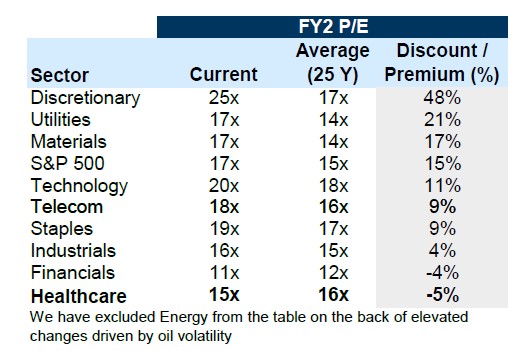
As you can see, the energy sector was left off because of earnings volatility. This sector is very cheap if you look at peak cycle earnings. You can’t look at this year because it will lose a lot of money. Healthcare sector is 5% cheaper than average.
Personally, I love the health insurance stocks because they are benefiting from the decline in elective surgeries. Consumer discretionary sector trades at a 48% premium to its 25 year average because of Amazon. To be fair, there has never been a tech stock like Amazon in the discretionary sector. It’s primarily a cloud stock if you look at profits.
Review Of Apple’s Earnings
Apple reported last week. Now that earnings season is calming down, let’s take a look. Apple reported $2.55 in EPS which beat estimates for $2.26. It had $58.3 billion in revenues which beat estimates for $54.54 billion. Apple under-promised and overdelivered even with a virus.
This company is a beast. It is one of the rare firms still buying back stock as it authorized a $50 billion increase in its buyback. It’s also paying an 82 cent dividend. Bad news is iPhone revenue fell 7% yearly to $28.96 billion. This is still primarily an iPhone company. As usual, services revenue was consistent. Apple wants this to be its bread and butter in the next 5 years. It had $13.34 billion in revenues which was up 16% from last year.
Tim Cook, the CEO, stated the lockdown is helping its TV subscription service. In hindsight, it was launched at the perfect time. He said, “It’s clearly helping the iPad and the Mac and, for that reason … we envision both of those to have improving year-over-year performances in this current quarter,” Cook told CNBC. “If you look at TV+ as an example, we’ve seen a significant uptick in the number of people that are viewing content as well as the engagement with content.”