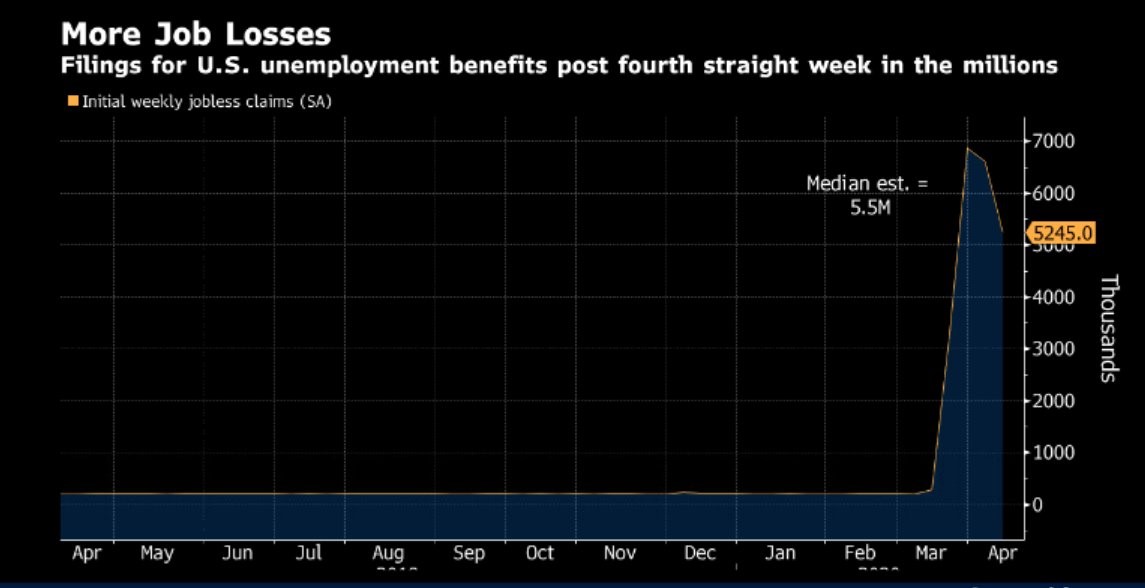
Jobless Claims Fall
As predicted, jobless claims fell sharply in the week of April 11th. Firstly, last week’s report showed claims were revised up from 6.06 million to 6.615 million which puts it just below its cycle high the week before. The addition of the 5.245 million claims in this latest report puts the unemployment rate slightly above 15%.
That’s higher than at any point since the Great Depression. Remember, stocks do well when the unemployment rate and jobless claims are high. Best case scenario is where we are now: high and falling claims.
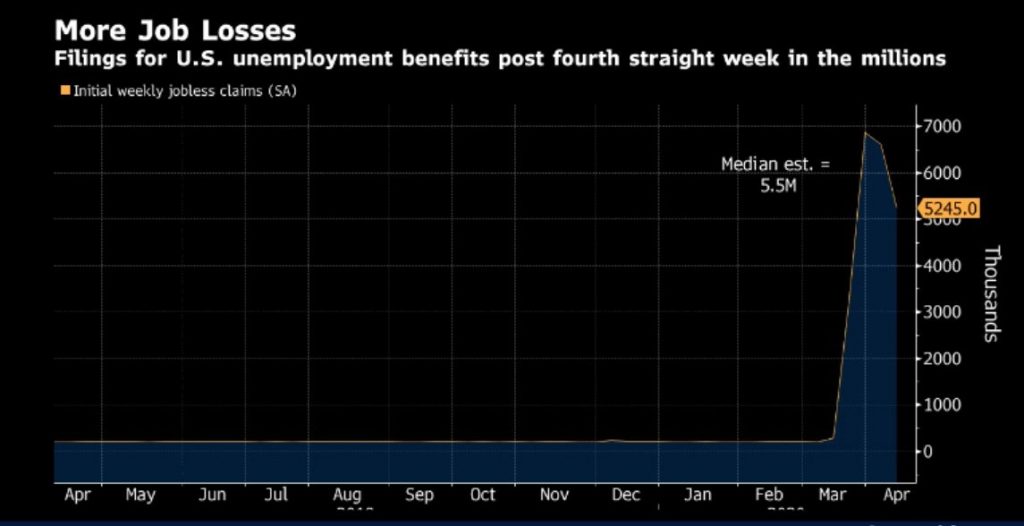
Estimates were nearly hit as the consensus was 6 million. Finally, the consensus was too bearish. That’s a very good sign. Even if this reading is revised higher, it won’t be revised above last week’s reading or the record high. That record high will hold because it’s impossible for that many people to lose their jobs every week without everyone being unemployed. Unemployment rate is already at 15%.
If you think it will peak somewhere around 20%, then the peak in jobless claims is in. As you can see from the chart above, current jobless claims are dramatically above where they were before this recession. Claims are so high that when you look at the long term chart you can barely tell the difference between the 2008 recession and this past expansion.
Record High Continuing Claims
Initial claims have become a ridiculous stat because all the claims that usually happen in a recession occurred in a period of a few weeks. Combination of this being the worst labor market since the Great Depression and the weakness happening so suddenly, make it tough to compare to other periods. Continuing claims get rid of the suddenness and allow you to focus on the total since continuing claims slowly build. In the week of April 4th, continuing claims rose from 7.446 million to 11.976 million.
Peak in the last recession was 6.635 million. We had more initial claims in one week in March than we had continuing claims in the worst recession since the Great Recession (2008). Remember, continuing claims peaked in the last week of the recession.
Most are looking for this recession to be very quick. We will have a good idea when it will end when claims peak again. Everyone will be saying how bad the economy is at the peak in continuing claims. Just like they are saying to sell stocks now even after initial claims peaked. Ignore them.
Poverty To Explode
People are going to be hurt by this recession. Many people who didn’t have a job before this recession won’t get any help because they didn’t file taxes which is necessary to get the $1,200. Obviously, you can’t get unemployment insurance if you never had a job. The government is doing a better job addressing this hardship than it ever has with a recession. That makes sense because we have seen an expansion in the social safety net and because the government caused this shutdown.
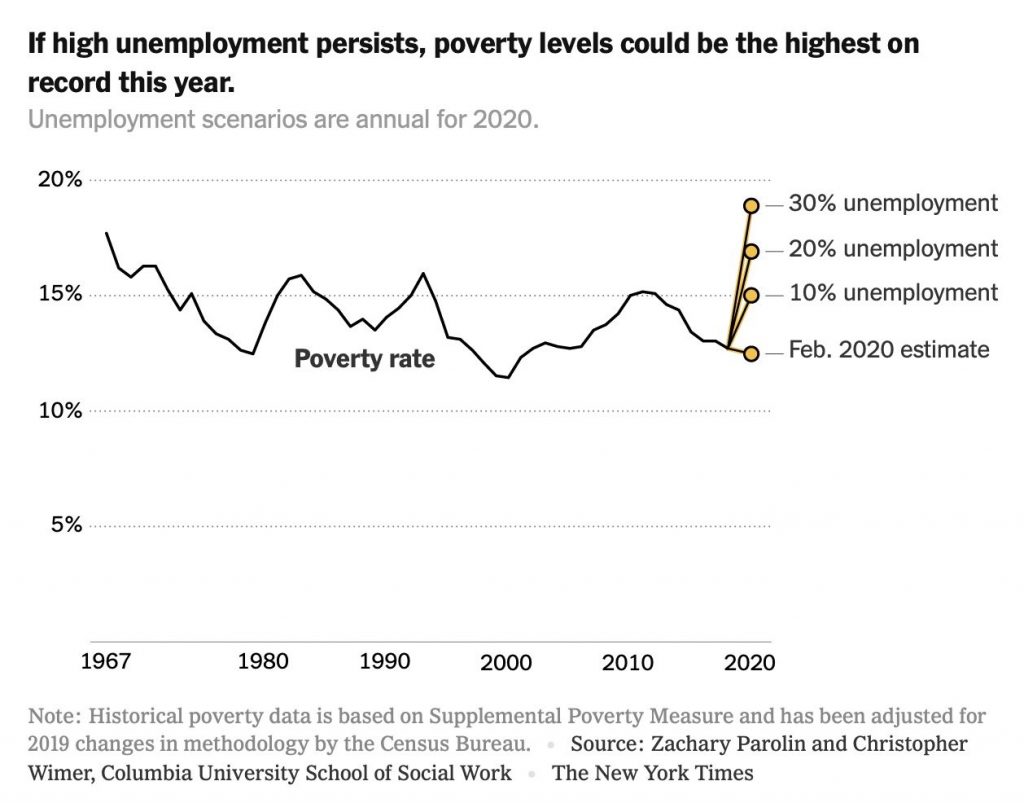
As you can see from the chart below, the poverty rate is set to increase to the highest level since right after the financial crisis if the unemployment rate rises to 10%. Unemployment rate is about 15% according to jobless claims. That means the poverty rate could rise to near 17%. Good news is the poverty rate doesn’t rise that quickly. That’s why it rose after the last recession.
If this recession is quick and we can get small businesses grants, we can avoid a huge disaster. Other good news is people aren’t getting kicked out of their houses for missing a mortgage payment. Kicking people out makes no sense because once the shutdowns end, people will be able to afford their payment. Estimate is 5.5 million mortgages will be past due if the unemployment rate rises to 15%. That’s 10.3% of them.
Reopening The Economy
A new narrative is that even if the economy is reopened, people won’t go back to normal. Even if a restaurant opens, people won’t show up. While it’s true that the government reopening the economy, it's only step one for the recovery. With basic safety measures, we will see an improvement in business activity.
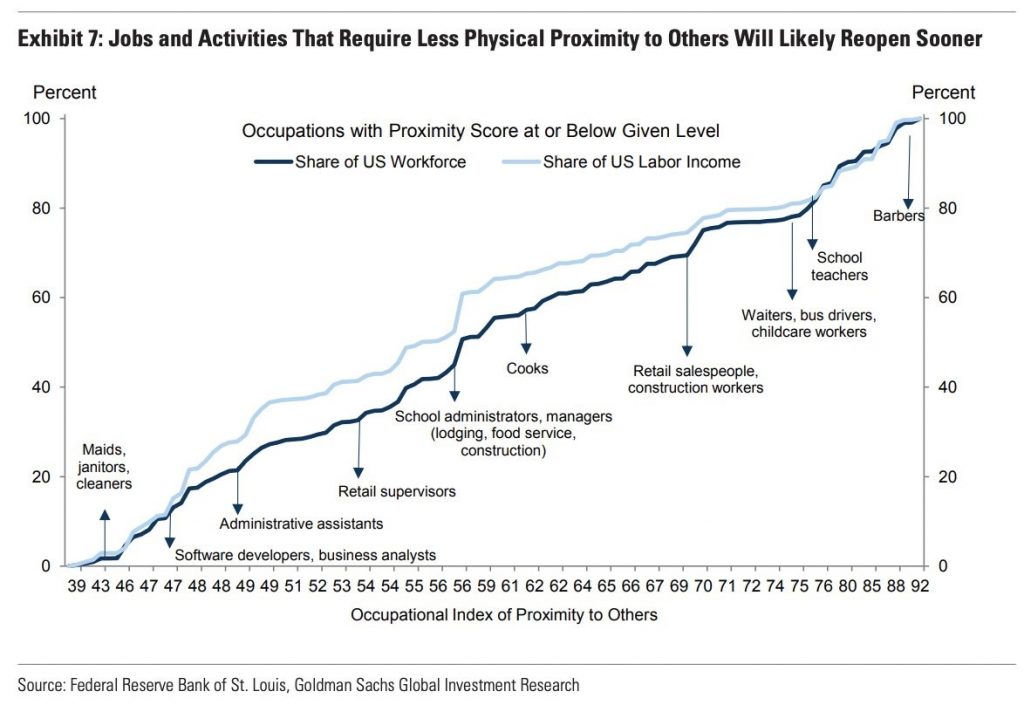
Of course, if a cure is found in the next few months, we can go completely back to normal. The chart below shows the occupational proximity to others as a percentage of the labor market. Obviously, barbers are very close to people which means they should be one of the last businesses to open.
On the other side, software developers and business analysts can work from home. Jobs on the left hand of the chart are likely to come back in May, if they ever stopped.
Earnings Estimates
Earnings season won’t be as bad as many expect for stocks. That’s because everyone knows Q1 will be weak and Q2 guidance will be nonexistent. As you can see from the chart below, estimates are for a decline of 12.07% in EPS in Q1. It won't be surprising if this is beaten because only the 2nd half of March was terrible. That can only do so much damage.
Q2 EPS estimates call for a 22.94% decline in EPS. That’s closer to what will happen than the -10.25% estimate at the start of the month. If the economy reopens in mid-May, the results might not be as bad as Goldman’s estimate for a 100% decline.
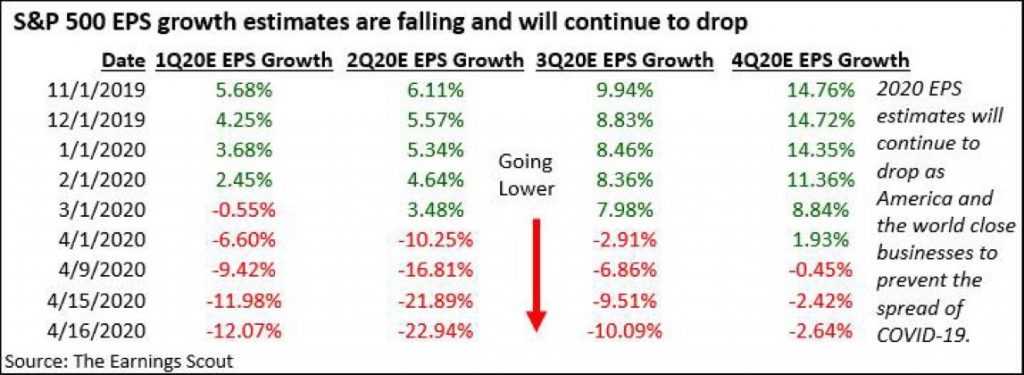
2020 consensus estimate for S&P 500 EPS fell from $152.10 to $146.79. That’s actually starting to get reasonable. Within a week or two, estimates will be too low and very beatable. That’s a buy signal. As you can see from the chart below, the FAANG stocks help earnings growth slightly.
In Q2, the FAANG stocks help EPS growth by 2.98%. Estimates vary widely, so this can be wrong. Amazon is doing really well, but retail is a low margin business. Netflix probably had a huge jump in subscriber growth similar to Disney+.
