Big Decline On Monday
S&P 500 had its biggest 1 day decline in 2 years as it fell 3.35%. This decline was so severe, it wiped out the entire year’s gains as the market is now down 15 basis points in 2020. This was the kind of volatility investors have been searching for all year. It’s the type of decline that makes me more bullish in the intermediate term as my year end target now implies more than a 7% gain in the next 10 months.
Let's first focusing on the context of the recent market action rather than the headlines of the day. We're doing that because when stocks are expensive and have run too far, they are vulnerable declines for any reason.
A new investor might want to know how it’s possible to figure out when various news events will move stocks. You can’t predict the news flow, but you can predict the likelihood of bad news having a big impact on stocks by reviewing sentiment and valuations.
The stock market now has had a reset where it can asses the coronavirus logically and work from there. Most investors don’t anticipate another big decline like this to be caused by the coronavirus. Next negative catalyst is Bernie Sanders doing well on Super Tuesday which is only in a week.
Coronavirus Scares Investors
Even though the coronavirus has become much less of an issue in China, it caused stocks to fall because it is spreading outside of China. Earnings would take a major hit if the economies of other countries such as South Korea, Iran, and Italy shut down for a month too. Obviously, if it can spread to Italy, it can spread to America which creates a new tail risk.
According to a survey of market participants, 44.2% stated they expect China to stem the spread of coronavirus by Q2 2020. 47.8% stated it wouldn’t spread widely in Western Europe or the U.S. New cases recently discovered definitely increase those odds. Finally, 66.1% stated they weren’t worried about their personal or family’s health. If that switches to yes, we could see indiscriminate selling that wildly surpasses that of Monday.
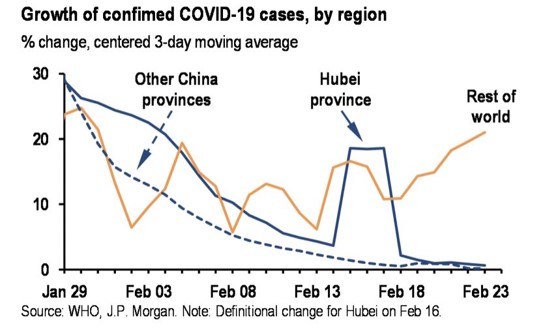
Situation in China outside of Hubei and inside Hubei is getting better quickly as you can see from the chart below. As of February 24th, there were 508 new cases and just 74 new deaths. There were 499 cases in Hubei and 68 deaths. That brings the total number of cases to 77,658 and the total number of deaths to 2,663.
On the other hand, there has been a spike in the number of cases in the rest of the world. There are a lot of countries this is growing in. If there are only a small number of cases in some countries, governments might be slow to act. They might not know of the cases quickly.
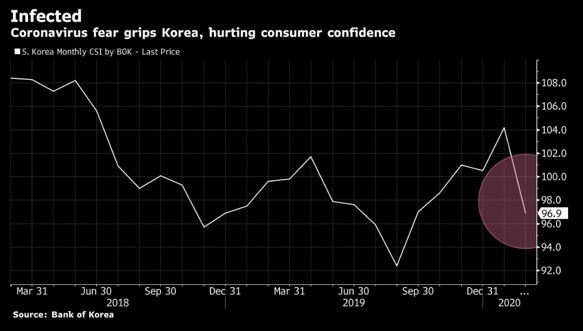
In South Korea, there were 60 new cases which brought the total to 893. There have been 8 deaths. This isn’t killing more people than the normal flu, but it is having a massive impact on the economy. As you can see from the chart below, consumer confidence in South Korea fell the most in 5 years. What if confidence fell like this in other developed markets? It would further impact Q1 GDP growth which is already going to take a tumble because of China.
China is showing signs of life. For example, there were 2.7 million people on China’s metro system on Monday. That’s up 58% from last Friday. That’s still below the average of 11 million, but it shows progress. China should be nearly back to normal in Q2.
Specifics Of The Wild Session
This was the 13th largest gap down for the SPY (the S&P 500’s ETF) since 1993 when it started trading. The market gapped down 2.91%. This was the 13th gap down of 2% or more on a Monday since 1993. Average change in the next week from Monday’s close is a gain of 3.25%.
CNN fear and greed index fell from 44 to 29 which is fear. It's still possible that this reading could get to extreme greed. It’s very close now, not that there is actually fear gripping Wall Street. There is only fear if you’re looking only at the long bond which has rallied tremendously.
30 year yield is down to 1.86% as it hit a new record low on Monday. This will probably put the average 30 year mortgage rate at a record low. 10 year yield is at 1.4%. Intraday all-time low was 1.325%. It hit 1.355% on Monday afternoon. It wouldn’t take much to cause it to set a new record low. The market is starting to price in 3 rate cuts in 2020.
Obviously, all sectors fell on Monday. Worst 3 sectors were energy, technology, and consumer discretionary. They fell 4.74%, 4.19%, and 3.53% respectively. Exxon Mobile stock fell 4.68% which now gives it a yield of 6.17%. Tesla stock fell 7.46%. Surprisingly, the speculative Virgin Galactic Holdings stock rose 1.24%.
Finally, the prediction that Bernie Sanders winning in the polls and votes would hurt healthcare insurance stocks worked out. IHF ETF fell 5.49%. It was the worst case scenario for these stocks. A pandemic would hurt their profitability. And Medicare For All would kill it. United Health stock fell 7.84% which was its biggest decline in 8.5 years.
Sanders Has A 62% Chance Of Winning The Nomination
There will be another debate on Tuesday. After Bloomberg was attacked last debate, it seems likely that the attacks will all shift to Sanders. He currently has a 62% chance of winning the nomination. Biden is expected to win 4 states and Bloomberg is expected to win 1.
Next race is South Carolina on Saturday and then comes Super Tuesday. Personally, I think Biden will win South Carolina as he does well in the Southeast. In the past 3 polls, Biden was up by 4%, 5%, and 15% in the state. It’s clear that Bloomberg has lost most of his momentum as the latest CBS national poll has him in 4th pace at just 13%.
Warren was in 2nd place at 19%. Warren surging is the worst case scenario for Bernie. If she hurts him in the next debate like she hurt Bloomberg last week, she will shoot up in the betting market.