Terrible Start To Q4
Q4 has started with back to back sharply down days. Many investors predicted the VIX would touch 20 this month and it hit 20 on the 2nd trading day. VIX was up 2 points to 20.56 because the S&P 500 fell 1.79%. The S&P 500 has never started a Q4 down at least 1% on consecutive days. Not even the terrible Q4 2018 accomplished that feat.
Last time the market fell at least 1% on consecutive days to start a quarter was Q3 2002. This didn’t even happen in the last recession. This is likely because new money comes in at the start of the quarter. Q4 is the best quarter on average. Most days the market has fallen 1% to start a quarter is 7 days in Q2 1932. These stats show how unusually bad these first 2 days of October have been. They don’t mean stocks can’t fall further in the next few days.
Why Stocks Sold Off On Wednesday
A main reason stocks sold off on Wednesday was Tuesday’s ISM report. Secondary reason was the disappointing ADP report. It also didn’t help that America announced new tariffs on the EU just before its big negotiations with China. Let’s hope this move means America is confident it will make a deal with China.
Unfortunately, hope isn’t a strategy, so we must stick with what we know. News was that America will tax EU aircrafts at 10% and tax agricultural and other products at a rate of 25%. Tariffs are expected to go into effect on October 18th and the 2 sides will meet for trade talks on October 14th.
Another negative on Wednesday was the automakers’ September sales results. Toyota sold 169,656 light weight vehicles which was a 16.5% yearly decline. Honda sold 113,925 vehicles which was a 14.1% decline. Nissan sold 101,244 cars which was a 17.6% decline. Automakers gave out an average of $4,100 in incentives in Q3 which was the highest ever. Those incentives were given out because of the inventory glut.
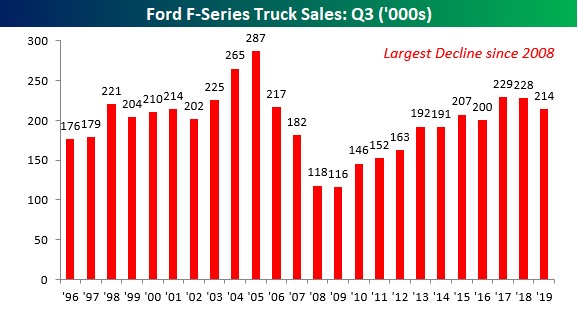
As you can see from the chart below, there were 214,000 Ford F-series truck sales in Q3 which was down from 228,000 last year. That’s the biggest decline since 2008. Ford stock fell 3.26%. Good news is it’s not close to the size of the 2008 decline. It might be a plateau rather than a recession signal.
On the positive side, the motor vehicles sales report showed there were 17.2 million total vehicles sold which beat estimates for 16.9 million. That’s up from 17 million in August. Domestic sales increased from 13.2 million to 13.4 million. These results support the narrative that the plateau is continuing.
September had 2 fewer selling days than last year. More importantly, sales around Labor Day were counted in August. This is why we use seasonally adjusted data. To be clear, I don’t have an opinion on the individual auto stocks. But I do think the pessimism was overdone given the strength in the overall report.
Details Of Wednesday’s Action
Nasdaq fell 1.56% and the Russell 2000 fell 0.92%. CNN fear and greed index fell 14 points to 34 which is fear. It’s amazing how quickly the market went from greed to fear as one week ago the index was at 59.
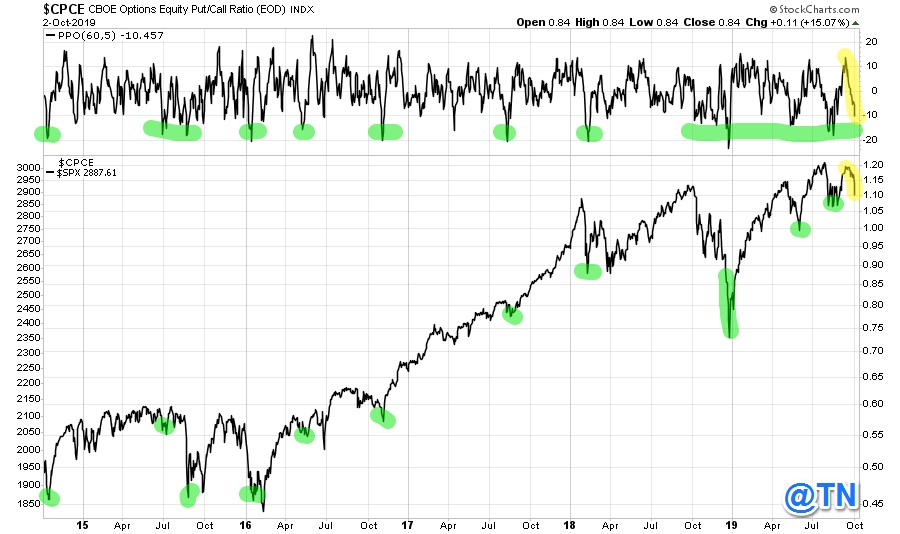
As you can see from the top chart below, the short term equity only put to call ratio has fallen sharply and is near extremes previously associated with a bounce in the S&P 500. While the data at the start of this article doesn’t necessarily mean stocks should rebound soon, this index is close to giving the all clear signal to buy stocks.
Another large decline on Thursday would make the market a great buy. This decline represents the market starting to price in the worst case scenario on trade and the economy even before the negotiations next week start. Let’s wait for bad news before selling because anything is possible.
Every sector fell just like on Tuesday. Once again energy and the financials fell sharply as they were down 2.61% and 2.1%. Energy sector’s speed in which it has lost its late August/early September gains rivals the speed in which Saudi Arabia regained all its production capability after the September 14th attacks.
Banks don’t like the odds of rate cuts increasing. There is now a 75.4% chance of a cut in October and an 87.7% chance of a cut by the end of the year. As I mentioned in a previous article, the cut has been moved up from December to October. Furthermore, there is a 37.8% chance of 2 more cuts this year. If the Fed cuts 4 times in 2019, there will only be room to cut 4 more times in an actual recession. 2 more cuts would signal that the Fed sees a recession coming soon.
Banks also don’t like the recent rally in treasuries. 10 year yield is now at 1.58% which puts it just 15 basis points above this year’s low. More negative data that comes out, the higher the chance it will hit a new record low. Since I don’t see a recession coming, I don’t see yields falling that low.
However, I have been too bearish on treasuries recently. The 2 year yield is at 1.47% which is only 4 basis points above its cycle low. That makes sense because the market sees potentially 2 more cuts this year. The Fed is about to steepen the curve with its cuts as the 10 year yield is 11 basis points above the 2 year yield.
Quick Democratic Primary Update
Elizabeth Warren is the official frontrunner heading into the October 15th debate. If the election was held today, I think she would win. Latest national polls have her up by 3 points and 6 points over Biden. His average polling lead has fallen to 1.7%. The election isn’t held today though, so she’s far from a lock to win the nomination. Only thing I can say is it will likely be her, Bernie, or Biden.