Biggest Spike In Oil Prices Ever
There was a massive increase in oil prices on Monday because of a coordinated attack on Saudi Arabia’s oil production. Specifically, the oil processing facility in Abqaiq and the nearby Khurais oil field were attacked. That shutdown 5.7 million barrels of production per day which is 50% of Saudi Arabia’s production.
Saudi Aramco is trying to regain 2 million barrels of production quickly. But estimates are for it to take weeks for the firm to restore most of its output in Abqaiq. This pushed Brent oil up 19.5% to $71.95 at the open which was its largest increase ever. It closed up 14.6% at $69.02. Similarly, WTI oil opened up 15.5% to $63.34 which was the largest increase since December 2008. It closed up 14.8% to $62.90.
If the only issue for oil production was the few weeks needed to regain production, oil prices wouldn’t have been as much as they were. There is now a geopolitical volatility premium in oil prices until this situation calms down. Initially, the Houthi militia in Yemen, backed by Iran, claimed responsibility for the attack, but many experts don’t think it has the capability to carry out such an attack. America and Saudi Arabia believe Iranian weapons were used.
The fear that is likely keeping oil prices up is that Saudi Arabia will retaliate against Iran. Saudi crown prince stated the kingdom is "willing and able to confront and deal with this terrorist aggression." The Iranian president stated, the attacks were a “reciprocal response” to Saudi Arabia’s aggression against Yemen.
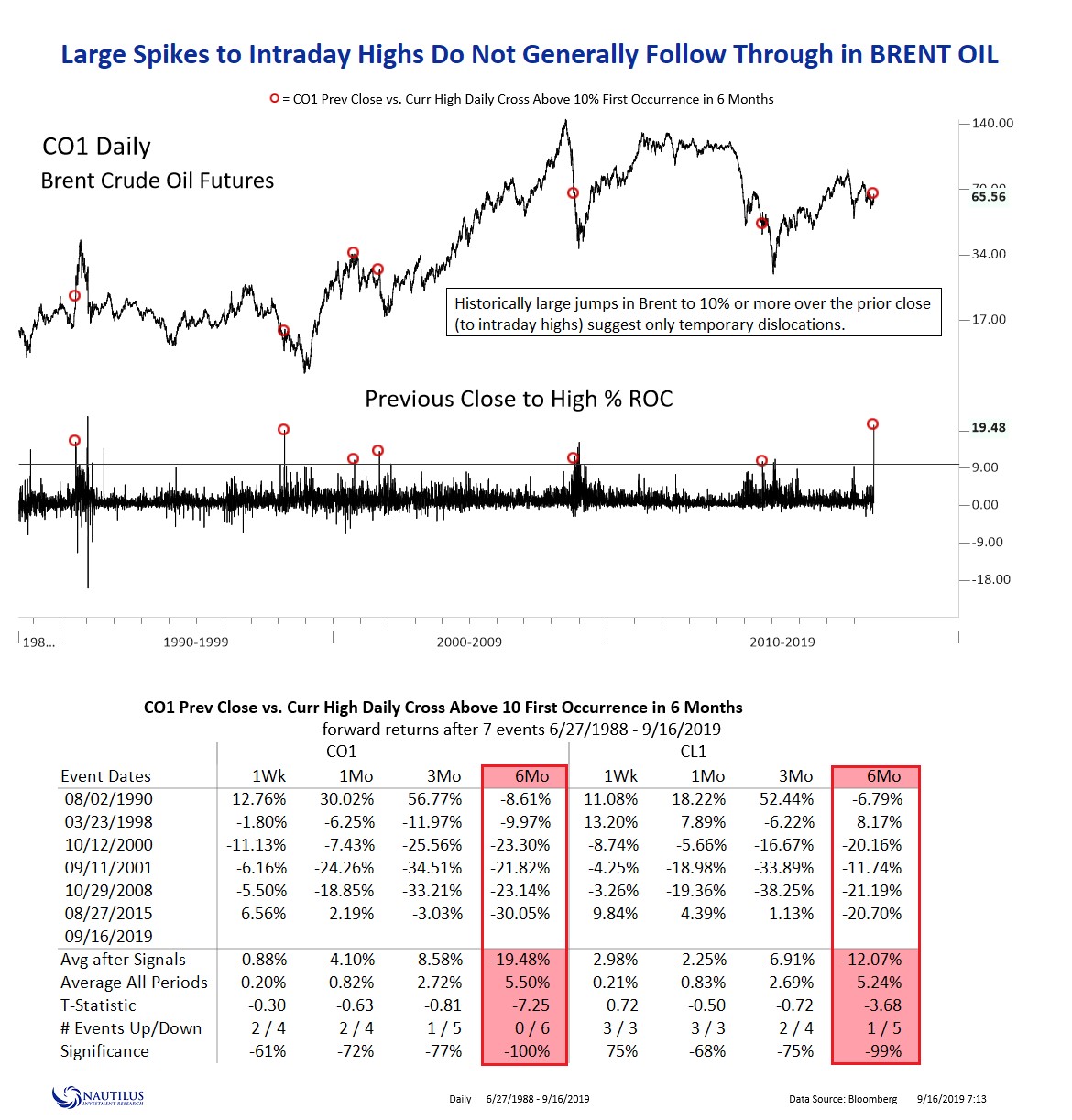
I don’t claim to be an expert in geopolitics. Hope is this situation will cool down without further action. At first President Trump stated America was “locked and loaded." But his latest comments were more muted as he stated he’s in no rush to respond to the attacks. As you can see from the chart below, usually oil prices fall after spikes. The 10 largest spikes in Brent crude oil were followed by an average decline of 19.48% in the following 6 months.
Geopolitics issues usually calm down. While I won’t say oil will definitely fall, I think it’s way too early to act as if we are in a new regime for oil. Even after this large rise, oil is still down from last year. Energy will hurt headline inflation in September and October unless oil really spikes in the next few weeks.
Spike In Oil Slightly Hurts Stocks
Stocks fell modestly on Monday. Equity investors don’t think this oil spike will last because if they did, consumer discretionary stocks would have fallen further. The sector only fell 1.31%. If oil does stay higher, it will hurt the consumer and help the manufacturing sector.
Overall, S&P 500 fell 0.31%, Nasdaq fell 0.28%, and Russell 2000 rose 0.41%. Obviously, the energy sector did well as it was the top performer, rising 3.29%. Oddly, this was only a continuation of the recent rally which started before the spike in oil prices. The sector is up 13.03% since August 27th.
Since then, energy stocks and regional banks have led the market. KBW regional bank ETF is up 13.21% in that period. The worst sector on Monday was materials which fell 1.63%. Real estate was up 1.02%.
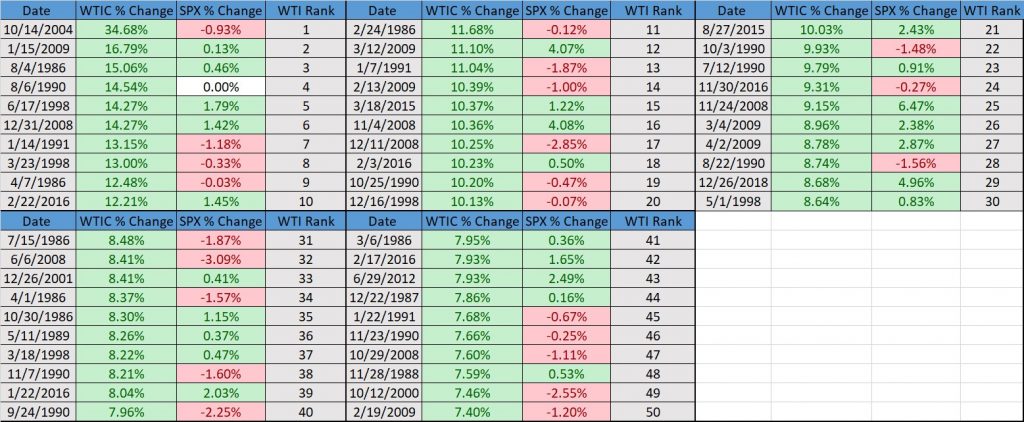
As you can see from the table below, big spikes in oil don’t necessarily mean the stock market is about to crash. Weak oil prices help the consumer, but also signal the global economy is weak. Strong oil prices signal the economy is strong, but act as a cost to the consumer.
When prices spike for geopolitical reasons, it’s a cost to consumers without signaling the economy is strong. It’s the worst of both worlds. For now, this geopolitical issue is limited to effecting energy. But if America and Iran go toe to toe, stocks will fall quickly at least temporarily.
The Fed Will Still Cut On Wednesday
Treasuries have rallied, taking back some of the spike in yields last week. That selloff couldn’t continue at that pace, just like how the rally year to date couldn’t continue. Action has been wild. Trends have gotten out of hand. 10 year yield recently peaked at 1.9% and now it’s at 1.83%. 2 year yield recently peaked at 1.8% and now it’s at 1.75%. The curve flattened a bit as the difference between the two yields is now 8 basis points.
Volatility in the repo market has sent confusing signals to investors looking at the Fed funds futures market to gauge this Wednesday’s Fed decision. Fed funds futures market only shows a 65.8% chance of a rate cut which is probably too low. Fed will definitely cut rates this week. The rise in repo rates is causing traders to expect the Fed funds rate to hold at the high end of the Fed’s new lower target rate.
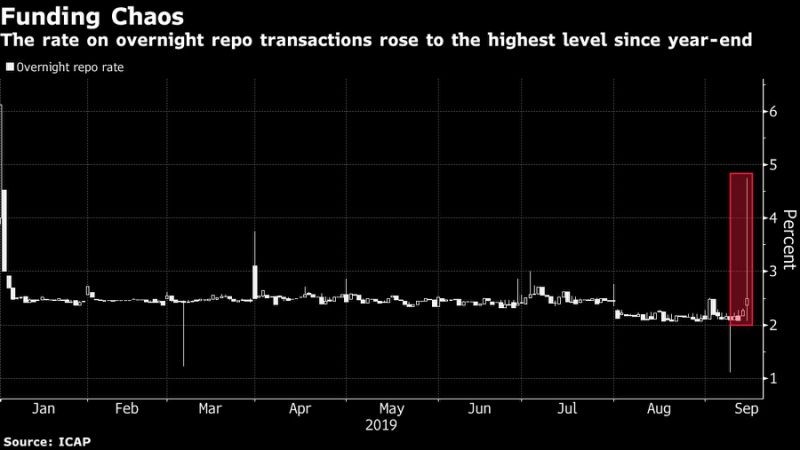
As you can see from the chart below, the overnight repo rate rose 248 basis points to 4.75% which is the highest rate since December. The rise was blamed on the settlement of the Treasury coupon auctions and corporations’ withdrawals from banks and money markets to pay quarterly corporate taxes. This is causing some to say the Fed has lost control of short rates. Since the peak, repo rates have fallen back to 2.5%.
Conclusion
We’ve seen oil prices fall after big spikes like this, but it’s tough to predict geopolitical issues. I stay out of projecting how markets react to political issues. Sometimes you can predict what politicians will do and still get the market movement wrong.
For now, this movement will have a modest impact on headline inflation and hurt consumers a bit. It doesn’t change my macro outlook much. It’s a massive rise in prices for one day, but it’s not as big of a deal over the intermediate term as long as prices fall modestly and don’t spike further.