Economic Growth - Negative Revision To April Chicago Fed Index
Economic Growth was below average, yet there is still no recession. June Chicago Fed National Activity index was released on Monday. It was -2 basis points which missed estimates for no change.
Any time the index is negative, it means growth is below average in standard deviation units. May reading was revised up 2 basis points to -3 basis points. This report looks relatively solid until you see the 3 month moving average. It was revised in May from -17 basis points to -27 basis points. In June, it was -26 basis points.
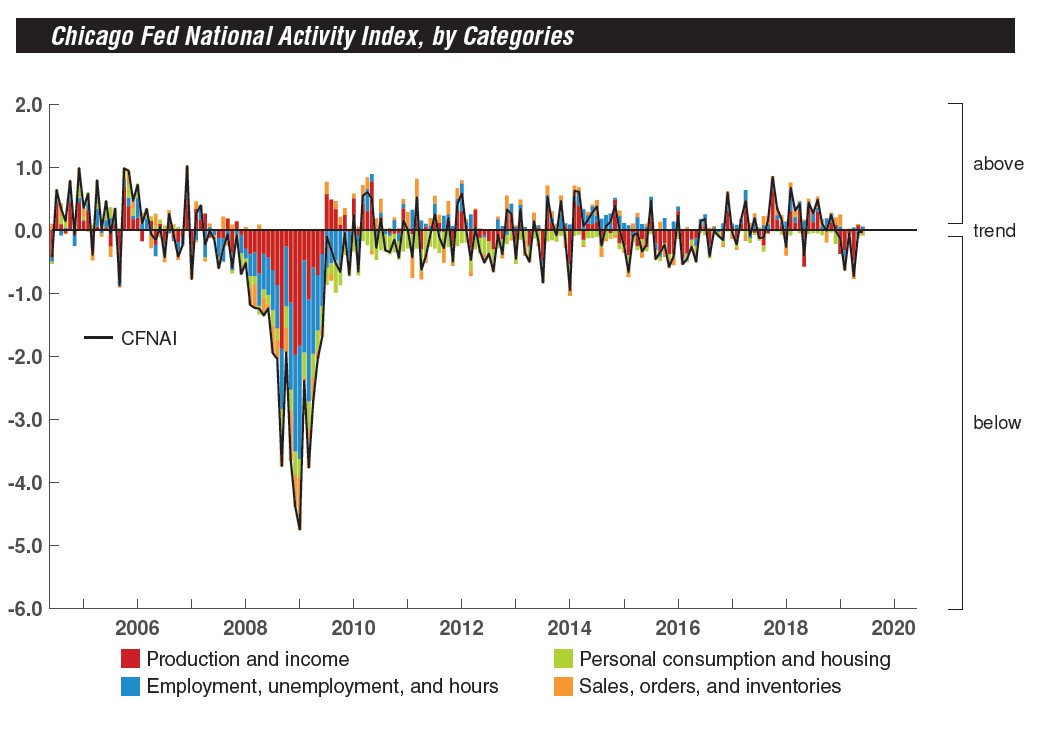
As you can see in the chart below, that weakness stems from the April reading was revised from -0.48 to -0.73. If the 3 month moving average falls below -0.7, it indicates a recession.
Therefore, if the readings would have been similarly weak in the preceding or following months from April, the economy would be in a recession based on this index.
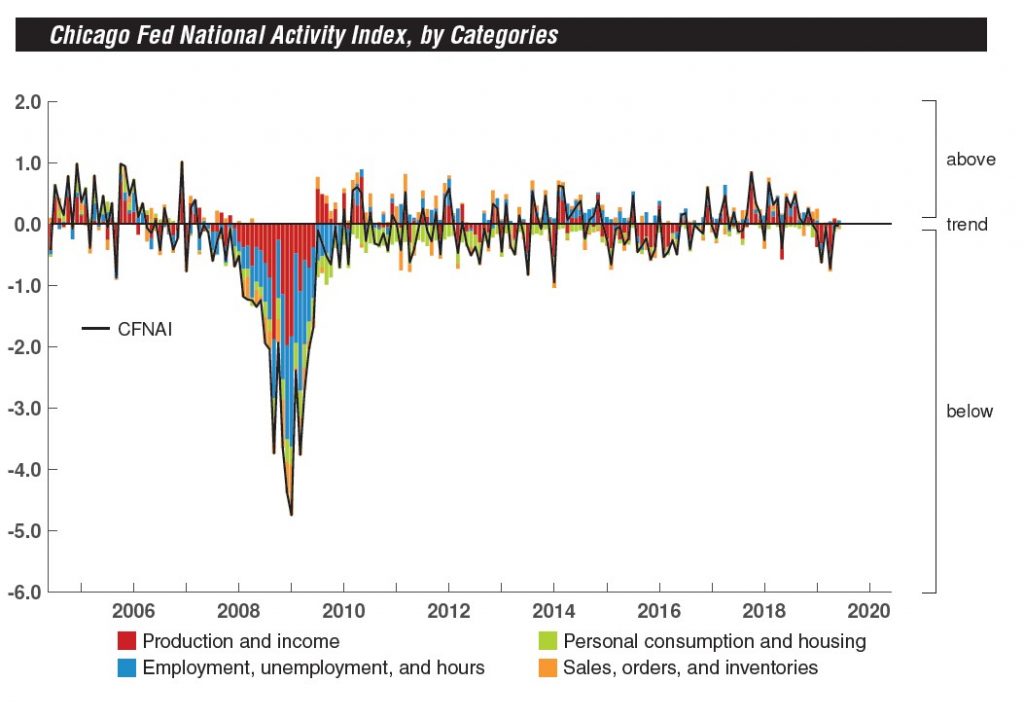
Since the negative revision was so sharp in April, it’s possible, but not likely, that the current months will be revised to show a recession.
Economic Growth - April was the worst month of the year as it surpassed February which was -0.64. As the chart shows, it’s very common to have negative readings. That’s why the 3 month moving average is relied upon so heavily.
In June, the employment segment was the only positive reading as it was up 6 basis points. That’s even with a very solid BLS report which showed 224,000 jobs created.
Production was flat. Sales orders and inventories were down 3 basis points. And personal consumption was down 5 basis points. Only 51 of the 85 reports in the index are in for June. This lack of a full data set explains why older reports can be revised so heavily.
This year’s trend has been flat to down. Which makes sense because Q1 was very weak in terms of real final sales. Q2 headline GDP growth will be unspectacular. But real final sales growth will pick up.
Specifically, the Chicago Fed index has been negative 7 months in a row. Every negative streak of 7 months or more has coincided with a recession. That being said, the June index could easily be revised to show a positive reading.
Economic Growth - Buy When The Economy Is Said To Be In A Recession
It’s best to buy stocks when the NBER determines the economy was in a recession because they are usually late to the game. By the time NBER determines the economy was in a recession, at the very least it’s the consensus. And often the economy is near the end of the recession or it’s already over.
This situation can be summed up as sell the rumor, buy the news. It’s like how traders sell the stock of a company that probably will cut its dividend. When the cut is announced, the stock often jumps. If a company is at a point where its liquidity is drying up, it’s best to cut the dividend so it has a better chance of surviving.
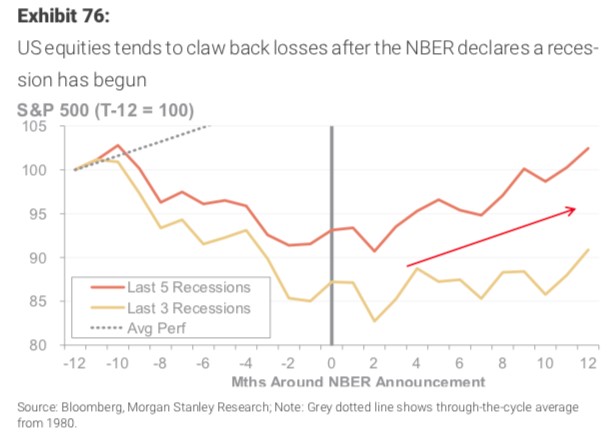
As you can see from the chart below, the S&P 500 fell almost 10% on average before the past 5 recessions were declared by NBER.
There was a slightly lower bottom about 3 months later, but by the time the NBER declared a recession almost all the losses were in. The yellow line shows performance in the past 3 cycles.
Stocks formed a near term bottom about 1.5 months before the NBER declared there was a recession. Then about 3 months after that call, there was a bottom about 2.5% lower. You want to buy stocks when NBER determines there was a recession because equities price in the future, not the past.
Fed’s Options At Its July Meeting
Economic Growth - Now is a great time to preview next Wednesday’s Fed meeting. We are in the blackout period where the Fed won’t make any more statements on interest rates. The blackout period is partially why the market is usually correct when predicting near term Fed policy.
Since the blackout period starts 10 days in advance of the meeting, 10 days before the meeting is similar to the actual meeting day. Especially since there aren’t any statements during the blackout period.
21 days before the meeting is really like 11 days before it. At that point, the Fed has said all it can and the market has its prediction locked in.
Economic Growth - This past week was highly unusual as 2 Fed members altered the odds dramatically
And then the NY Fed and Bullard walked back their statements right before the blackout started. NY Fed’s statement may have been written by Williams himself. He thought his points were misconstrued. I think he was clear; it wasn’t the market’s fault for pricing in 2 cuts.
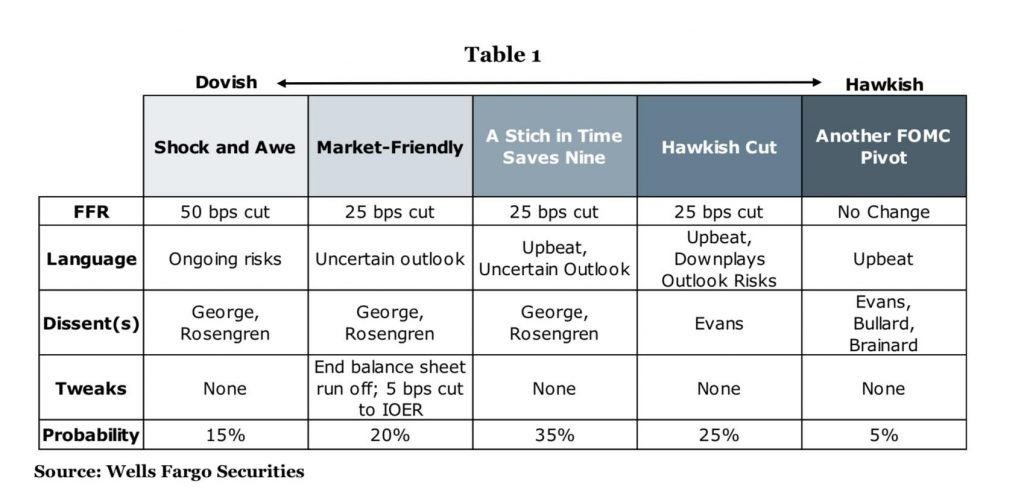
The table below is interesting because it has 5 potential options. With the Fed funds futures market showing a 100% chance of a cut and only 2 members going against a cut, we can safely eliminate the column on the right.
There is a 24.5% chance of a 50 basis point cut, which doesn’t put it on the table in my opinion. The guidance after the 25 basis point cut can be market friendly, neutral, or hawkish.
Market friendly option includes the phrase “uncertain outlook.” Neutral option includes that phrase, but is upbeat.
This hawkish cut is upbeat and downplays outlook risks.
Economic Growth - To be clear, "a stitch in time saves nine" means doing something now to avoid future problems. That describes a Fed rate cut preventing a recession.
I think the cut will be either neutral or dovish. The stock market will likely rally slightly after this meeting as a relief that the uncertainty is over.
While this meeting is very important like the one in December, it won’t lead to a big decline in stocks. Fed is on board with rate cuts.
Personally, I don’t expect the Fed to guide for more cuts this year. But that doesn’t rule them out. Fed effectively ruled out cuts in May, yet here we are with a cut in July. I see one more cut coming in September.