Stocks Vacillate - Very Volatile Tuesday
Volatile swings continued Tuesday as the S&P 500 opened up big. Then it gave back all the gains and fell. Next it rallied a bit more, and finally closed down 0.04%.
At the morning peak, the S&P 500 was up 1.3%. From the morning peak to the afternoon trough, the S&P 500 fell 1.9%. Traders are nervous, but there is very solid support at the February low preventing the market from closing down big.
When you consider the technical support, it makes sense. If the S&P 500 falls through its floor, it will likely continue falling.
A 15% correction isn’t justified given the current economic data. Secondly, there is no reason to make a large trade in either direction until we know what the Fed will do next week.
It’s tough to make a prediction with such little margin of error. But I think stocks won’t fall below the February low until after the Fed meeting. I’m not saying stocks will fall afterwards. I’m just saying the market is in a ‘wait and see’ mode.
Stocks Vacillate - Stocks Could Rally Sharply On December 19th
The CNN fear and greed index fell from 9 to 8. That means if the market is pleased with the Fed’s action, we could see a huge rally on December 19th.
The problem with betting on stocks with that event in mind, is it’s tough to tell what markets will be pleased with.
If the Fed guides that it will raise rates 2 times in 2019, will the market be happy with the dovish move in guidance or be mad it didn’t become even more dovish? I won’t make any bets on that event because it’s too hard to predict. I just think there’s a chance stocks could rally sharply because they are oversold. And, historically, stocks typically rally on FOMC announcement days.
Stocks Vacillate - Sector Breakdown
Nasdaq rallied 0.16% and the Russell 2000 fell 0.21%. Regional banks have been destroying the Russell 2000 in the past few weeks. KBW regional bank index fell 1.03%. Even though there were major swings in the market, VIX fell 3.89% to 21.76.
Worst sectors were the financials and the industrials. Financials fell because the yield curve flattened. The curve is very close to signaling a recession, as I will review in the next section of this article.
The best sector was consumer staples which rallied 0.82% because the flight to safety trade was in place. Campbell Soup stock was up 2.92%.
It’s usually a very bad sign when a defensive stock like Campbell Soup leads the market without any company specific news.
Stocks Vacillate - Yield Curve Flattens Further
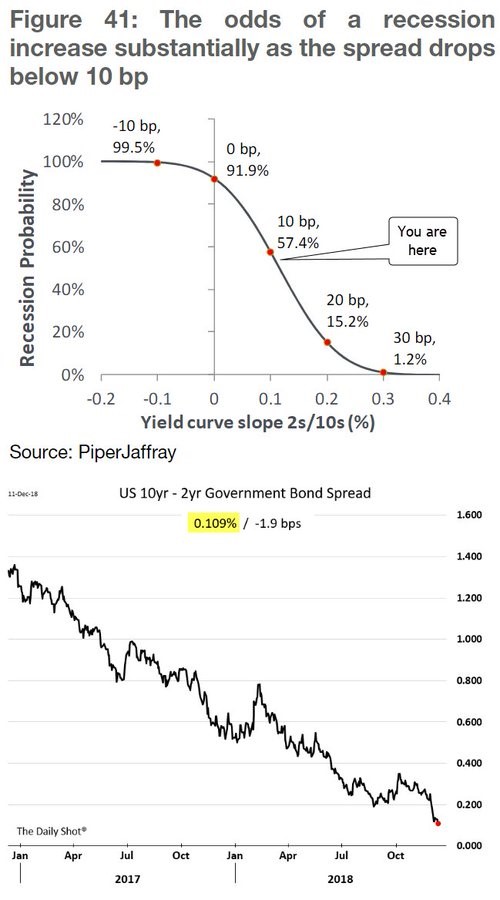
Because the 10 year/2 year curve is so close to inverting, every single basis point is critical. Since stocks sold off sharply when the 5 year yield went below the 3 year yield, I expect another selloff when the 10/2 curve inverts.
The 5/3 year differential has a bad track record of predicting recessions because there are many false readings. If stocks reacted to that differential, which isn’t closely followed, expect a bigger reaction to the 10/2 year inversion.
The 10 year yield is at 2.89% and the 2 year yield is at 2.78% which means the curve is 11 basis points away from inverting. Since the probability of a rate hike next week is below 100%, the 2 year yield would increase slightly if that was the only news released.
However, since guidance is more important, the 2 year yield will react to that. A dovish dot plot could cause the 2 year yield to fall which would steepen the curve. Currently, there is a 76.6% chance of a hike next week. There is a 57.3% chance of at least one hike in 2019.
As you can see from the chart below, the Piper Jaffray analysis shows when the 10 year yield is 10 basis points higher than the 2 year yield, there is a 57.4% chance of a recession.
When the difference is zero, there is a 91.9% chance of a recession. There is probably going to be a recession in the next 1-3 years.
However, it’s more important to figure out how that will affect markets. The inversion might cause a selloff immediately like when the 5/3 year curve inverted.
Stocks Vacillate - JOLTS Beats Estimates
The 4 week moving average of the jobless claims has been rising in the past few weeks. The October JOLTS report isn’t showing weakness yet.
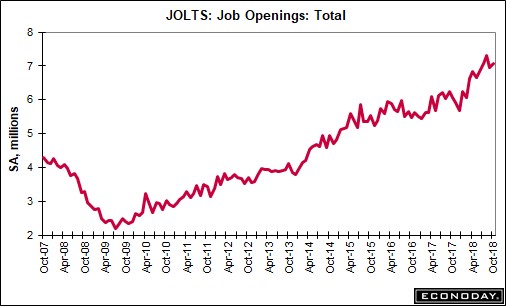
This is probably because most of the jobless claims spike came in November. However, it’s still good news that there were 7.079 million job openings which beat estimates for 7 million.
As you can see from the chart below, the October openings beat the September results which were revised from 7.009 million to 6.960 million. September was a relatively weak report.
There are over 1 million more job openings than people looking for work. There were 6.075 million people looking for work in October and 5.975 million in November.
Hires were slightly below those looking for work as they increased 3.4% to 5.892 million. Many workers aren’t qualified for the jobs employers are looking to fill. There is a skills gap.
Openings were up 16.8% year over year and hires were only up 5.2% year over year. Number of quits fell 1.4% to 3.514 million. They are up 5.7% year over year.
Quits signal workers are changing jobs to get better pay.
Stocks Vacillate - Conclusion
The market is focused on many risk factors at once: the slowing economy, hawkish Fed, yield curve inversion, Brexit, Italian recession, trade war, and government shutdown.
Technicals have prevented stocks from cratering this week. It will be interesting to see if that can be maintained if the curve inverts.
Everything is leading up to the Fed decision next week. The market is like a slinky which has been compressed and is ready to explode. I expect the wild swings to continue for the rest of year. My forecast for stock returns in 2019 will depend on how the year ends because there could be a big shift, down or up.