Consumer Discretionary Stocks Tell the Future
The relative performance of consumer discretionary sector gives us an indicator where the economy is headed.
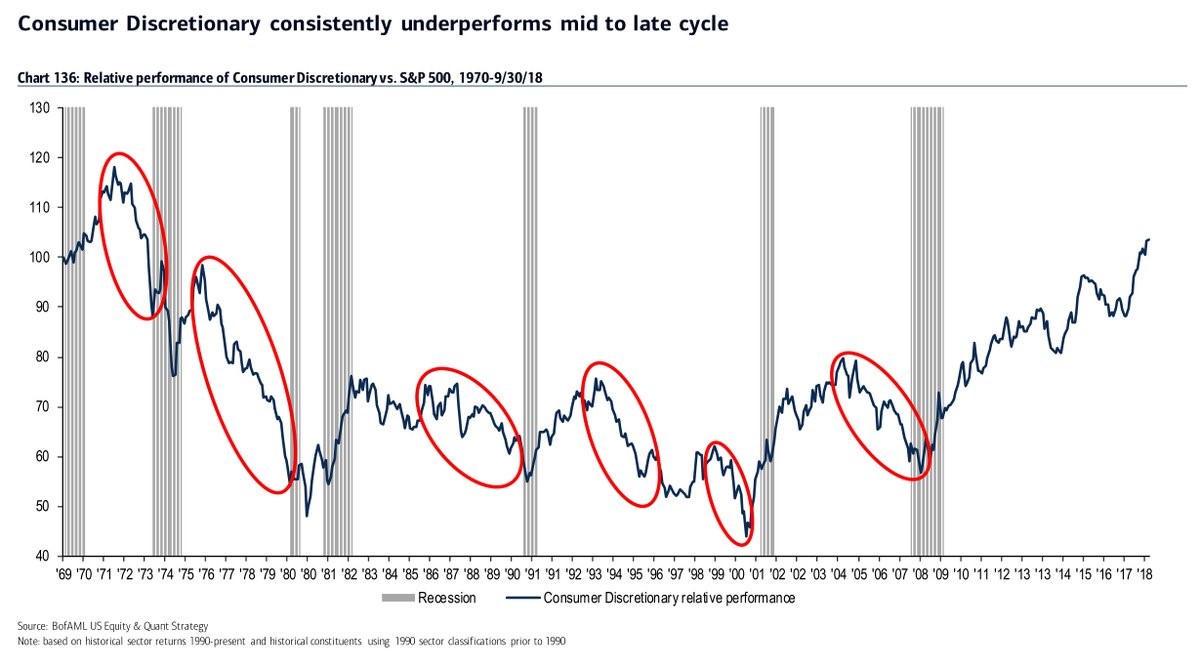
As you can see from the chart below, the consumer discretionary sector has outperformed the S&P 500 as of September 30th. That suggests a recession isn’t coming soon.
The chart shows relative outperformance peaks about a couple years before recessions. One major outlier was the early 1990s when consumer discretionary underperformed the S&P 500. But the cycle wasn’t near its end.
An obvious problem with this chart is it doesn’t include the recent volatility in the past few weeks. From October 1st to December 10th, the consumer discretionary sector fell 11.48%. In that period, the S&P 500 fell 9.81%.
As you can see, consumer discretionary has moderately underperformed. But a recession indicator isn’t close to being shown.
This is why I review daily sector performance. Amazon’s performance is critical because it drives the consumer discretionary sector and has been one of the leaders of this bull run.
Some experienced investors fear the FAAMG stocks will suffer the same fate as the Nifty 50 which was a group of the hottest stocks in the 1960s and 1970s. They have since underperformed.
The truth is those stocks suffered a similar fate as any random group of stocks as most firms don’t last as long as investors think they will.
Consumer Discretionary Stocks - FAANG The Next Nifty 50?
Nifty 50 firms became particularly problematic because of high valuations. FAAMG stocks might have high valuations if analysts’ estimates are too high.
That comes down to your individual analysis. For example, Microsoft survived the tech bubble burst and has become a part of this next wave of speculation; however, many tech firms failed. It’s likely impossible to know now which stocks in the FAAMG group will do well in the next speculative wave.
For example, profiting off user data might be limited as consumers care more about their privacy. Luckily, you don’t need to pick the best of the momentum internet names now.
Whenever you think the next recession is coming, sell high beta stocks and buy them back after the recession is over. It will be time to pick the winners of the next expansion after the recession, when you are picking among the rubble.
Consumer Discretionary Stocks - Recession Coming?
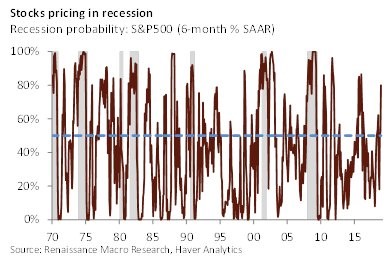
The chart below is a great visualization of a point I have made previously. Stock market corrections are tests to see if the economy is falling into a recession.
If the economy weakens in rate of change terms, the stock market falls to price in a potential recession. However, if none is present, stocks resume their rally. Another way of putting is stocks correct during slowdowns and crash during recessions.
Consumer Discretionary Stocks - Sometimes stocks fall into bear markets outside of recessions
But that is rare, and the declines aren’t as bad as when a recession is present or coming very soon.
As you can see, the 6 month seasonally adjusted annualized returns in the S&P 500 give us a probability of a recession. The indicator always works during recessions, but has many false signals.
There was a false signal during the European sovereign debt crisis in 2012 and the near recession in 2016.
If stocks decline much further, investors are pricing in an economic decline as bad as the one in 2016. This is why as stocks fall further, I’m more open to the possibility that stocks can be a buy.
Each data point updates my thinking on the odds of a recession and each move in the market changes my viewpoint on stocks.
It’s common to see stocks decline on no news or good news. For example, stocks fell on Friday after the decent jobs report. That made many investors more bullish.
On the other hand, we also have seen stocks rally on bad news such as when stocks recovered in November even though jobless claims were increasing.
These moves allow you to profit off quick trades as you try to understand where the economy is headed in the intermediate term. There doesn’t need to be one big trade where you bet on the direction of the economy. It’s not that dramatic.
Consumer Discretionary Stocks - Defensive Stocks Rally
While consumer discretionary stocks have only modestly underperformed the S&P 500 in the past few weeks after outperforming all year, there has been a sharp turn in the relationship between cyclicals and defensive stocks.
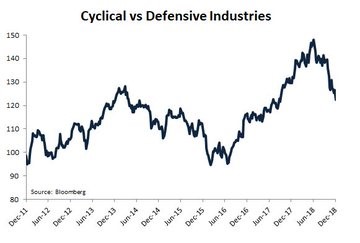
As you can see from the chart below, in the past 6 months, defensive stocks have begun to outperform. That’s because the big internet names have been underperforming.
Maybe their relative underperformance is more important than the consumer discretionary names. Keep in mind, there is some overlap as Netflix and Amazon are a part of both groups.
As you can see, the defensive stocks started to outperform in early 2014. That was an early warning sign economic growth was peaking. Growth likely peaked in Q2 2018, making this a solid indicator.
Consumer Discretionary Stocks - No Recession Coming?
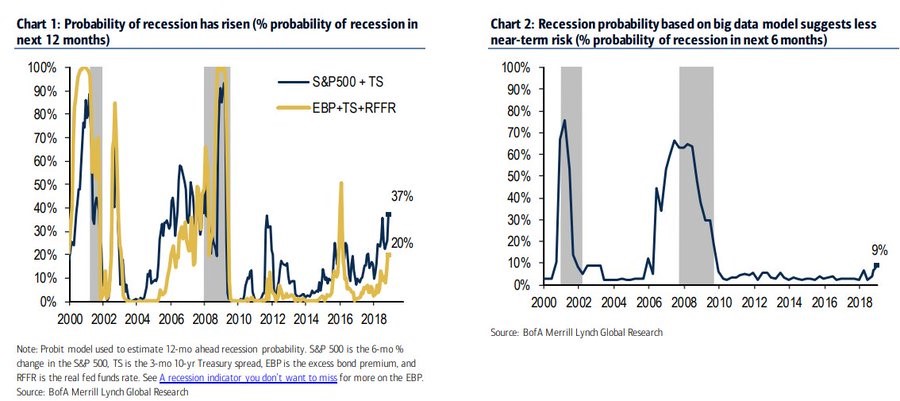
The chart on the left shows when the S&P 500 and treasury curve are combined, there is a 37% chance of a recession in the next 12 months.
A problem with this model is stocks have been falling because the treasury curve has been flattening. That double counts the variable. This chart also shows the percentage chance of a recession when including the treasury curve, and the real Fed funds rate. Also the excess bond premium is 20%.
The chart on the right is what Merrill Lynch calls big data.
However, it’s just data such as building permits, consumption, and C&I loans. That’s not big data. Either way, it shows there is a 9% chance of a recession in 6 months.
The elephant in the room comparing these two charts is that one looks at the next 12 months and one looks at the next 6 months. I’m extremely confident there won’t be a recession in the first half of 2019. My confidence falls afterwards as I think there will be a recession in 2020.