Retail Craters - Stocks Crash Further On Tuesday
Bearish outlook despite the low CNN fear and greed index was correct again on Tuesday. S&P 500 fell 1.82% even as the CNN index entered the day at 8. That signals extreme fear.
Losses on Tuesday pushed it to 6. 14 day relative strength index is actually 41.33. It indicates the market isn’t oversold yet. This market is tricky to understand this week due to the Thanksgiving holiday.
It’s very unpredictable how the market will do in the 2nd half of the 4 day week. Many traders won’t be at their desks. Technically, the market is at a critical level. It closed right where it bottomed on October 29th.
If it closes below that level, it could fall to the lows made in February.
Retail Craters - Crashes On Tuesday
Usual suspects of this correction outperformed on Tuesday. Facebook stock was up 0.67% and the ITB homebuilder ETF was down 0.03%. Nasdaq fell 1.75% and the Russell 2000 fell 1.84%. Every sector was down.
Best performers were healthcare and utilities which fell 0.97% and 0.51%. Worst sectors were energy and consumer discretionary which fell 3.29% and 2.18%.
Energy fell because of the weakness in oil.
Retail Craters - Target Leads
Retail fell because of earnings reports from a few key names such as TGT - Target.
Target stock fell 11.28%. Remarkably, the stock is down 21.2% since Thursday November 8th. That’s only 8 trading days.
Personally, I purposely avoided saying retail stocks like Target fell on weak earnings. Actually, this report by Target wasn’t bad.
In this negative environment, retailers that report good results fall 10%. Ones that report bad results fall 20%. I think investors know that this will be the last strong holiday season in this expansion.
It’s interesting to see oil cratering along with retail. You’d think lower gas prices would help most of retail.
However, the cycle turning is much more important than a few dimes per gallon saved at the pump.
The CEO of Target stated there is absolutely “no sign” the consumer is cooling off headed into holiday season. Stock market weakness usually affects consumer spending among upper income Americans. That’s not the target demographic for Target. Perhaps Target CEO’s statement where he said it was one of the best economies he had ever seen in his career in August was a sign of a top. But the weakness isn’t here yet.
Target’s results were solid. But the estimates expected perfection. Guidance last quarter was extremely strong.
Retail Craters - Target may Have Over-promised and Under-delivered.
Q3 EPS was $1.09 which missed estimates for $1.12. Revenue was $17.82 billion which beat estimates for $17.8 billion. Same store sales growth was 5.1% which missed estimates for 5.2%.
Investors are worried Target has taken in too much inventory. It will need to be marked down if it doesn’t sell through. Retail sales growth was solid in October. Oil prices have been falling which should increase disposable income.
Despite the volatility in stocks, consumer confidence is high. I think investors know that even if the inventory sells through, the economy will weaken in 2019 anyway. There are 2 ways to win by being short this stock.
Retail Craters - Oil Crashes Further
After stabilizing for a couple days after going on a record long losing streak, oil cratered further on Tuesday. It continued its high correlation with the stock market.
WTI oil fell 6.6% to $53.43. This is a strong signal traders are worried about demand because of the weak economy. Oil is at the lowest point since October 2017. That signals it may have a negative effect on year over year inflation. WTI is down 31% from its 4 year high in October. Brent is down 29% from its recent high.
One other negative news event for oil was that President Trump supported America’s ally Saudi Arabia. Even after the CIA reported Saudi’s crown prince ordered the killing of a journalist.
President Trump wants to keep peace with Saudi Arabia, so it doesn’t cut supply. Regardless of this relationship, eventually there will be OPEC cuts in reaction to this decline in prices.
This decline is mainly a demand issue, not a supply issue. There was also a huge sentiment reversal as traders had a record long position in oil futures earlier this year.
Retail Craters - Goldman Manages Expectations
Some firms such as ECRI have been predicting an economic slowdown for over one year. Yet firms like Goldman Sachs and JP Morgan are reacting to the decline in stocks by changing their forecasts.
These aren’t reliable predictions. But they do show us where the consensus is headed. Goldman Sachs expects only 1.75% GDP growth by the end of 2019. JP Morgan expects the economy to grow 1.9% in 2019.
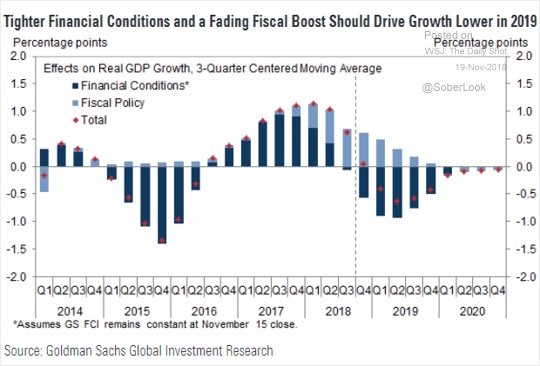
The chart below shows what I have been writing about for a few weeks. Fiscal stimulus will lose its effect in 2019. This chart shows the combined effect of fiscal policy and financial conditions.
Tightening financial conditions combined with the shrinking effect of the fiscal stimulus will hurt growth starting in Q1. They will last all year. Rising rates on investment grade and junk bonds are a big part of the tightness in financial conditions.
The chart on the left shows Goldman Sachs’ predictions for the S&P 500 and S&P 500 earnings.
This needs to be taken with a grain of salt. Estimates were higher before this correction. Estimates are cut when stocks fall, and estimates are raised when stocks increase.
Retail Craters - There are many negative catalysts for stocks - Goldman Predictions.
Somehow Goldman doesn’t see stocks falling in 2018, 2019, and 2020. They see earnings increasing every year as well. Alpha generation comes from sticking your neck out and betting performance will be worse or better than these estimates. I think it will be much worse.
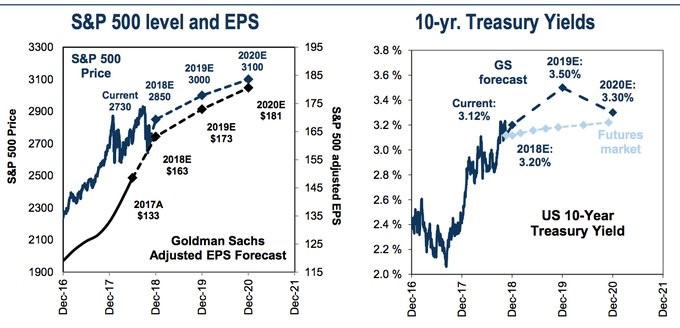
The chart on the right shows Goldman’s forecast for the 10 year bond yield. Since the 10 year is at 3.07%, Goldman sees a sharp 13 basis point increase in the next 5 weeks. Personally, I am very far away from Goldman’s estimate for the 10 year to yield 3.5% in 2019. I think it will be below 3% given the slowdown in growth and inflation.