Mid-Term Elections - Consumer Confidence In The Government
Election Day is November 6th in America. The entire House of Representatives and 1/3rd of the Senate are up for election. This article will analyze what that means for the stock market.
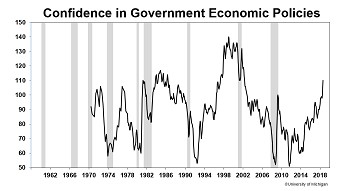
First, below is the University of Michigan chart. It shows consumer confidence in government economic policies.
This index is mostly a combination of which party consumers support. And also how good their individual personal financial situation is. However, there is a small group who look at individual policies objectively. Confidence varies based on the policy.
As you can see, economic policy confidence is currently very strong. That’s good news for the GOP in the mid-terms because it is the incumbent party.
However, the Democrats lost the 2000 presidential election even though economic confidence was high. This means economic policy confidence isn’t the only factor that affects the vote.
Mid-Term Elections - Polls Project Dems Could Win the House, But Lose Senate Seats
The Democrats are planning to reverse the Trump tax plan and raise corporate tax rates which would hurt corporate earnings. That would be bad for stocks.
However, if the Democrats don’t control both branches of Congress, that will be almost impossible. The Dems should pick up seats in the House of Representatives. They have a 7.7% lead in the generic congressional polls according to Real Clear Politics. Currently, the Dems are favored to win 205 seats and the GOP is favored in 199.
President Trump’s approval rating has increased, but his unfavorability is still 10.8 points above his favorability.
The problem for the Democrats is the GOP is expected to pick up 2 Senate seats, giving it a 53 to 47 lead. Even if the Dems win the Senate, President Trump can still veto a repeal of his tax cut. Exactly like how President Obama vetoed the Obamacare repeal bills.
This means stocks shouldn’t have a big reaction to this election in the intermediate term.
Mid-Term Elections - Consumers Aren’t Concerned About The Economy
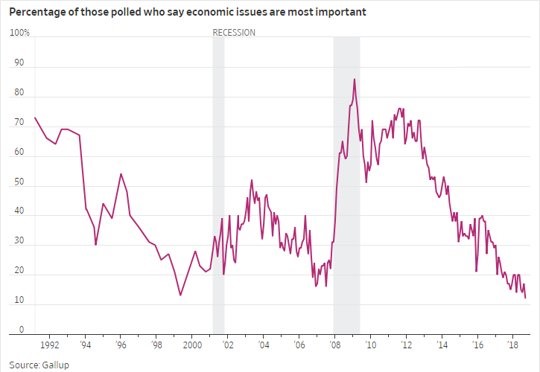
The chart below has two important takeaways. When the consumer has stated economic issues aren’t important, it has meant the cycle is near its end.
The consumer has near record confidence. That explains why since 1991 this is the lowest percentage of consumers that named economic issues as the more important.
This cycle could be different because inflation hasn’t spiked. However, the Fed is still hiking rates. That could be enough to slow the economy once rates get above the neutral rate.
The second takeaway is political. If the economy is so strong that it isn’t an issue, people may not vote based on it.
The theory is the economy is so good voters don’t care about their personal finances when voting. This theory is supported by this chart and takes away the advantage the GOP thought it had.
If this theory is true, the economy can hurt incumbents. But it can’t help them because voters begin to look at other issues at the end of expansions.
Mid-Term Elections - Buy Stocks After The Election?
I think investors should ignore the election when deciding whether to buy stocks they will hold for the next 12 months. Current economic policies should remain the same until 2020.
I analyzed the potential results because it’s wrong to assume the election won’t matter in the intermediate term. In the short term, if the Dems win the Senate, there could be a small sell off. The chance of a corporate tax increase goes up.
If the GOP wins the House, stocks could rally. Tax rates will be more secure and the personal tax cuts could be made permanent. Meaning they won’t expire, not that they can’t be overturned. The market won’t come close to fully pricing in changes to the law until serious polls come out a few months before the 2020 election.
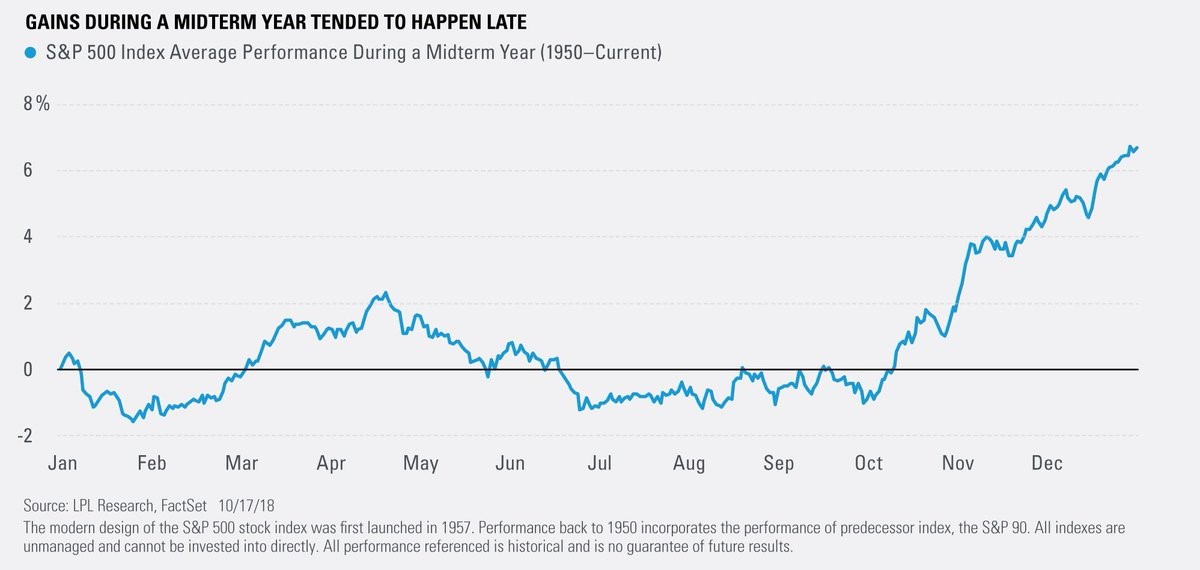
The chart below shows the average S&P 500 performance in mid-term election years since 1950.
As you can see, stocks fall until October. Then their yearly gains accumulate from late-October until the end of the year. My theory is investors worry about the election and then become certain after the results come out.
Certainty is great for stocks. It’s important to avoid thinking stocks will follow this average precisely because they already haven’t.
Stocks are now positive for the year and there was a sharp correction in the winter. You can’t assume the average effect from the election will always occur. This is why I reviewed the polls.
My opinion on stocks for the rest of the year depends on where they are at the moment, on economic reports, and on earnings reports. It’s obviously not just about the election.
Mid-Term Elections - Chinese Tax Cut
America isn’t the only major economy with a tax cut.
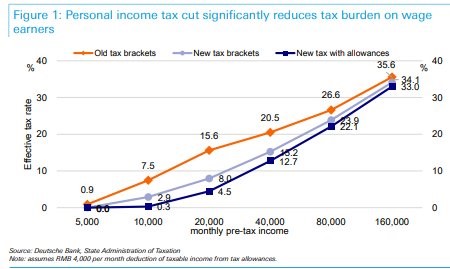
As you can see from the chart below, the tax brackets that will start in 2019 lower tax rates the most for those making between 10,000 and 40,000 yuan per month. 10,000 yuan per month is $17,272.68 per year and 40,000 yuan per month is $69,090.72 per year.
187 million Chinese people paid income taxes in 2017. That will likely fall to 40 million with the new brackets and allowances.
Most of those people don’t earn much money. But the income groups I just highlighted, who have earnings between 10,000 and 40,000 yuan per month, can boost economic growth with their increased cash.
It will be interesting to see how this policy change impacts 2019 growth considering the current slowdown and trade war. I could see Chinese growth surprising to the upside if the trade war ends before the end of this year.
Mid-Term Elections - Conclusion
I don’t have an election forecast because I only review stocks and the economy. Consumers don’t feel the economy is a top issue.
There could be a short term boost if the GOP wins the House and a short term decline if the Dems win the Senate. If the Dems win the House and the GOP holds the Senate, I don’t expect any reaction.
Stocks usually do well at the end of the year after mid-term elections. However, that performance will probably depend more on economic and earnings reports than the election.
I’m skeptical of 2019 returns because the Fed should become hawkish and the stimulus will lose steam. I don’t factor in fiscal policy because it shouldn’t change.
Based on the polls, neither party will be in control of both the executive and legislative branches.