Stocks Decline - Fall Slightly
Stocks decline - The S&P 500 is still in that awkward phase where it hit a record high on Tuesday, but hasn’t closed above its record high in January. I may be making too big of a deal of this because it could be purely fundamentals driving the market.
However, I know many short term technical traders have the 2,872 close in mind when they see the market at this level. The fears of trade wars and the slowing economy are enough to make me neutral on stocks.
The CNN Fear and Greed index is still at 59 even though the market has been down two days in a row. The S&P 500 was down 0.17% and the Russell 2000 was down 0.32%. The material and energy sectors were down the worst as they fell 0.7% and 0.52% respectively.
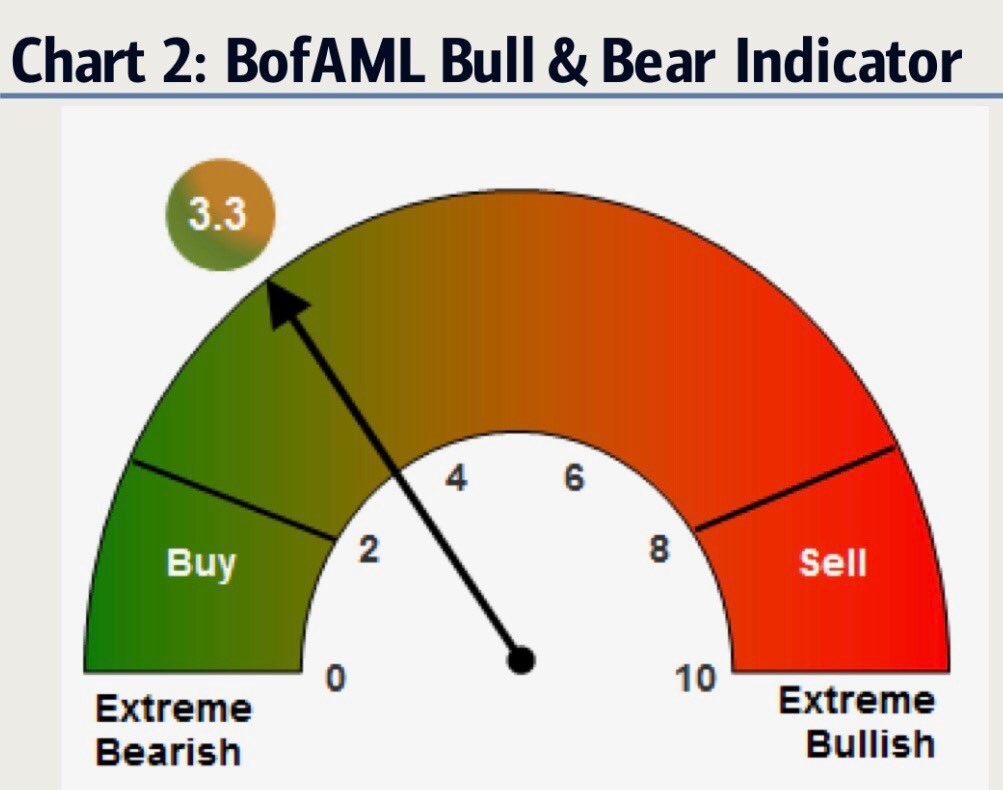
Technology was the only one in the green as it was up 0.18%. The Bank of America bull & bear indicator, shown in the chart below, shows a bearish reading which means now is a decent time to buy the S&P 500.
Stocks Decline - Tariffs Hurt Stocks
The Dow was pulled down by Caterpillar which was down 2% on trade war fears. The August 23rd tariffs were implemented on China as expected. A 25% tariff on $16 billion worth of goods was enacted, and China responded in kind.
Once I heard about the discussions between mid-level ambassadors, I knew that the market would negatively react to these new tariffs going into place because you don’t tax a country you are having serious positive negotiations with.
This tariff proves President Trump’s statement that there wasn’t much chance of a deal occurring was correct.
Stocks Decline - Dollar, Oil, & Treasuries
You may be wondering how stocks are rallying if there have been a few bad economic reports, earnings season is over, which means fewer positive catalysts for individual names, and the tariffs are providing negative headlines.
The reason international names have done well is the dollar has been falling. After peaking at $96.73, it is down to $95.44. You can say, the dollar isn’t helping stocks. It’s just not hurting them anymore as it had been a thorn in their side for the past few months.
It’s interesting that energy was one of the worst sectors because oil was only down 3 cents to $67.83. Oil was up over more than $2 per barrel on Wednesday because the government reported a bigger than expected decline in stockpiles.
The shine of that report has gone dull.
The 10 year treasury was flat at 2.83% and the 2 year treasury yield was up 3 basis points to 2.62% which means the difference between the two yields is only 21 basis points.
The 10 year yield is screaming that growth and inflation are slowing. The increase in the 2 year yield tells us that the odds of a December rate hike have increased.
There is now a 67.8% chance of a rate hike in December as it is very close to the 70% threshold which tells us if the Fed is raising rates. I think there will be a rate hike which will push the 2 year yield close to 2.7%.
Stocks Decline - Yet Longest Bull Market Ever
This is now the longest bull market ever. That doesn’t matter much because the only thing you should be focused on are future returns; this fact gives no help in forecasting them.
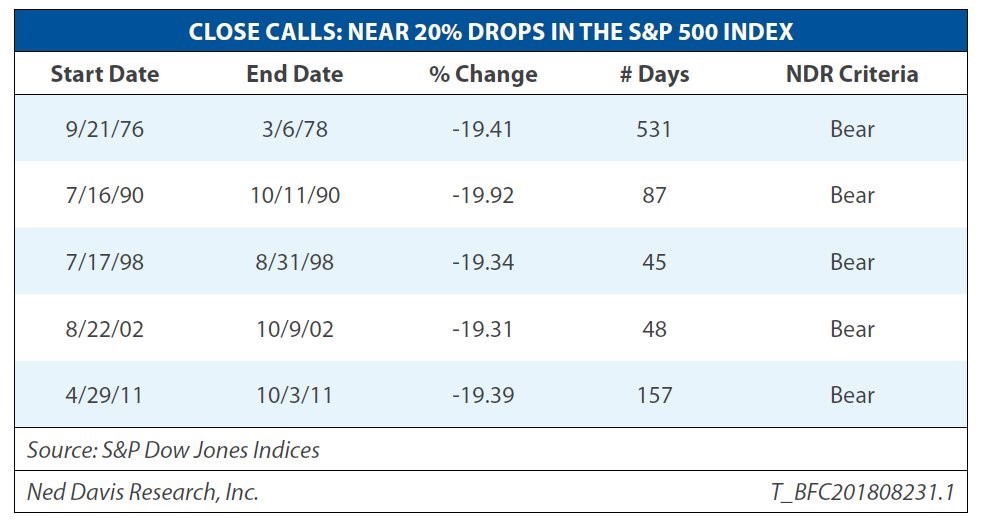
It’s interesting to look at the times when the market almost fell 20% because that number is arbitrary. There’s nothing that happens when stocks fall 20% instead of 19% other than the media clamoring about a bear market.
As you can see from the table below, there were a few instances where the market fell slightly less than 20% which means there wasn’t a technical bear market.
The one which is most important is the 19.39% decline in 2011. The bull market would be 2 years shorter if the market would have fallen 11 basis points more and you round up. The point in showing this is that it’s meaningless whether there has been a bear market recently or not.
Some people like to say the start of the bull market is when the market hits a new record. Using that definition, there barely was a bull market at all in the last cycle.
This bull market would have started in 2013, making it only 5 years old. Finally, you can change the definition of a bear market by taking into account time and price declines. This makes sense of the term ‘horizontal correction.’
Since stocks are usually rising, a 2 year gap where stocks don’t go up or down should be considered a bear market. Many investors would rather a quick 20% decline in which the losses are recovered in a few months than a long drawn out period where stocks don’t move much.
Stocks Decline - Target Beats Earnings & Climbs To A Record High
TJX, Target, Nordstrom, and Wal-Mart have all reported great results. This counters the idea that the consumer is weakening put forth by the August consumer sentiment reading. Target’s same store sales growth was the highest in 13 years as it was 6.5% which beat estimates for 4% growth.
The CEO of Target said this is the healthiest environment he’s ever seen. Online sales were up 41% after growing 32% last year. EPS was $1.47 per share which beat estimates by 7 cents. Revenues were $17.78 billion which beat estimates for $17.28 billion and were up 7%. 2018 guidance was raised from $5.15 to $5.45 to $5.30 to $5.50.
The stock hit an all-time high on Thursday and is up over 10% since the start of the month. These reports are giving us information on the last 3 months of sales, but these firms wouldn’t all be raising estimates if the start of the quarter was bad.
These guidance increases defeat the weakness in consumer sentiment until we have further support for the thesis that the consumer is pulling back.