Stocks Fall On Friday Led By The Financials
It's worth a mention that the Syrian air strikes that were feared by the stock market earlier this week were announced by President Trump on Friday afternoon. This could send stocks down on Monday. Geopolitical events are always difficult to determine as speculation swirls. I think the best approach is to be cautious rather than sell as a knee jerk reaction.
Stocks declined modestly on Friday as the S&P 500 was down 0.29%. The bad news was that the financials were down 1.55% after the earnings reports of Citigroup, JP Morgan, and Wells Fargo came out. I will review all three of these reports as they are our first taste of what Q1 earnings will look like.
Citigroup Beats Estimates But Its Stock Falls
Citigroup reported earnings per share of $1.68 which beat estimates for $1.61. Equity trading revenue was up 38%. This makes sense because of the volatility in Q1. There was a 7% decline in fixed income trading. The effective tax rate fell from 31% in Q1 2017 to 24% Q1 2018. Revenues beat estimates slightly as they came in at $18.872 billion which beat the $18.865 billion consensus. Net interest income missed estimates as it was $11.17 billion which was below the consensus for $11.26 billion. Fixed income, currencies, and commodities trading revenue was $3.4 billion which missed the estimates for $3.68 billion.
Citigroup stock was down 1.55% on Friday; it’s up about 20% in the past year which shows these great results may have been already priced in. Because the fixed income trading is a larger business than equities, overall trading revenue was only up 3% to $5 billion. The goods news for Citigroup is the volatility in equities has continued in April so far. The global consumer banking business revenue increase 7% to $8.4 billion with the Latin American division growing 15% to $1.3 billion. When you buy Citigroup, you are doing so because you think the economy will improve, interest rates will go up, and volatility will continue. The forward PE for Citigroup is below the market’s average as it is only at 11. This cheap valuations in the sector could be why some investors are looking to the financials to lead the market higher.
JP Morgan Earnings Beat & Stock Falls
You should be noticing a pattern as the top banks beat estimates, but their stocks fell. JP Morgan reported $2.37 in EPS which beat estimates for $2.28 per share. Revenues were $28.52 billion which missed the estimates for $27.68 billion. There was a 7% decline in investment banking revenues; adjusted fixed income trading revenues were unchanged which missed estimates for a 3% increase. There was a 25% increase in equity trading because of the volatility in Q1 which led to a 7% increase in markets revenue.
JP Morgan reported great results as the firm saw a 13% increase in client investment assets. There was a 15% return on equity. Even with these great results, the stock fell 2.7% on Friday. You can’t blame the market for the weakness because the financials are what caused the decline. This stock is best of breed, yet it only has a forward PE of 12.4. I think this is the stock to buy if you are bullish on financials because of rising interest rates and strong economic growth. Asset and wealth client assets increased 9% to $2.8 trillion as it stole market share from Wells Fargo. The bank plans to open 400 new locations in the U.S. in the next 5 years.
Wells Fargo Beats Estimates & Its Stock Falls Sharply
Technically, Wells Fargo beat estimates, but it wasn’t a great quarter as I’ll get into. The firm beat EPS estimates for $1.06 as results were $1.12. There was a 5.5% increase in net income. Even the weak players grow in a good environment. Revenues beat expectations for $21.73 billion as they came in at $21.93 billion. The company is facing regulatory scrutiny for its sales practices specifically in auto insurance and mortgage rate lock sales.
Net interest income was $12.2 billion which was down $86 million. Non interest income was $9.7 billion which was down $235 million. Average deposits were $1.3 trillion which was down $2 billion. The regulatory story could be hurting the bank’s image with customers. It seems rational to take your business to another bank such as JP Morgan or even a local bank instead of dealing with the risk that Wells Fargo will open up phony accounts.
When this entire process is over, Wells Fargo will be a better bank with more stringent controls, but there’s no reason to choose them over another bank now. The stock was down 3.43% on the day. Even though the firm reported bad numbers it’s far from being worthy of a short as the forward PE is only 10.8. It simply doesn’t seem likely that the stock will outperform the sector. At some point, when the regulatory issues are gone and clients forget about the issues, the multiple will improve, but I don’t expect that to happen soon.
2nd Half Of 2018 Economy Looking Weaker
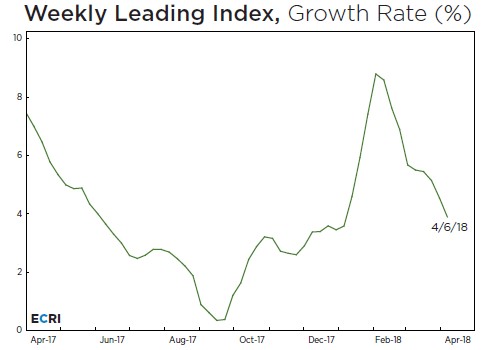
One of the reasons why I am moderately bullish on stocks is because I think the economy will improve in the middle of the year after a weak first quarter. The ECRI report supports the notion that there will be a bounce in growth. However, the index has had a sharp reversal in the past couple months which continued in the latest release. As you can see from the chart below, the growth rate fell from 4.5% to 3.9%. With the difference between the 10 year bond yield and the 2 year yield only at 47 basis points, the chance of a 2019 recession isn’t far out. Therefore, I’m worried that the decline in this leading index continues into the negatives. That would be unlike the previous drop in the summer of last year which stopped just above zero.