Record Low VIX Close
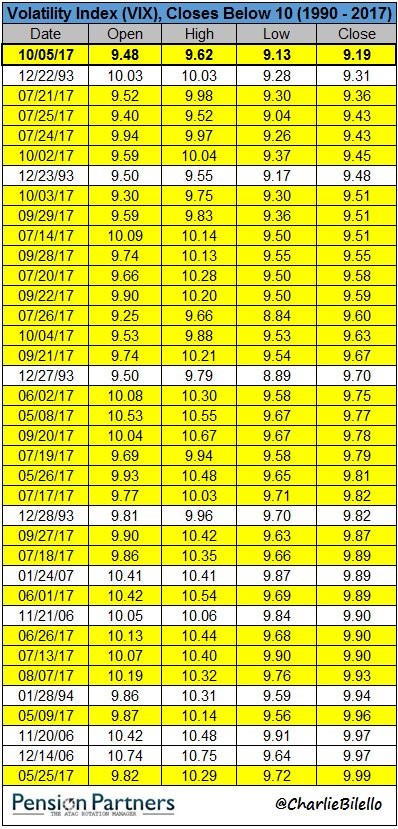
Thursday was another fantastic day in the stock market as all major indexes were up and hit record highs. The VIX was down 4.57% to 9.19. As you can see from the chart below, that’s the lowest close since 1990. Not only have we had the lowest close ever this year, but also 28 of 37 lowest closes have happened this year. The S&P 500 is up 8 days in a row which is the longest winning streak in 4 years. The 6 day streak of record highs is the longest streak since 1997. Since Janet Yellen said valuations were stretched, the S&P 500 is up 29.5% even though earnings have just recovered to the Q3 2014 trailing twelve month high.
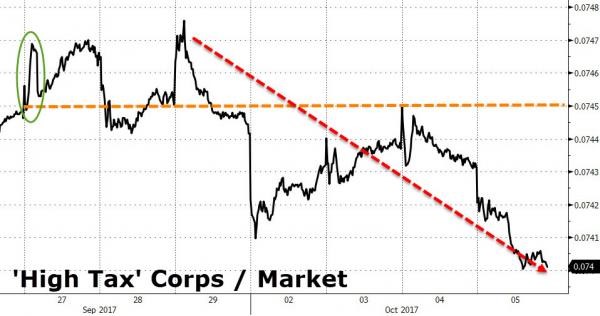
The chart below shows that the high corporate tax rate companies have been falling. It’s in stark contrast to the overall market which has been increasing in the hopes that the tax plan would pass. There was news on the tax cut front as the House passed a budget on Thursday which is supposed to be the first step toward passing the tax cut. Usually the budget is passed in the spring. This shows that the GOP is behind schedule along with being unable to get a big win with healthcare reform. The 2018 budget resolution passed 219-206 with 18 Republicans voting against it. This shows that even a bill which isn’t too controversial got disapproval by some party members. The party is splintered. The tax cut is expected to add $1.5 trillion to the deficit. The plan remains to get something done by the end of the year, but the window is closing. There is also the impending debt ceiling showdown which has a deadline of December 8th. That will take center stage in November, so the GOP is hoping to make progress on the tax plan before then. This House budget that passed increases defense spending by $72 billion and cuts nondefense spending by $5 billion, while the Senate keeps spending steady. The Senate and the House will need to convene to get the tax plan done because that unlocks the reconciliation rules which lets the Senate pass a plan with a majority.
The problematic part of the budget is that it cuts trillions of dollars in funding to Medicaid and Medicare. It cuts $203 billion in spending for welfare programs specializing in nutrition and education. This plan is more of a conservative dream than something that can pass the Senate. The plan doesn’t add anything to the deficit. I think the final plan that’s voted on in the Senate will add to the deficit because some moderates won’t like these cuts. The Republicans will bank on dynamic scoring to sell their plan to the voters. The Senate plan cuts $1.5 trillion in taxes, but doesn’t keep the $203 billion in welfare spending cuts. In a surprise to no one, the chances of any of these plans passing are low because there’s not enough money to go around. Either large cuts need to be made or the deficit will need to explode. Neither of those options appeal to moderates and conservatives. It’s weird to see stocks rallying so much on the back of such a low likelihood event.
Car Sales Boost GDP
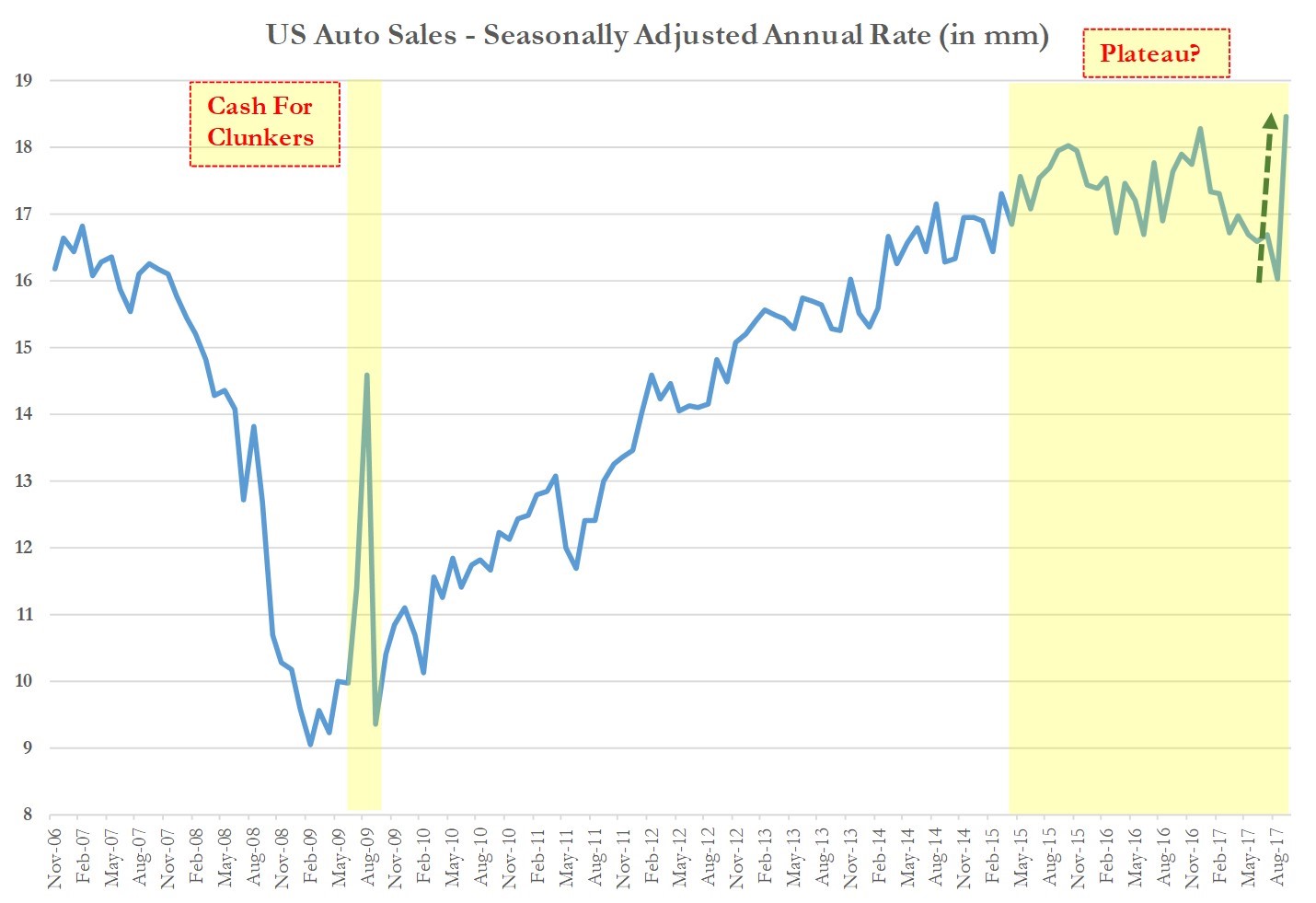
One of the parts of the economy that we’ve discussed being positively impacted by the hurricanes was autos. If your car is destroyed, you have no choice but to buy a new one. The chart below shows that narrative playing out as auto sales increased 15.2% sequentially to 18.5 million units from 16 million units. All of the major auto companies beat estimates. GM’s sales were up 11.9% year over year. Ford was up 8.9% and Fiat Chrysler was down 9.7%. Toyota was up 14.9%, Honda was up 6.8%, and Nissan was up 9.5%. According to Stone McCarthy, car sales were down 2.8% and truck sales were up 8.1% year over year. These great auto sales results aren’t sustainable, but they will have a big impact on Q3 GDP. The GDP Now estimate rose from 2.7% to 2.8%. This improvement was because the real consumer spending forecast increased because of this great auto sales report. The negative affect on the forecast was from the manufacturing report and the international trade report. They caused the real equipment spending forecast to fall.
Quarles First Fed Pick For President Trump
Quarles was nominated by President Trump in July to fill Daniel Tarullo’s role as top bank regulator. He is going to be the vice chairman in charge of bank oversight. Quarles was confirmed by the Senate on Thursday as a member of the Federal Reserve’s Board of Governors. Interestingly, Quarles has had a similar career path to Powell as both worked at the private equity firm The Carlyle Group. Both were undersecretary to the Treasury. Powell was under Bush the elder and Quarles was under Bush the younger. Quarles is expected to be softer on regulations. It’s ironic that this position was created as a result of Dodd Frank since President Trump seemingly wants to roll that regulation back. With Quarles in place, the Fed still has 3 more Governor positions open which need to be filled. With Quarles leading the charges as a deregulator, I think this opens the door for Powell to be picked as chair. Powell is now at 31% in the betting market as the President will likely select the chair soon. It’s a good sign that Quarles was confirmed easily. Hopefully, whoever President Trump picks gets confirmed easily as well because uncertainty would be terrible for the markets.
Conclusion
Stocks continued their upward trajectory as the large caps have tagged along with the small caps to reach record breaking results day after day. On the economic front, the auto sales data helped boost GDP forecasts which are now starting to look good again as the rebuilding in September after the hurricanes takes hold. On the Fed front, President Trump’s selection of Quarles was approved easily. That’s a good sign for his Fed chair pick which will be either Powell or Warsh.