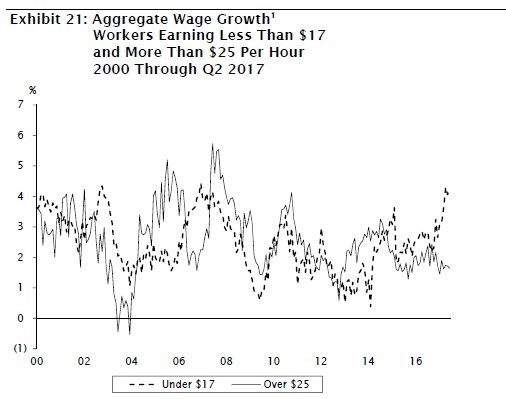
A previous article mentioned how low skilled workers are seeing more income growth than middle skilled and highly skilled workers. The chart below shows this trend in a different light. As you can see, those making less than $17 an hour are seeing more income growth than those making over $25 an hour. Part of this increase may be from the minimum wage increases in cities like Seattle. Raising the minimum wage doesn’t help the low-income people on aggregate, but does raise wages. The problem is less jobs are available. This aspect is why governments raise the minimum wage when the labor market is strong. The negative effect on the number of low wage jobs available isn’t noticeable because there are already too many jobs. Essentially, this wage increase is following what the market would give anyway. It’s made out to be a big political movement, but the reality is the government operates at the whim of the market. There’s no way any city would try to raise the minimum wage during the 2008 crisis when the economy was crashing and jobs were scarce. During the next recession, these minimum wage hikes will stop. That’s when the rhetoric shifts to increasing regulations to prevent the next crisis. Politics is cyclical. Acknowledging this makes predicting the changes easier.
Another aspect of this shift in wage growth which started in the past 12 months is the shift in the labor force. Many manufacturing firms are saying they can’t find workers to employ in entry level positions. After years of hearing that manufacturing is dead in America, the pendulum has switched too far. Many more people are getting college degrees because they thought there was no chance in manufacturing. I’m not claiming that the economy will switch from a service oriented one back to construction and manufacturing, but some more people switching industries would help solve the tight slack in that labor market. There’s only a certain amount manufacturing firms can raise wages. Eventually this tight slack catalyzes robot technology advancement which takes humans’ jobs. This is the same trend that’s occurring in fast food restaurants as firms are replacing cashiers with touch screen devices to avoid paying many workers the new more expensive minimum wage.
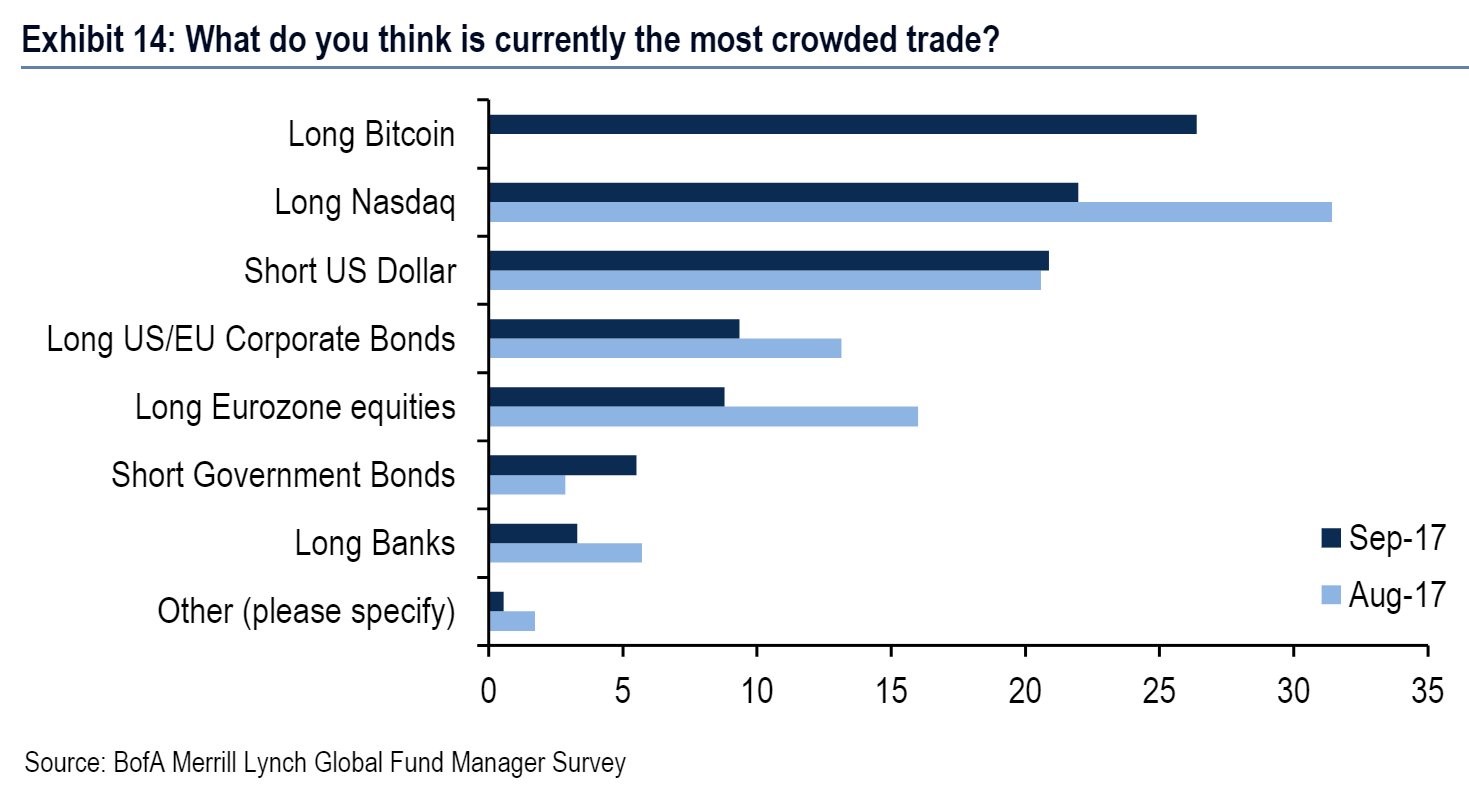
As I have discussed many times, I like to look at the Bank of America Merrill Lynch Survey to get a pulse of the market. It has a decent track record of protecting trend changes. As you can see from the chart below, fund managers are less bearish on the long Nasdaq trade than they were in August. The short dollar trade remains considered overcrowded. That trade has been steadily working although I’ve discussed how it could reverse. I would take a bearish stance on U.S. stocks if the dollar started to rally. The strong dollar recently was in concert with the earnings recession and volatility seen in 2015-2016. The strong dollar trade would switch the performance of the S&P 500 with the Russell 2000 as small caps would get more attention. The long banks trade has fallen out of favor in being considered overcrowded because the lack of regulation cuts and the flattening yield curve have put a damper on the performance of the financials. I find it weird that U.S. and corporate bonds were mentioned together because of the bifurcation in the action. I find European junk bonds to be in the biggest bubble. If European junk debt was separated, I’d expect it to garner more votes.
As you can see, the answer that got the highest vote percentage was long Bitcoin which is a new addition to this poll. Bitcoin is already down about $800 since the peak, showing how volatile it is. By the time the poll was released, there was already a change in the price which probably would have changed people’s vote. Bitcoin is an overcrowded trade at $5,000. It’s less crowded at $4,200.
This poll comes on the heels of CEO of JP Morgan- Jamie Dimon’s comments on the cryptocurrency today. He called it a fraud. The price of Bitcoin is up over 1,000% since Dimon said it was a bubble in 2015. Dimon has been calling Bitcoin a bubble since 2012. His track record is poor to say the least. This time Dimon hedged himself by saying Bitcoin could go to $100,000 before crashing. Personally, I think that’s a bizarre statement because if it could go up over 20-fold, I would want to buy it. He sounds like stock market perma bears. My opinion on Bitcoin is it should be a very small percentage of your net worth. It’s tough to trade in and out because it moves at its own whims, but I’d trim some when it goes up and buy the dips. If you put 1% of your portfolio in Bitcoin and it went up 20-fold, you would have your year made even if you put the rest of the money you had in cash or treasuries. As I said, the price of Bitcoin has fallen by about $800 since the peak which is near when this poll was taken. Therefore, I wouldn’t be bearish based on this poll alone. Bitcoin is also not the best security to be asking investment managers about because they likely don’t know much about it compared to the knowledge they have on corporate debt or stocks.
Conclusion
Jamie Dimon has been wrong about Bitcoin for years. He reminds me of the meme ‘old man yells at cloud.’ He is getting upset about Bitcoin unnecessarily. Just like the angry old man, you should ignore his advice. The problem with perma bears who have been wrong about Bitcoin is they never admit it. If Bitcoin rises to $100,000 over the next 10 years, he will keep harping on the same tune. It’s an extreme position to say that Bitcoin is worthless. This skepticism provides fuel for the rallies. It’s best to be practical and flow with the punches if you want to be a good investor.