On Tuesday, the stock market sold off as it finally followed the recent trend in the 10-year bond and dollar. I have mentioned in a previous article that the 10-year bond yield decline is a sign inflation expectations and GDP growth estimates have diminished. Some may have postulated the 10-year yield falling was a minor correction because it increased too much, too quickly into the Fed’s rate hike. These investors are now questioning their initial analysis and considering if my point about growth has any merit. The 10-year bond yield has fallen about 19 basis points from when it reached above Bill Gross’ 2.60% target last week. That sharp rally in bonds goes against the concept that the Fed is raising rates to prevent inflation from getting too high.
The dollar is singing the same tune as the 10-year bond. After closing at $102.20 early in March, the dollar index has been on a one-way trip lower to below the critical $100 level. The Fed raising rates is supposed to be bullish for the dollar. Instead the dollar sold off just as the chances of a Fed rate hike in March started to increase. This doesn’t confirm the supposed strength the Fed sees in the economy. The dollar index has ignored the Fed and followed GDP expectations lower. Another recent reason for the dollar’s selloff today is the French presidential election. There was presidential debate yesterday where the centrist Macron did well which is bullish for the euro. In a snap poll of who was the most convincing Macron received 29% and the right-wing Le Pen received 19%.
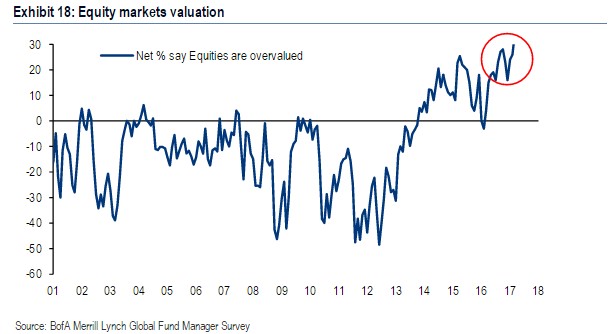
When you look at the stock market from this perspective, it’s amazing the market hasn’t fallen sooner. The Fed is the only one of these four indicators who is bullish on the economy and the Fed raising rates is bearish for stocks. Supporting my point that’s it’s amazing stocks have rallied so much is the latest fund managers survey from Bank of America Merrill Lynch. As you can see in the chart below, there is a record amount of fund managers who say the U.S. stock market is overvalued. 81% of fund managers think the U.S. is the most overvalued region in the world. Usually investor polls match the market’s recent performance because if investors are acting in the same way as they state in the polls, they move the market in that direction, but fund managers polls tend to act as counter indicator since it’s the ‘smart money.’ However, it’s unusual to see such a large difference in market performance and polls for this length of time. For most of the past three years, fund managers have thought stocks are overvalued. As a bear who does objective analysis, I expect to be wrong as the market rallies on irrational hope.
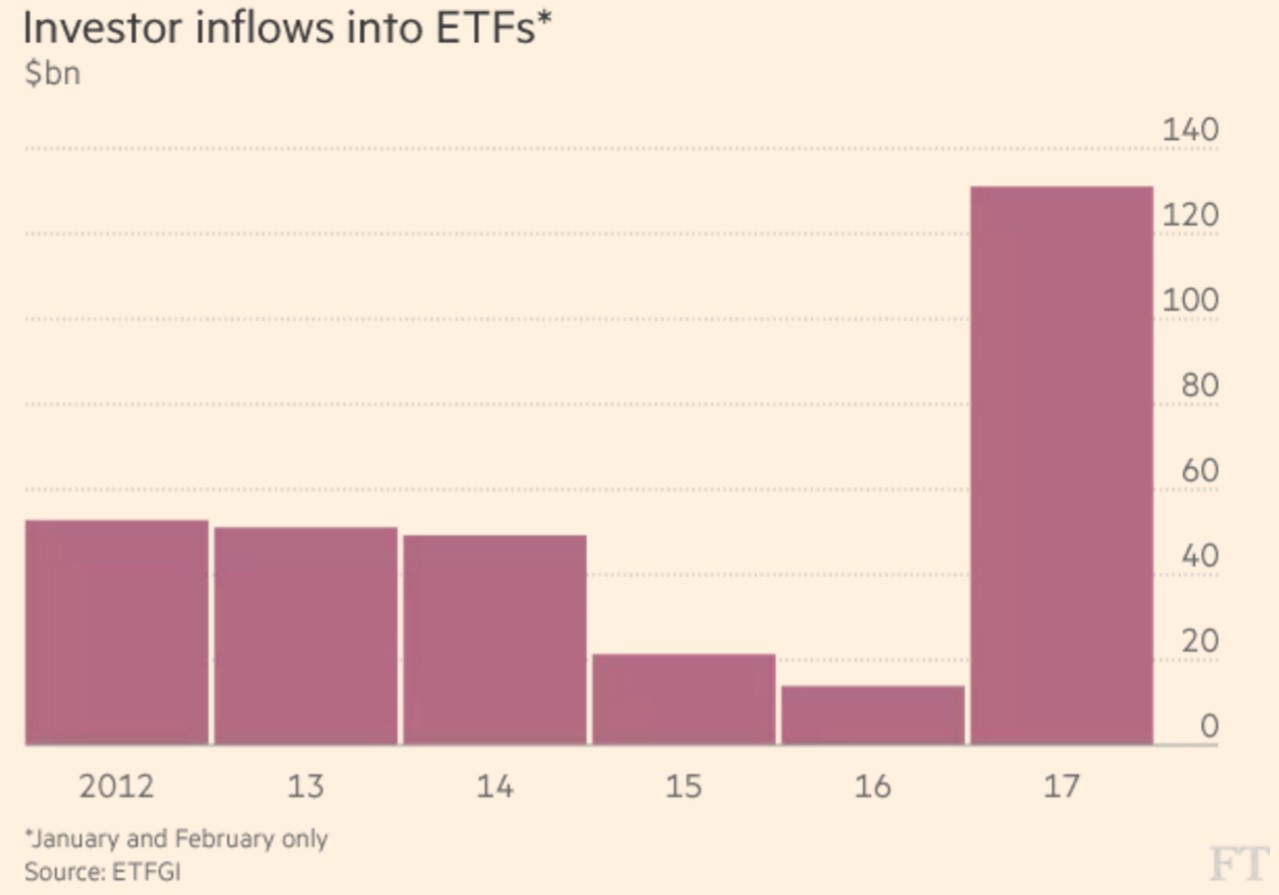
One of the explanations for why stocks have levitated higher even though fund managers are bearish is high ETF inflows. As you can see from the chart below, if you annualize the first two months of inflows, ETFs will have an incredible year in 2017 (the best first 2 months of a year ever). It’s a tough situation for money managers because investors are leaving them for ETFs which is pushing the market higher. If the money managers are cautious based on the objective truth that stocks have high multiples, then they are only accelerating the trend towards investors leaving them for ETFs. You may think that if money managers are going to lose market share to ETFs anyway, why don’t they act cautiously because they’ll at least preserve capital for their investors who stay? The reason this logic doesn’t hold is they still must beat out their competitors. Because the pie is shrinking, the competition is fiercer. The more bullish you are, even if it goes against your analysis, the better your performance is. Money managers acting against the long-term interest of their clients is an agency issue.
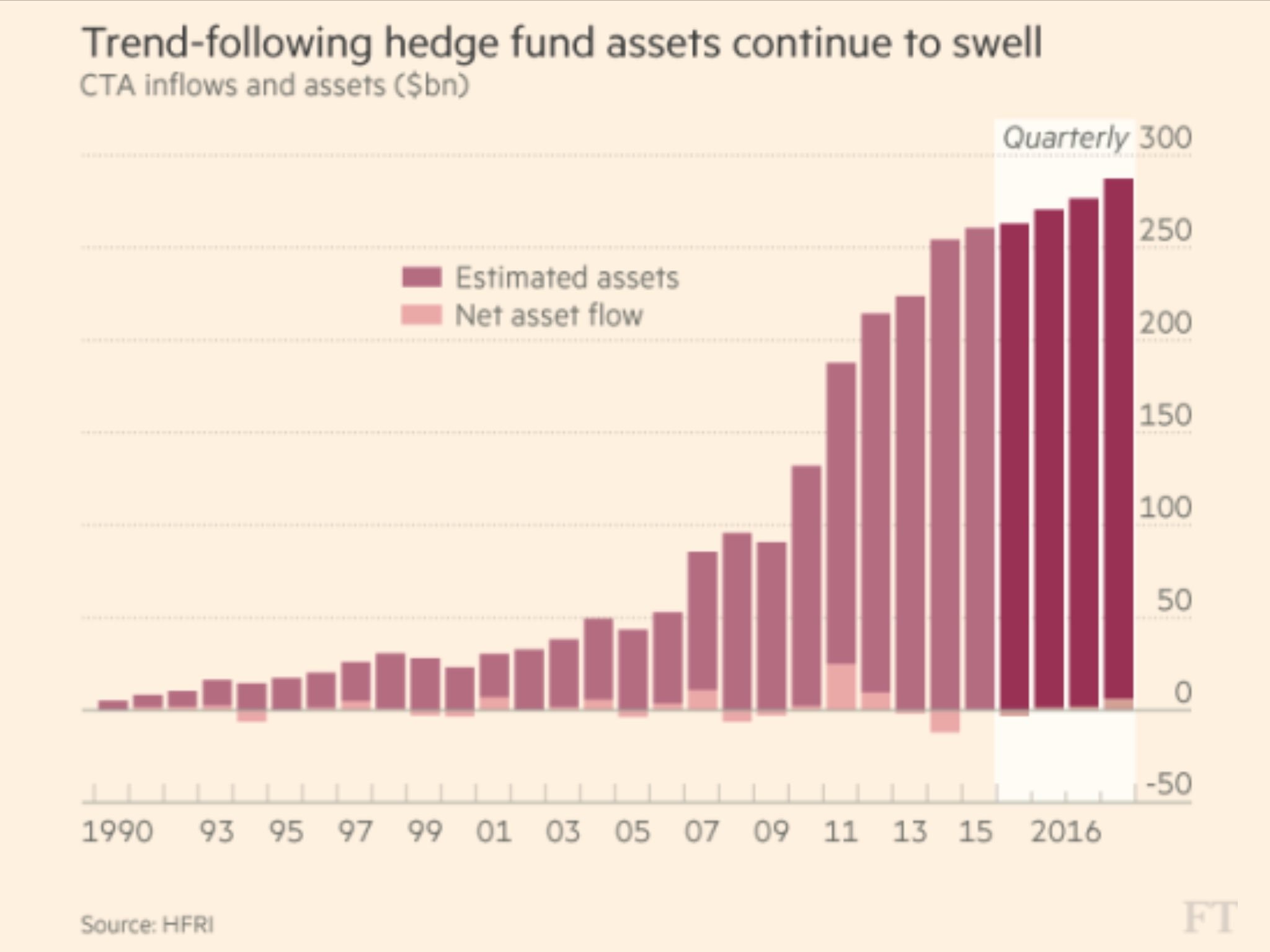
Another area of asset management which has been gaining increased attention from investors is commodity trading advisor funds. These trend-following funds use financial models and algorithms to find trends and ride them. The fact that the amount of assets in these funds is high is a signal that the bull market trend has been strongly in-tact. Because these funds also do well in bear markets, if the trend is clear, these funds can be thought of as ways to protect your portfolio. The rise in these funds can also be thought of a way to measure the fear investors have about the potential for a crash. The question of whether these funds will be able to do well in a declining stock market is another matter entirely. As you can see, they have become much more popular in this past bull cycle. I haven’t reviewed the individual performance of these funds, but it sounds too good to be true that these funds can do well in bull and bear markets.
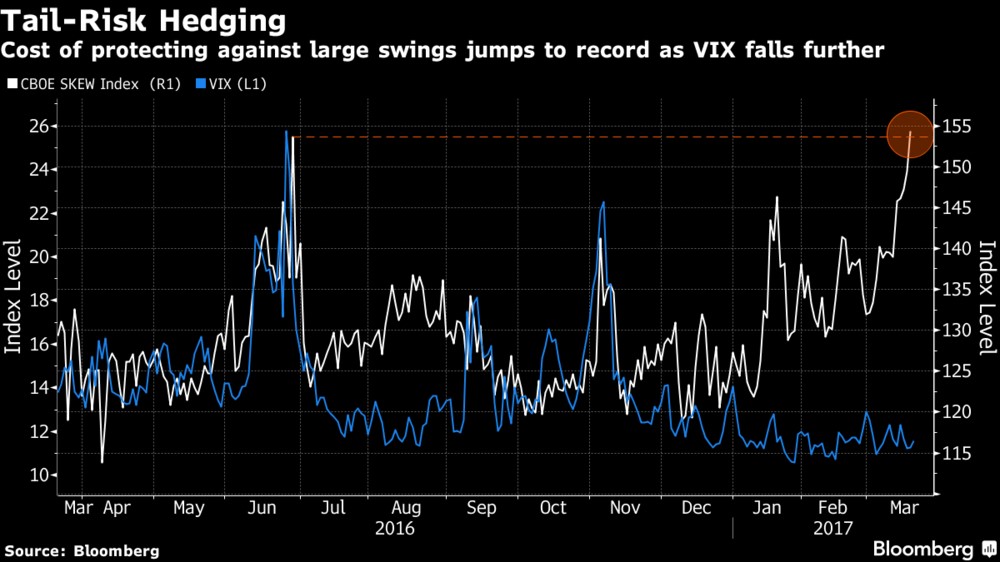
Another way to measure the uncertainty of investors is the CBOE SKEW index. As you can see in the chart below, it has risen sharply lately. The last time it rose this high, the VIX jumped to 24. This may signal volatility is coming soon.
Financials led the charge lower on Tuesday as investors came to the realization that a low Q1 GDP report could stymie the Fed’s ability to raise rates. For the first time this cycle, investors had cheered on rate hikes because it signaled the economy is strong enough to take its medicine. The problem is it isn’t strong enough. That means a selloff is likely as the market mourns the loss of the punch bowl.
Conclusion
The weakness in the dollar and strength in the 10-year signaled a correction was possible. While the market avoided post-Fed hike weakness for a few sessions, it finally caught up to it as the market sold off over 1% Tuesday for its worst day in 6 months. It will be interesting to see how this plays out in the next few days. If the selloff continues, the Fed may signal to the market the hikes will slow down.
1 Comment
Rick
March 22, 2017Great article. Have been trying to figure out why there have been such market contradictions with the fundamentals (haven't we all, even though we have heard the many stated reasons.) I believe you have nailed it with this summary. You clearly answered a couple of my key questions--shocked at the flow into ETFs. (BTW, I approach financial world from fundamental perspective, see my website MarketLionsDigest.com if any interest.) You continue to reinforce my faith in my long-held (and long-suffering I might add) short positions. Cudos. Rick Hornbeck